Showing posts with label russia. Show all posts

Russia: Crowdmapping Corruption With Bribr Mobile App

Global Voices Online
Sunday, October 7, 2012


Bribr [ru; App Store, Facebook] is a newly-launched iPhone/iPad app that allows anonymous users in Russia to submit the locations and the amounts of the bribes they pay. Later, it will be possible to report on the bribes taken as well.

According to the Bribr Manifesto [ru],

[...] Doctors, the army, customs - in some cases bribes compensate for the low official salaries, in other cases the laws are written in ways that make it impossible not to violate them [...]. Sometimes we offer bribes ourselves, sometimes they are being extorted from us - but most often bribes are taken and given because this is how the system works. [...]


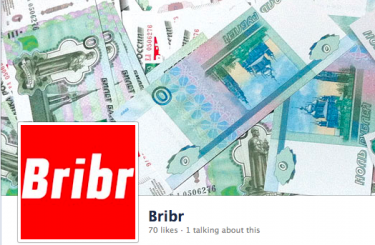
A screenshot of Bribr's Facebook page, featuring the most appropriate Russian currency for bribes: fake 0 ruble bills.

In 2011, Russia ranked 143rd out of 183 countries in the Corruption Perceptions Index, published by Transparency International.

The meter on the Bribr website [ru] currently shows that 1,795,295 rubles ($58,000) have been spent on bribes since Sep. 24. The website also has a map - and statistics on the "Who" and "What For" of the Russian bribing (the former contains 14 entries so far, with courts and traffic police topping the list).

The Bribr Manifesto states that the project is apolitical:

[...] The goal of Bribr is to show the numbers. Conclusions and opinions aren't our job. [...]

Members of the Bribr team, however, believe that knowledge and social responsibility are key to positive change, and in this context the post-election protests in Russia (GV coverage is here and here) are mentioned in the Manifesto:

[...] Everyone knows that bribery is common in Russia. But everyone had also known that falsifications did take place during the elections - and only when the observers showed on Dec. 4 how the votes were being stolen at several polling stations, only then did the people take to the streets. It is one thing to know that everyone is giving bribes and quite another to know just how much the 2nd Special Regiment of [the traffic police] is making [in bribes] on Rublyovskoye Shosse [aka Rublyovka, one of the priciest Moscow suburbs]. [...]

Bribr is not the only crowdsourcing platform tracking bribery and corruption out there.

Its currently dormant predecessor in the post-Soviet space - vzyatka.crowdmap.com [ru] - was launched by NewReporter.org/Internews [ru] in March 2011, but lasted only about two months and contains no more than 20 reports.

In India, there is the I Paid A Bribe crowdsourcing initiative, which was launched in August 2010 to "[encourage] people to not put up with official abuse of power and to report their stories of bribery to 'uncover the market price of corruption'” (GV text is here).

In May 2012, anti-corruption activists in Kenya launched their own I Paid a Bribe project, modeled after and in partnership with the Indian counterpart (GV text is here).

And in July 2012, Monitor de Corrupción [es] (”Corruption Monitor”) was launched in Colombia; according to IJNet, it uses a "two-tiered reporting system that allows both journalists and citizens to submit reports about corruption in their communities, municipalities and on a broader scale, regionally and nationally [...]."

Michael Idov, editor-in-chief of GQ Russia, commented on the Russian Bribr project on his Facebook page:

[...] If this thing works, the world will soon see a truly epic wiki-illustration of the breadth and depth of Russian corruption. [...]

Ukraine: Authorities Shut Down BitTorrent Tracker Demonoid

Global Voices Online
Tuesday, August 14, 2012


On August 6, the Ukrainian authorities shut down Demonoid, one of the world's largest BitTorrent tracker sites, whose servers were hosted by a data center in Kyiv (all Ukrainian IP addresses had been blocked from accessing Demonoid, however, to avoid violating Ukraine’s copyright laws). The shutdown was allegedly connected with first deputy PM Valery Khoroshkovsky's recent visit to the United States: a number of online news outlets and bloggers described it as an attempt to show Ukraine's tough stance on copyright infringements.

Anonymous, a "hacktivist" group, launched DDoS attacks against a number of Ukrainian government agencies in response, targeting the National TV and Radio Broadcasting Council, the Agency for Copyright, and the Anti-Piracy Association (the latter two are still down). AnonPR blog ("Where the Media Can't Twist our Words") and Anonymous World Wide News blog carried the group's video and text [en] statements about the launch of #OpDemonoid.

On Watcher.com.ua blog, reader Myroslav Holyak expressed doubts [uk] about the efficiency of Anonymous' response:

[...] All these government entities that have been attacked couldn't care less that their crappy sites are being DDoS-ed, trust me...

On the Russian collaborative blog Habrahabr.ru, user pazzive shared this insight [ru] about the timing of the shutdown:

Three years ago, I interviewed Demonoid's Ukrainian hosts [the interview with ColoCall data center, ru], and they said on-the-record that the situation would change only when the copyright holders buy themselves an MP [in the Ukrainian Parliament] who would lobby for the needed law. Because at the time no one saw the fight against pirate trackers as worthwhile, and they [ColoCall] were just providing hosting and weren't violating a single Ukrainian law. It was interesting to re-read that old interview in light of the recent events.

My impression is that someone is trying to score some points ahead of the [Oct. 28 parliamentary election in Ukraine].

Earlier this year, in February, when Ukraine's biggest file-sharing site Ex.ua (accessible to Ukrainian users, unlike Demonoid) was temporarily shut down due to repeated copyright violations, netizens protested by launching DDoS attacks on various governmental websites, including those of the Ukrainian President and the Ministry of Internal Affairs (Tetyana Bohdanova's text on it is here). Ex.ua has been back online for months now - and some Habrahabr.ru users mentioned this in their conversation:

smartlight:

again, the idiocy of the situation is that they've shut down Demonoid, but ex.ua continues to work.

esc:

[The shutdown of Demonoid] is a great opportunity to bootlick the West, without upsetting the local voters ;) [the way the situation with ex.ua did]

Andriy Tsykholyas wrote this [uk] on his blog on August 7:

[First deputy PM] Valery Khoroshkovsky has done a good job of bootlicking the United States. That is, not even the States, but their film and music gangs. In order to please them, [Khoroshkovsky] shut down Demonoid, which was hosted in Ukraine.

It does not matter to [him] that there were no legal grounds to shut down this tracker (because it was not violating any local laws). But now he has a warm welcome across the ocean.

Well, Valery Khoroshkovsky truly deserves an honorable spot at http://www.political-prostitution.com. I hope this portal will not neglect [Khoroshkovsky] and place him next to the "heroes" already featured there.

On Demonoid's Facebook page (31,245 'likes'), some users sounded quite desperate on learning about the site's shutdown. Thomas Poterek wrote:

Someone turn on the Bat signal ..errr I mean Anon Signal!!

Patrick James McGoran wrote:

now i know what junkies go through in detox

While the Ukrainian authorities' actions caused some to experience withdrawal symptoms, they also sparked anti-Americanism in those who considered Demonoid's shutdown a "gift" to the United States. On TorrentFreak.com, for example, an anonymous user posted this comment:

sooner or later shit will hit fan for the entertainment industries and for the US. this dictatorship will backfire on them. what the hell does the Ukraine think it is going to get from the US in return for doing this sort of thing? whatever it is, they need to think again! now they have gone down this road once, the US will just keep them on a string to do what they want as and when. what a price to pay. the guy needs to be ousted asap and told exactly why!

what pisses me off so much is, the US doesn't rule the world, has no right to rule the world and hasn't the sense to rule the world, so why the fuck does the world keep chucking itself at it's feet? why let itself be ruled by the US? unbelievable!!

The article on TorrentFreak.com has generated nearly 900 comments. At some point, when users were discussing possible host country alternatives for Demonoid ("a country like iran where they don't bend over to the US"), Russia was brought up - and quickly discarded:

Water is cool:

Russia is having its own censorship bill being concidered at the moment. Not sure on whether they rejected it or not but I do know it's been signed and was awaiting for putin to write his signature last I heard (If anyone knows the news on that,do speak).

tyr:

Out of the frying pan and into the fire.

Ukraine, Russia: Olympic Athletes' Birthplace Controversy

Global Voices Online
Tuesday, July 31, 2012


This post is part of our special coverage London 2012 Olympics.

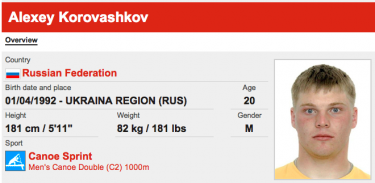
LVOV REGION (RUS), ZHITOMIR REGION (RUS), UKRAINE REGION (UKR), UKRAINA REGION (RUS): these bizarre geographic names were used last week on the official website of the London 2012 Olympics to describe the birthplaces of at least a dozen of Ukraine-born athletes representing the Russian Federation (e.g., volleyball player Taras Khtey, judoist Vera Moskalyuk, rhythmic gymnast Karolina Sevastyanova, canoeist Alexey Korovashkov).

The errors most likely got there due to sloppiness of the Russian Olympic Committee officials responsible for filling in the athletes' biographical data forms and passing the information to the event's organizers. Several Russian team members born in the Caucasus and Central Asia had their birthplaces mixed up as well.

Many netizens in Ukraine found these misplacements offensive and rather typical, however - a kind of a post-imperial Freudian slip reflecting what's often perceived as Russia's possessive attitude towards its neighbors.

An online protest was launched [uk; en] in response:

On the official site of the 2012 Olympics, Ukraine has become part of Russia [...].

I propose writing angry letters to the Russian Olympic Committee (pr@olympic.ru) and to the organizers of the Olympic Games in London (complaints@enquiries.london2012.com). A sample letter [in English] is below.

[...]

Dear (London2012/Olympic) Committee,

I am writing to express my deep disgust concerning your mistake about
the russian athletes birth place. Thus, for instance, according to
London 2012 web site, Korovashov is born in Ukraina region (RUS)
http://www.london2012.com/athlete/korovashkov-alexey-1010562/ and
Khtey is born in Lvov region (rus)
http://www.london2012.com/athlete/khtey-taras-1013482/

It is well known that Ukraine is an independent country and
not part of russian federation, and that Lvov (correct spelling Lviv)
is situated in Ukraine (and was one of 4 cities of Euro 2012)!

I am really very disappointed by these ’mistakes’ and demand to
correct them immediately!

Kostyantyn Hryshchenko, Ukraine's Minister of Foreign Affairs, got involved, reporting on the steps taken by his office via Twitter. Below are Hryshchenko's exchanges [uk] with the online newspaper Ukrainska Pravda.

@ukrpravda_news:

@Gryshchenko Kostyantyn, can you comment on this? What does "Ukraine region" mean? Will there be a reaction from [the Ministry of Foreign Affairs]? pic.twitter.com/fZsa13P7


A screenshot of Ukrainska Pravda's tweet addressed to Ukraine's Foreign Minister, featuring a screenshot of the Ukraine-born Russian gymnast's bio page on the London 2012 website.

@Gryshchenko:

@ukrpravda_news The word "region" definitely shouldn't be there. A silly mistake even from the standpoint of the English grammar. We'll find out whose error it is and get them to correct it.

@ukrpravda_news:

@Gryshchenko Keep us posted!

@Gryshchenko:

@ukrpravda_news I've just asked our Embassy in Great Britain to get in touch with the organizing committee of the Olympics, so that they corrected this error.

Eventually, some of the errors were indeed fixed (albeit somewhat inconsistently) - while others remain. What used to be "LVOV REGION (RUS)" on Taras Khtey's page has turned into "LVOV REGION ()", Vera Moskalyuk's "ZHITOMIR REGION (RUS)" is now "ZHITOMIR REGION ()", and Karolina Sevastyanova's initial birthplace of "UKRAINE REGION (UKR)" is now "UKRAINE (UKR)". Alexey Korovashkov still has "UKRAINA REGION (RUS)" in his bio:


A screenshot of Alexey Korovashkov's bio page on the London 2012 website.

The gaffe and the subsequent Ukrainian reaction didn't go unnoticed on Twitter.

User @MeybeGiuliia mentioned Sol Campbell, a retired English football player, who, back in May, didn't think it was safe for the English fans to come to Ukraine for the Euro 2012 (the fans did come anyway and later informed Campbell, through a mock protest in Donetsk, that he had been "wrong"):

ATT GB Olympic committee: Ukraine - isn't REGION of Russia, it's COUNTRY. Please, ask Sol Campbell.

Joel Draper (@DraperMovies) mentioned the Russia-Ukraine controversy along with two others that preceded the Olympics, including the South/North Korean flag mix-up (GV text is here):

Yesterday the issue was a flag mix up, today it's Ukraine being a 'region' of Russia and a welsh player being listed as english #London2012

JaWill (@lgyyjaw) used the #olympicgeography hashtag in this summary of the situation:

Ukraine is a region of Russia #olympicgeography #London2012

User @Voloschka wrote:

Did these people even learn geography? Official London 2012 Olympics website's a mess. http://www.kyivpost.com/content/sport/russian-olympic-committee-annexes-ukraine-region.html …

Jonathan Campion (‏@jonathancampion) wrote this, linking to the not-yet-amended bio page of Karolina Sevastyanova:

This hasn't gone down well in Kyiv: an Olympic gymnast from the "Ukraine region" of the Russian Federation. http://www.london2012.com/athlete/sevastyanova-karolina-1013451/ …

And so did Nikolaus von Twickel (‏@niktwick):

They won't risk a war because of a beautiful sportsmenka [female athlete]? MT @jearlemsk Russian #Olympics gymnast from "Ukraine" region http://www.london2012.com/athlete/sevastyanova-karolina-1013451/ …

And The Economist's Edward Lucas (‏@edwardlucas):

Ukraine is a "region" in Russian eyes (according to bio of an Olympic athlete) http://l2012.cm/QD92zX

On Facebook, Ukrainian journalist Vakhtang Kipiani also posted a screenshot of Karolina Sevastyanova's page, along with the opening words [ru] of the Soviet anthem:

"An unbreakable union..." Yuck.

Kipiani's post generated nearly 70 comments; below are a few of them [uk; ru].

Yuri Beresten:

The spectre of the Soviet Union has started haunting Europe again!

Oksana Stebelska :

This is simply unacceptable...

Vlodko Tomash:

A disaster... oy-oh... unacceptable... while the fact that [the Ukrainian state officials] are [stealing] billions and dooming the country to annihilation is something we can close our eyes to... [...]

Oleh Pastukhov:

Just an ordinary sports betrayal that everyone is used to already. [...] People have been selling their motherland for gold and food for a few thousand years already.

Victoria Veremiienko (in reply to Oleh Pastukhov):

[...] I wouldn't call this betrayal - if a country is offering decent work conditions [...], why would [an athlete] refuse? (and for an athlete this is work). The same way one can consider it a betrayal that thousands of Ukrainians are going abroad to earn money.

Karolina Sevastyanova, the Ukraine-born Russian rhythmic gymnast - and "the face" of this controversy, did not seem to be aware of the seriousness of the situation. On her Vkontakte page [ru], a friend posted a note [ru] about the gaffe, but in the comments to this post there were no mentions of the protest letter-writing campaign or of the high-ranking Ukrainian official's involvement. The athlete's fans and friends were mainly wishing Sevastyanova good luck, she was chatting back, and the discussion [ru] was in general very friendly and apolitical:

Zlatoslav Kalinich:

Accept our congratulations! Ukraine is proud that it now has such an athlete)))

Maxim Sedoplatov:

Most likely, Karolina was born in Ukraine, and is Ukrainian, but lives in and represents Russia. And the organizers must have thought that the region in which Karolina was born (Ukraine) is part of Russia. Is that true?

[...]

[I guessed it right!] Moreover, Karolina was born in Kiev! Well, well, now there's nothing surprising for me here! Kiev women have always been known for their beauty!

Karolina Sevastyanova:

A huge thank you ) I'm very pleased! Yes, I was born in Kiev. But since early childhood I have lived in Moscow. And, naturally, Russia is my native country )

Natasha Kosinova:

Karolina, which passport do you hold? Russian or Ukrainian?

Karolina Sevastyanova:

I've never lived in Ukraine! I was only born there.

[...]

The passport is Russian.

On Twitter, where Sevastyanova (@Karolisha_S) has nearly 850 followers, she wrote:

After they reported everywhere that I had been born in Kiev, I am getting friend requests exclusively from Ukrainians!

This post is part of our special coverage London 2012 Olympics.

Russia: Netizens Trying to Explain the Devastating Flooding in Krymsk, Helping the Victims

Global Voices Online
Monday, July 9, 2012


On July 6-7, more than 170 people died and 35,000 were injured or lost their property [ru] in the floods in Krasnodar region (photos and video in these PublicPost reports [ru] - Day 1, Day 2, Day 3). The death toll is likely to grow, as rescuers and emergency services continue their work in the affected areas. The hardest-hit town is Krymsk: water rose to over 3 meters there within minutes and late at night, when many people were asleep and did not have time to escape.

In the blogosphere and on the ground, there is no consensus as to what caused the Krymsk catastrophe. Some claim it was a natural disaster; others for a while believed the water in the nearby Neberdzhayevskoye Water Reservoir had been released towards Krymsk in order to keep the port city of Novorossiysk from being flooded; and there are also those who blame the tragedy on the unfortunate combination of extreme weather conditions (about four monthly norms [ru] of rainfall within one day), the unsatisfactory state of the reservoir, the town's vulnerability due to its location at the foot of the mountains and with several rivers nearby, and the authorities' failure to warn and evacuate the residents.

Most of these online discussions are politicized, too: bloggers who subscribe to the view that there was no human factor involved in the disaster are clashing with those who hold local and federal authorities responsible for deliberate actions and negligence that, in their opinion, resulted in severe damage and numerous casualties.

Official statements have been inconsistent, and a lot of people, both online and in the affected region, are not convinced by the messages that the authorities are trying to convey.

The blogosphere hasn't been the most reliable source, either: many bloggers were basing their theories on the information that later turned out to be false. The Neberdzhayevskoye Reservoir, for example, does not have floodgates, so the authorities could not have opened them to let the water out; there is a mountain range that separates Novorossiysk from the Neberdzhayevskoye Reservoir, and its waters couldn't have flown towards the city; the other reservoir, Varnavinskoye, mentioned in some of the earlier post-disaster blog posts as a possible source of flood water that hit Krymsk, is located at a lower altitude than Krymsk, not above it.

All this adds to the general confusion and makes it even harder to understand what really happened in Krymsk. As Masha Gessen wrote on the New York Times' Latitude blog, "Thus in addition to the tragedy of the people who died in Krymsk, there’s the tragedy of having no hope of ever knowing what really happened to them."
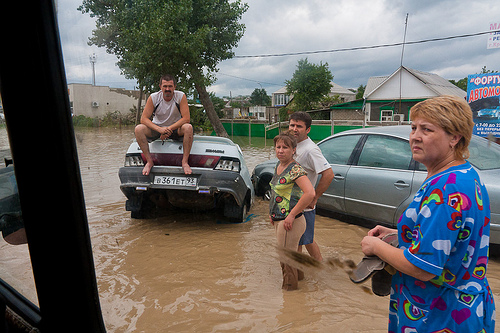

Flooding in Krymsk, Krasnodar region, Russia. Photo by Vladimir Kotelnikov (Flickr user Kotelnikov). Used with permission.

A number of bloggers have analyzed the situation, drawing on the photos, maps, infographics and other data available.

LJ user eugenyshultz, in a lengthy post that has generated over 2,500 comments, offered this explanation [ru]:

[...] The flooding in Krymsk is the result of an extremely heavy rain in the mountains, which caused a massive deluge of water from the mountains, and because of that ALL mountainous streams as well as the rivers Bogago, Neberdzhay and Bakanka merged into a catastrophic torrent that went along the Adagum River, which flows through the center of [Krymsk]. And the reservoir must have overflowed, too, but the water from the reservoir ALONE could not have done this much damage. [...]

LJ user abondarcev, an engineer specializing in bridge construction, concluded [ru] that the Neberdzhayevskoye Reservoir's drainage system was inadequate and unlikely to be able to prevent an overflow caused by heavy rains:

[...] This [the Reservoir] is not really a bathtub, it's a swimming pool 50x50 meters with a drain opening [the size of] that of a bathtub. [...] How can you build a city and not inform the people living there? And they live there until the first serious rain in the mountains. A normal water reservoir has to be constructed, with a normal drainage system, and a canal bypassing the city has to be dug out in case some overflows occur [...].

[...] The authorities hold responsibility for the town's location and for the lives of the people who live in a place that is so unfit for life - it starts to rain and the town is washed away... [...]

Suren Gazaryan, a local environmental activist (LJ user gazaryan-suren), wrote this [ru]:

[...] I drove up along the rivers Bakanka and Neberdzhay, as far as I could. Came to a conclusion that the release of water from the Neberdzhayevskoye Reservoir could not have been the cause of the flooding, even though the locals support this version. Water level was up in all the tributaries of the Adagum River, not just in the Neberdzhay River, on which the Reservoir is located.

LJ user moshkow did some calculations [ru], estimating that some 3-10 million cubic meters of water must have entered Krymsk at the speed of 1,000-3,000 cubic meters per second (while, normally, the water in the Adagum River moves through Krymsk at 10-30 cubic meters per second), and it was exiting Krymsk too slowly, at 150-500 cubic meters per second, due to the insufficient width of the "exit canyon" outside Krymsk:

I became curious about the reasons of the flood in Krymsk. Things written by "the opponents of the regime" and by "the defenders of the regime" are turning into a crazy mix of [deliberate disinformation], lies, meaningless as well as real facts.

So let's just count [...].

[...]

Moral #1. With water inflow of 3,000 cubic meters per second and water outflow of 500 cubic meters per second - Krymsk was doomed to sink.

Moral #2. There was no wave or tsunami. But there was a rather quick flooding of up to 5-7 meters high - as in a bathtub whose drain opening is ten times narrower than the entry opening.

Moral #3. The Neberdzhayskoye Reservoir made its contribution to the flooding [65 cubic meters per second through its drain opening]. [...]

Moral #4. Neberdzhay gave us 65 cubic meters per second, but Krymsk was getting over 1,000 cubic meters per second. The rest of it came from the unblocked streams and rivers [...], which carried all the water [...] into the plains [...] and into the Adagum River.

Moral #5. The flooding alert system has to be different from what it is now in the places like the Black Sea coast of the Caucasus (and it appears that there was almost no warning).

Moral #6. When you live in an area that allows more water in than out - you must listen very carefully and know how much [precipitation] has fallen on the mountains above you.

Roustem Adagamov (LJ user drugoi, @adagamov) tweeted:

I think that, most likely, they simply failed to give warning to the residents in #krymsk, treated it as [something unimportant]. That's why so many died inside their houses.

While some RuNet users are trying to figure out the cause of the tragedy in Krymsk, others are either on their way to the affected region or already there, as volunteers or journalists. Much of the current online discussion focuses on the relief effort, too.

On Twitter, hashtags #крымск ("Krymsk") and #поможем ("let's help") are being used, and among those tweeting from Krymsk and the surrounding areas now are Miriam Elder (@MiriamElder - en, ru), Konstantin Dikhtyar (@konstantinmsk - ru), Suren Gazaryan (@Suren_Gazaryan - ru), Roman Pereverzev (@RomanPomych - ru), Danila Lindele (@dlindele - ru), Alyona Popova (@alyonapopova - ru), Ilya Ponomarev (@iponomarev - ru), Anastasia Karimova (@aakarimova - ru), @Cockroach_brain (coordinates volunteers; her July 8 photos from Krymsk are here - ru), Dmitry Maletin (@eMaletin - ru).

ITAR-TASS photographer Sergey Karpov posted this mini-report [ru] on his Facebook page last night:

Life is returning to Krymsk: electricity and, partially, gas have been turned back on. There are many volunteers from all over [Kuban]. They are constantly bringing food, clothing, water. Still, do bring more, it won't go unneeded. Old people have been relocated to the kindergarten, there are tent camps for victims and those who are now homeless. [...]

Some of the citizen media tools, platforms and initiatives [ru], whose goal is to coordinate the relief effort, are: the Ushahidi-based Kuban/Krymsk Help Map (launched by RuNet Echo's Gregory Asmolov); the Floods sections of Rynda.com (Virtual Alarm; a GV text about this initiative is here); krymskhelp and this post on Krasnodar Live! on LiveJournal; Facebook groups "Help for Kuban" (1,333 members) and "Aid for Victims of Kuban Floods" (606 members); VKontakte communities - here (583 members) and here (4,637 members); this message board at Kuban.ru.
Russia: Kenyans at Pro-Putin Rally Identified As Moscow Circus Acrobats

Global Voices Online
Tuesday, March 27, 2012


This post is part of our special coverage Russia Elections 2011/12.

A month ago, the video of a group of Kenyan men who allegedly participated in the pro-Putin rally at Luzhniki on Feb. 23 received much attention [ru] on the RuNet.

For opposition-minded netizens, the presence of the young Kenyans at the pro-Putin rally confirmed yet again that much of the support for the Russian PM was not genuine. It also provided them with something of a comic relief: "International conspiracy" was part of the title of activist Igor Drandin's video post [ru]; "Putin is a politician of intergalactic scale, even Kenya supports him," wrote [ru] LJ user cuduyc in a comment to Drandin's post; "the representatives of international Putinism are very impressive," wrote LJ user pier_luigi, commenting on LJ user panzicov's photo post [ru].


The state-controlled NTV channel included [ru; approx. 5:20-5:45] the footage of the Kenyans in its controversial film about the recent opposition protests, implying that their appearance at the pro-Putin rally had been arranged by the opposition to discredit the regime.

Despite all this publicity, the Kenyan men have remained anonymous, just like most other, less conspicuous participants of the various rallies that took place in the past few months. In a comment to Drandin's post, LJ user bereg_solnca expressed the general assumption as to their possible identity:

Poor African students working hard for 750 rubles [$25]?

However, one blogger - Alan Butaev (LJ user butanti), a circus clown performing with the Butanti Comic Company - recognized the Kenyan men in the Feb. 23 video as the acrobats who were brought to Moscow from Kenya in 2011 by the Russian circus authorities, to hone their skills and have them later perform here. Because of the sorry financial state of the Russian circus and the hardships that local Russian circus artists are facing, this was not seen as a welcome initiative [ru] by some in the Russian circus community. LJ user butanti wrote [ru] on Feb. 24:

Exactly a year ago, I wrote [a post, ru] on how the leadership of the RosGosTsirk company (the Russian State Circus) had bought a number of Africans so that they, with their [extra-hard work and superhuman endurance], brought the Russian circus from the state of crisis [...] at last.

Of course, replacing Russian artists for Africans is a brave innovation, modernization and reform, no doubt about it.

Needless to say, that [RosGosTsirk couldn't care less] about its own unemployed compatriots.

[...]

It hasn't even been a year since that blissful period when RosGosTsirk brought the Kenyans to Russia to teach them the circus craft, and today the enthusiastic bunch of these dashing African guys is out at the Feb. 23 rally in support of that one candidate for the post of the President of Russia. [...]

In a comment to his own post, Butaev wrote [ru]:

I think it's a totally idiotic initiative to gather the Kenyans for the rally that they have nothing to do with whatsoever.

It doesn't matter who and for which purpose had gathered the Kenyans: the authorities or the opposition. Either way, it's disgusting.

In the past, students of the circus college used to earn extra cash by acting in movies, taking part in various concerts and performances.

Now, alas... they are earning money by dragging around banners and posters at rallies and marches.


The Kenyan acrobats performing at the Moscow Circus on March 23, 2012. Photo by Veronica Khokhlova

Andrei Provotorov re-posted Butaev's text [ru] on his blog at the Radio Echo of Moscow site. User tereza2011 left this comment on Feb. 26:

Turns out that not only "our mental asylum is voting for Putin" - but also the Kenyan one. Though it is obvious that they wouldn't have managed to make the posters by themselves - [their Russian isn't that good].

At the RusCircus.ru forum, user Yahia wrote [...]:

The story of the Kenyans turned out to be very funny. They should have given this money [paid to the Kenyan acrobats] to those [Russian circus artists] who are unemployed, should have sent them on vacation to Kenya... They've got the most delicious coffee there.

This post is part of our special coverage Russia Elections 2011/12.

Russia: "Anatomy of a Protest" Film Causes "NTV Lies" Scandal

Global Voices Online
Monday, March 19, 2012


This post is part of our special coverage Russia Elections 2011/12.

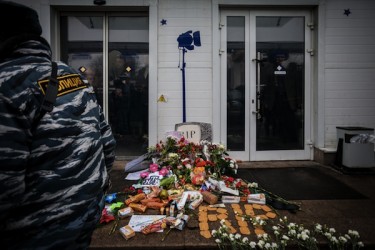
On Sunday, March 18, there were old TV sets, a mock coffin, and plenty of flowers and cookies outside the Ostankino TV tower in Moscow, where a few hundred protesters gathered for a mock funeral of the "truthful television."

The unsanctioned rally was organized via social networks [ru] in response to "Anatomy of a Protest," a film produced by and aired on the state-controlled NTV channel on Thursday, March 15, which claimed, among other things, that those who attended recent opposition rallies had received "money and cookies" for their participation.

NTV's mock grave at the Funeral of the Truthful Television rally at Ostankino, Moscow. Photo by EVGENY FRANK, copyright © Demotix (18/03/12).

On Friday, March 16, public outrage sparked by NTV's film gained momentum, with the hashtag #НТВлжет ("NTV lies") soon becoming one of the top trending topics on Twitter.

Tom Parfitt ‏(@parfitt_tom) wrote:

#НТВлжёт - "NTV lies" is trending hard on Russian Twi after ridiculous smear documentary about Russian opposition [...]

Nataliya Vasilyeva (@NatVasilyevaAP) wrote [ru]:

I'm watching yesterday's NTV "film." And these people are called "journalists" too. I can't stay silent. But I can't allow myself to [use bad language] either ((.

Nikolaus von Twickel (@niktwick) commented on Novaya Gazeta's online reaction to the scandal:

Nice: @novaya_gazeta no longer writes NTV but only NTVlies (#НТВлжет) [...]

Miriam Elder (@MiriamElder) wrote about the reaction of another Russian media outlet, the Expert Magazine:

Expert mag cutting all cooperation w NTV after false use of ed-in-chief interview in yesterday's hitjob https://www.facebook.com/ExpertOnline/posts/316335338428051 v @Yenisei23

Alex Sidorenko (@sidorenko_intl) wrote about the reaction on the Russian social networks:

Bloggers got completely tired of accusatory #NTV journo-crap. DDoSed #NTV servers and completely trashed Vkontakte page: vk.com/ntv

Daniel Sandford (@BBCDanielS) noted the reaction [ru] by Ashot Gabrelyanov, the editor of LifeNews.ru online tabloid:

Chief Executive of lifenews.ru @gabrelyanov says to those complaining about NTV attack on the protests. "Watch Facebook" if u don't like TV.

@NatVasilyevaAP tweeted about NTV's surprising counter-reaction to the public outrage:

NTV is set to show a re-run of its hatchet job on the oppossion in the evening of the planned rally against NTV http://t.co/Y8WhQZjt

@BBCDanielS pointed out that, according to NTV, the film's re-run was scheduled "due to popular demand." He wrote:

NTV has decided to wind the protestors up. It is going to RE-BROADCAST the controversial documentary on Sunday night after the demonstration

Both @NatVasilyevaAP and @BBCDanielS were referring to the March 18 protest at Ostankino. On Saturday, March 17, however, a smaller protest took place at Pushkin Square in Moscow. On his Facebook page, Andrei Jvirblis posted a few photos from the gathering and wrote [ru]:

[...] [A rally] either for freedom to political prisoners, or against NTV's lies, or just to have a chat. Spring is here, finally!

Journalist and activist Olga Romanova, whose husband, businessman Alexei Kozlov, was sentenced to five years in prison on March 15, attended the March 17 gathering at Pushkin Square, and later explained [ru] on her Facebook page why she was against boycotting NTV:

[...] First, good, honest people remain there and continue working [...]. Second, you shouldn't share links to the stupid film - its ranking is only growing because of that, i.e. [the money continues to flow in]. If you don't like it, ignore it. [...] Third, the honest employees of NTV will attend the rally at Ostankino tomorrow, and it's the toughest for them now, by the way. [...]

A reader, Marina Mirlina, responded [ru]:

I know, too, that there are some wonderful and honest journalists at NTV. [...] And I'll go to the rally now. I think that this way we'll be able to help those honest journalists who still work there. And they understand perfectly well that these rallies are not against them but for them...

Vera Lurie wrote [ru]:

Olga, I used to think differently, but I admit that you are right and I'm not. It's impossible for everyone to resign. Teachers at all schools, because there are dishonest ones, those who took part in falsifying [the election results]; journalists, because there are many corrupt and cynical, with no shame and consciousness; all the judges, because a huge number of judges have lost their human qualities. As [Niels Bohr] used to say, at least tiny pockets of decency should be preserved. Everywhere.

A number of online anti-NTV initiatives have emerged in the past few days.

There is now a "Boycott NTV" Facebook page, with 1,566 members; its mission statement reads [en]:

In Russia, tv channel NTV (НТВ) issued a false statement alleging that the opposition to the ruling party is being paid by "money and cookies". This group was created in order to call for a boycott of NTV and its advertisers.

Tomsk-based user Sergey Maltsev posted [ru] a list of NTV's advertisers, both domestic and foreign, with their contact info and a sample appeal letter:

[...] I am writing to inform you that I refuse to buy and use [your] products, because your company, as an advertiser, supports the Russian TV - NTV channel in particular - which broadcasts absolutely dishonest and offensive programs. [...] The [latest NTV show], an absolutely dishonest "Anatomy of a Protest," has affected me personally, since I am a participant of all the political rallies "For fair elections!" that took place in Tomsk from Dec. 2011 to March 2012. I am an ordinary citizen and I do not have any means of exerting pressure on NTV's executives, except for one: boycotting the products and services of the channel's advertisers. I'll be calling everyone who shares my views to such actions, via my personal blog, social networks, mass media outlets accessible to me, etc. I hope that when our numbers have grown noticeably enough, your company will refuse to advertise on NTV. [...]

@sidorenko_intl reported on a similar initiative on LiveJournal (the LJ post [ru] mentioned in the tweet below now has over 2,000 comments):

Bloggers continue attacking #NTV: @ottenki_serogo had created a list of NTV advertizers in order to boycott them http://ottenki-serogo.livejournal.com/248162.html [ru]

Another Facebook group, "I do not watch NTV," has 1,607 'likes'. Alfred Koch, who headed Gazprom-Media at the time of its controversial takeover of NTV in 2001, argued [ru] on his Facebook page that "our opponents understand the language of money well" and that it might be a lot more efficient to stop watching NTV than to "go out in the freezing temperatures to yell something anti-Kremlin for two hours":

[...] Just in Moscow, around 2 million people could support the "I do not watch NTV" action. Such a significant loss of audience cannot be ignored by the Gallup Media, and this, in its turn, will become public. Which means that the advertisers will learn about it. NTV losses due to such an action will amount to millions of dollars a month. [...] The conditions to be met for the action to stop are also simple [...]: clear and unambiguous apologies for the "Anatomy of a Protest" show [...]. [...]

In another Facebook post [ru], Koch provides some financial projections:

[...] According to my estimates, NTV earned approximately $700-$800 million from advertisement last year. Even a 10-percent shrinking of the audience (and I think we can achieve this, if about 40 percent of the population voted against Putin and we could get at least every fourth person involved), this would mean a year-end earnings loss of about $80 million. Or around $6-$7 million a month (the action's approximate duration). Trust me, it's a significant blow! [...]


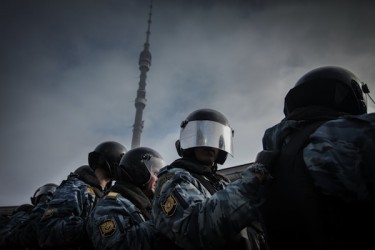
Riot police at the Funeral of the Truthful Television rally at Ostankino, Moscow. Photo by EVGENY FRANK, copyright © Demotix (18/03/12).

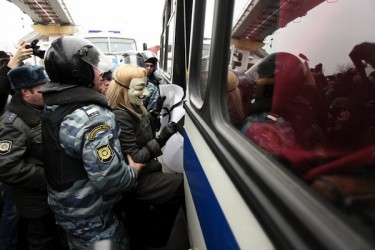
Back in the offline world, at the March 18 Ostankino rally, the riot police, quite predictably, ended up detaining "about 100 protesters." The echo of these detentions was best heard online, of course.

Fedor Kemenov (@fkemenov) posted a picture of a protester being detained and tweeted [ru]:

Participants of the rally at #Ostankino, tired and cold, are being helped into a warm bus by the caring policemen [...]

On Facebook, Vyacheslav Yegorov posted a photo of an elderly man being detained in a very rough manner and wrote [ru]:

Yesterday at [Pushkin Square], this [old man] kept asking the police: "Don't you see what's happening to the country?" Today, they dragged him [...] to a [prisoner transport vehicle]. How can it be???!!! What's he so dangerous for?? [...]

Artem Ayvazov (@shegolll) tweeted [ru] his own detention:

Oh, I've been detained, am sitting in a [prisoner transport vehicle]. [Detained] for the "Trained to Broadcast Lies" poster [...]

He tweeted throughout his ride to a police station (during which he and other detainees were joking [ru] and singing [ru] Yuri Shevchuk's songs, as well as Katyusha, a Russian wartime song), and throughout his stay there [ru], and was released approximately four hours later, along with others.


A young woman is being detained at the Funeral of the Truthful Television rally at Ostankino, Moscow. Photo by MARIA PLESHKOVA, copyright © Demotix (18/03/12).

This post is part of our special coverage Russia Elections 2011/12.

Russia: Anglophone Bloggers Discuss Election Fraud and Post-Election Future

Global Voices Online
Wednesday, March 7, 2012


This post is part of our special coverage Russia Elections 2011/12.

One way to begin writing about the March 4 presidential election in Russia is with some irony, as Mark Adomanis did on his Forbes blog, The Russia Hand:

Well, in what is surely one of the more shocking developments of the past several months, Vladimir Vladimirovich Putin just won the election to become Russia’s “next” president. [...]

Or, as Craig Pirrong did on his Streetwise Professor blog:

Tsar Vlad the Lachrymose has won his electoral bid to return to Russia’s presidency. This result is hardly surprising (though for a while there was some question as to whether he would win in the first round). [...]

Another way to approach the topic is by being serious and straightforward about it, as Katherine Brooks was on TOL's East of Center blog:

The presidential elections in Russia took place on March 4th amid various claims of fraudulent behavior at the polls. Despite the presence of 30,000 trained volunteer election observers and the installation of webcams in more than 90,000 polls in Russia, nearly 1,000 irregularities were reported by midday with Russia’s League of Voters tallying 3,000 reports of fraud by day’s end. In particular, there were numerous complaints of “carousel voting” – wherein a group of voters is bussed from polling station to polling station to register their vote multiple times. [...]

Either way, when writing about this past Sunday's election, it seems impossible to avoid mentioning the allegations of voting fraud and its implications for Putin and the Russian citizens.

Adomanis, in his post quoted above, wrote:

[...] The question over the scale of the fraud is not merely an interesting academic exercise, though it is certainly that, but something that offers very meaningful insight into the likely course of Putin’s third term. An election which was free of the most blatant and absurd irregularities (i.e. official results which flatly and blatantly contradicted exit polls and other pre-election opinion polls) would suggest that team Putin was slightly humbled by the recent spate of popular protests and recognized the need for conciliation and change. An election that was just as blatantly rigged as the last one would be rather more ominous and suggest that Putin was not humbled but angered by the recent weakening of his position. [...]

After reviewing some of the Western media assessments of the alleged fraud, Adomanis concludes:

So, unfortunately, what the presidential election seems to suggest is a Kremlin that is dead-set on keeping power and that will use any and all of the bewildering arsenal at its disposal. Expect things to get worse before they get better, and expect there to be some increasing nastiness in Russian society as the anti-Putin opposition become ever more radicalized.

Pirrong wrote this in the post linked to above:

[...] The key issue in the near to medium term is whether it is widely perceived in Russia-and among the elite especially-whether Putin really won decisively (as he claims, winning 60+ percent), or whether a far narrower margin of victory was grossly inflated by fraud. The more widespread the perception that Putin felt it necessary to manufacture a huge margin, the more vulnerable he will be. In contrast, if it is widely accepted that his margin was legitimate and largely untainted by fraud, his position will be strong, at least in the near term. [...]


A woman votes in the Russian presidential election at a polling station in St. Petersburg. Photo by YURY GOLDENSHTEYN, copyright © Demotix (4/03/12).

Yuri Mamchur of Russia Blog mentioned the costly state-funded webvybory2012.ru [ru] election transparency project:

[...] International observers stated that the elections were fair and transparent, with 89% of all voting locations performing as excellent, 10% - with "minor technical" violations, and 1% with "major violations as reported by the observers." The nearly half-a-billion-dollar expense on 130,000 web cameras has certainly paid off for Putin - any Russian citizen could watch the elections online at www.webvybory2012.ru to follow the real time voting action at any of 90,000 locations across the country. Most likely there were violation. However, doubtfully they would amount to anything but a margin of error [...]. [...]

Kyle Keeton and his wife Sveta, of Windows to Russia blog, spent the night of the vote count watching webcams installed at polling stations "all over Russia":

[...] We found very little variance all over the Russian country and I will post an hour long boring video in the next few days. [...] The fact is very little cheating happened and it was very much in the eye of the camera at all times. People worked hard to ensure a proper election and to tell otherwise is to insult that thousands and thousands of people that spent long hours at a tedious job…

Putin won and that is that! [...]

Anatoly Karlin of Sublime Oblivion came up with a detailed preliminary analysis of "the degree of fraud," based on the election data available at the moment:

[...] My assessment is that in these elections it was on the order of 3%-4%, which is lower than my estimated range of the 5%-7% fraud in the Duma elections, but still far too high by developed country standards. The geographical distribution of fraud has changed significantly: Moscow actually appears to be very clean this time wrong (in stark contrast to 2011, and 2009). However, there were little to no changes for the better in the ethnic minority republics, which is where the great bulk of the falsifications are now concentrated. [...]

Andy Young of Siberian Light compared this election with the Dec. 2011 parliamentary vote:

[...] After the December’s Duma election debacle, I had held out some hope that the Presidential election would be a bit fairer and increased scrutiny (via webcam, no less) might temper the fraud we’ve seen previously. Alas, I can’t really see any improvement worthy of note and Russian elections still don’t pass the smell test. [...]

He also shared some thoughts on the future of the Russian opposition:

The real damage to [Putin's] aura of invincibility won’t come from the election result, it will come from a reinvigorated opposition.

[...]

One of the main reasons that Putin has had such an easy ride over the past decade is that there has been no opposition to speak of. And this year’s election was no different – at least, when it came to the candidates. [...]

[...]

I expect the protests to die off pretty quickly after the election, but I think in 6 years time they will have proved tremendously valuable in kickstarting a genuinely engaging opposition movement in Russia. I have no idea what that opposition will look like – will it be co-opted by the current opposition or will a new grouping emerge? But I’m fascinated to see how it develops.

Mark Galeotti of In Moscow's Shadows asked more questions on what happens next:

[...] Will the current, largely negative movement begin to cohere around a positive platform of reforms and leaders, and then create the political machine to build a national campaign? Will Putin crack down (I don’t expect more than some moves against ‘disloyal’ elements of the media)? More to the point, given that he has pledged directly and indirectly to spend on social programs, economic diversification and military modernization, pledges he cannot possibly all fulfill, whom will he disappoint, and what will this mean?

Galeotti compared the changes taking place in Russia now to "the shifts of continental plates":

[...] trying to watch them move is rarely dramatic. I suspect much the same can be said about this election. Big Stuff is happening, but that doesn’t always mean gratifyingly quick or dramatic. [...]

Brian Whitmore of RFE/RL's The Power Vertical expounded on Galeotti's metaphor, noting, among other things, the role of the Internet in today's Russia:

[...] thanks to deeper and broader Internet penetration, Russia now has its first horizontally integrated generation.

Previous generations have been vertically integrated, whether through the Orthodox Church, the Komsomol, or, more recently, through youth groups like Nashi.

But with Twitter, Facebook, Vkontakte, LiveJournal, YouTube, etc, like-minded Russians are now able to connect with each other -- and organize -- from Kaliningrad to Vladivostok. And they can do so independent of -- and most often in often in opposition to -- the regime.

The process is still in its infancy, but this Power Horizontal will, over the long haul, make it very difficult for Vladimir Putin's Power Vertical to go on with business as usual. [...]

This post is part of our special coverage Russia Elections 2011/12.

Russia: An Overview of the Pre-Election Anglophone Blogging

Global Voices Online
Wednesday, February 29, 2012


This post is part of our special coverage Russia Elections 2011/12.

The pre-election month of February has been filled with reports of large-scale gatherings of both the opponents and the supporters of Russia's current regime. On Monday, Feb. 27, however, as the countdown to the March 4 presidential vote entered its final stages, the news of the foiled attempt to assassinate Vladimir Putin, the Russian PM and one of the presidential candidates, temporarily succeeded in shifting the spotlight onto the person who may re-enter Russia's political scene as the head of state quite soon - and away from the citizens, their hopes, fears and demands.

Below is a quick overview of what some of the Anglophone bloggers have been writing about the pre-election politics in Russia this past month.

Mark Galeotti of In Moscow's Shadows shared initial thoughts on the Putin assassination plot:

[...] I’m willing to accept that this was a real plot, not some complete fabrication (as some seem to imply). On the other hand, the news was obviously held back with the aim of seizing the news cycle just before the elections. This is not exactly unique to Russians, but considering the wide scale skepticism, even downright disbelief with which the revelation has been greeted in Russia, this does not seem to have been an especially effective tactic. To be honest, how many times can you play the same kind of card? [...]

Mark Adomanis wrote this on the same issue:

[...] Discussion has already turned to the political significance of this plot, and it is fully possible that it augurs for a “tightening of the screws” and that Putin will once again use the threat of terrorism as an excuse to tighten political control (recall that the most dramatic re-centralization of political power occurred in the aftermath of the attack on Beslan). However I lean towards a slightly less malign interpretation in which the thwarting of this plot is merely a PR stunt and an opportunity for some (mostly harmless) pre-election chest thumping: Putin will get a chance to play the aggrieved victim of aggression, a role he plays very well, and say a few things about the tenacity and determination of his government in confronting and defeating terror. We’ll see what happens, but given the totality of the political situation in Russia and the obvious weakening of Putin’s position I don’t think a dramatic re-centralization of power is even possible, at least without the widespread use of force. [...]


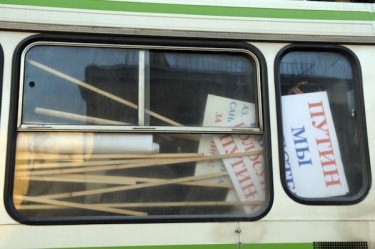
St. Petersburg: "For Putin" banners inside a bus that has brought people to a presidential campaign rally in support of the Russian PM. Photo by YURY GOLDENSHTEYN, copyright © Demotix (18/02/12).

Eugene Ivanov of The Ivanov Report has produced a series of posts on the upcoming election: The Dinosaur (on Vladimir Zhirinovsky, Feb. 9) Putin and the Polls (Feb. 16), Putin and Elites (Feb. 21), and Putin and Protesters (Feb. 26). In the latest post, he put the recent rallies into perspective and explained their significance for Putin's political future:

I’m puzzled when someone begins comparing the number of people participating in pro- and anti-Putin demonstrations in Russia: to me, it’s like comparing the number of apples with the size of oranges. I get even more puzzled when I hear that by putting more people on the streets, the Kremlin “has won” over its opponents. It’s about the same as to say that because the admirers of Yo-Yo Ma can be comfortably accommodated in the Carnegie Hall with its 2,800 seats whereas Britney Spears can easily attract a crowd of 30,000 fans at a sports arena, the pop diva is ten-time better musician than the venerable cellist.

[...]

What the protesters should really pay attention to is their message. Brought together by the power of a single emotion – the outrage at the rigged Duma elections – they now need to transform their “raw feelings” into a set of comprehensive political goals and demands. Far from trying to beat the Kremlin in the game of numbers, the protesters should actually reduce the size of their columns by decisively parting with the nationalists, monarchists and the like. And if they want to broaden their appeal, they would better outreach to industrial workers whose loyalty to Putin is only conditional and may rapidly disappear should Russia’s economic situation deteriorate.

[...]

Yet, the major reason Putin so far hasn’t made any attempt to start a dialog with the protesters is that he doesn’t understand them. Putin seems to be genuinely at a loss to figure out why a bunch of well fed people would go on a protest action, especially if their grievances are caused by such a nuisance as “irregularities” in the parliamentary elections. The concept that some people may value their principles and their dignity over material well-being seems to be completely foreign to Putin. (Apparently, there are no such people in the close circle of Putin’s associates.) That’s why he tries to explain their behavior by something he can comprehend: money, directives from the State Department, or “orange leprosy.” [...]

Following the Feb. 4 opposition rallies, Mark Adomanis compared the turnout in Moscow with that in other Russian cities:

[...] One thing that does seem noteworthy, though, is that the protests in other Russian cities seem to have been rather underwhelming. [...]

[...]

What does this mean for the future of the protests? Well, probably nothing good. Putin and his team are not going to be easy to displace, and I think only a sustained and truly nation-wide popular mobilization could possibly compel them to do so. As always, the situation is fluid and should be watched closely, but there are certainly indications that Putin’s grip on power remains quite secure in large sections of the country. His image has taken a very big and very noteworthy dent, but at this juncture it seems improper to project the palpable anger and frustration of Muscovites onto all Russians. [...]

Kevin Rothrock of A Good Treaty moved a few levels down from the overly familiar nationwide politics story, taking a closer look at the relatively obscure local confrontation that occurred in the town of Lermontov in Stavropol region; not surprisingly, he discovered that the latter shared its most important elements with the former:

Yesterday, the town of Lermontov (located in Russia’s North Caucasus) experienced what some are calling “a small revolution.” As the state municipal building was preparing to close for the evening, a collection of townsfolk and former members of the city council gathered and eventually forced their way into the main lobby. Once inside, reporters accompanying the activists took turns interviewing ex-deputies and disgruntled locals. Acting head of the city’s government Viktor Vasil’ev warned protesters that they were breaking the law by illegally occupying state property. Undeterred, the former deputies announced the beginning of an indefinite hunger strike, promising to occupy Lermontov’s municipal building night and day, until their demands are met: chiefly, the cancelation of the city’s upcoming local elections, which the ex-deputies consider to be illegitimate because they were denied the right to participate.

[...]

The Lermontov ‘crisis’ has something for everyone. If you’re a diehard enemy of the Putin regime, there are former city officials protesting in the open, linking local regional corruption to the Kremlin’s evil influence. Certainly, many aspects of the Lermontov election — barred candidates, political control of the courts, and the squashing of local independence — echo the larger criticisms commonly made of ‘Putinism.’

On the other hand, fans of the Prime Minister seem to find it inspiring that several of the assembled protesters are reaching out to Putin in the tradition of ‘good tsarism,’ hoping that he’ll notice their plight and swoop in to right the city’s wrongs. [...]

This post is part of our special coverage Russia Elections 2011/12.

Russia: The "Big White Circle" Protest in Moscow

Global Voices Online
Monday, February 27, 2012


This post is part of our special coverage Russia Elections 2011/12.

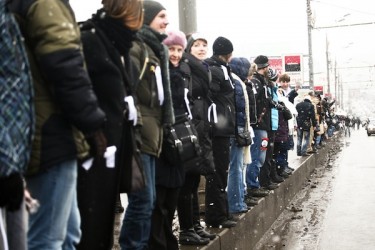
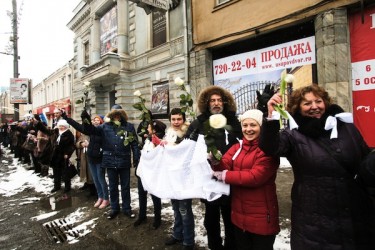
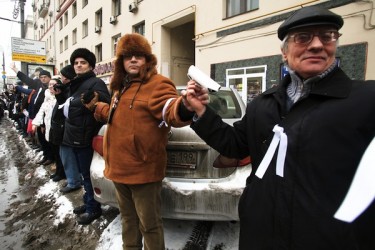
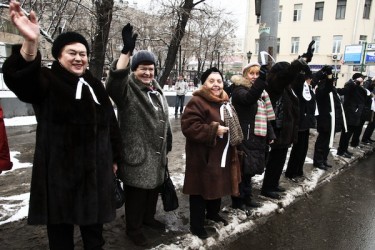
On Sunday, Feb. 26, thousands of people gathered in central Moscow for the Big White Circle protest, forming a human chain along most of the length of the Russian capital's 15.6-kilometer/9.7-mile Garden Ring, protesting against corruption and demanding a fair presidential election, which is to take place in one week, on March 4.


The Big White Circle protest for fair election: people stood along the Garden Ring in Moscow, holding hands and waving white ribbons, flowers and balloons. Photo by MARIA PLESHKOVA, copyright © Demotix (26/02/12).

According to the Q&A note [ru] posted on the Facebook page [ru] devoted to the protests in Moscow, the idea of the Big White Circle does not have a specific author:

[...] The idea is on the surface: hundreds of groups of people were doing this in the 20th century when they wanted to show solidarity with each other regarding certain issues. The best-known action of this kind is [the Baltic Way] of 1989, similar actions took place in Moscow in the late 1980s, and this is being done in Europe nowadays. [...]

In the same Q&A note, there is an explanation of why one of the protest's slogans - "Let's encircle the Kremlin" - shouldn't be taken literally:

[...] We can now be sure that if we choose to surround the Kremlin on Feb. 26, we'll definitely have detentions, beatings, arrests and trials. [...] Are you sure that we have 5,000-6,000 people who are prepared to be jailed for participating in this story? We are not sure [...]. [...] Some of us are probably prepared to play the game of "a 70% chance of getting [a 5-year sentence]" - but this, of course, is a game for heroically courageous people. Our courage, just like yours, has its limits. We respect those who are prepared for such a self-sacrifice. And we also respect those who aren't prepared for that. [...]

There's been no lack of international media reports on the Big White Circle protest. One post on the Moscow protests Facebook page reads [ru, en]:

The whole world has learned about the White Circle! Here are some of the headlines from the world's leading news agencies and mass media: Thousands join human chain protest against Putin || Anti-Putin protesters form 'ring around Moscow' || Impressive anti-Putin demonstration in Moscow || Moscow's Big White Circle || Nine mile human chain encircles Moscow in anti Vladimir-Putin protest || Moscow surrounded: Holding hands 'for fair elections' || Muscovites link hands to protest Putin's grip on power || Putin protests cause a 'chain reaction'...

In a comment to this post, Ekaterina Vizgalova wrote [ru]:

The whole world has noticed, while the [state-owned] Channel One hasn't.

RIA Novosti, a state-owned Russian news agency, did notice the Big White Circle protest, however, producing this fast-motion video of a car ride around the Garden Ring at the time of the protest:


A popular Russian blogger Roustem Adagamov (LJ user drugoi) also took a ride around the Garden Ring, pausing to take photos. He wrote this [ru] in the intro to his photo report:

A few tens of thousands of Muscovites have gathered at the Garden Ring today, to take part in the Big White Circle civic action. I rode all around the Garden Ring in an hour and a half, with brief stops - it all looked very cool and fun. The way it always does at genuine gatherings of free citizens who come there of their own free will and not on the orders from their bosses. Cars with white [symbols of the protest] were riding along the [Garden Ring], honking, and people were waving white ribbons, flowers, and balloons. An excellent action, very upbeat and cheerful. [...]


The Big White Circle protest. Photo by MARIA PLESHKOVA, copyright © Demotix (26/02/12).

Another popular blogger, Oleg Kozyrev (LJ user oleg-kozyrev/@oleg_kozyrev), also drove around the Garden Ring, taking photos and shooting a video (which he hasn't posted yet). Following this ride, Kozyrev tweeted [ru] that initially he had doubted that the Big White Circle protest would succeed:

Now I'll confess that I didn't expect success and was feeling pessimistic :)

In the intro to his photo report - a "photo-circle" - Kozyrev wrote [ru]:

[...] A white circle, a live circle. It is becoming more and more obvious that the angry [PM Vladimir Putin] has already lost. He can no longer stop this avalanche of positive resistance.

Will the smile be able to stop the rough force? This is what we'll have to find out in the coming days. [...]


The Big White Circle protest. Photo by MARIA PLESHKOVA, copyright © Demotix (26/02/12).

"Moscow in the circle of friends" is the title of LJ user vova-maltsev's photo report from the Feb. 26 protest. He wrote [ru]:

Some people were saying that we wouldn't be able to close the circle around the Garden Ring. Aha... We have closed it, in two rows. The first one - with the pedestrians, the second - with the drivers.

If you want to see what people who love their country and wish it well look like, here [they are]. [...] I haven't seen so many kind, happy and smiling people in a very long time. At the [regular] rallies, everyone are piled together, while here you are walking down the street and enjoying it. [...]


The Big White Circle protest. Photo by MARIA PLESHKOVA, copyright © Demotix (26/02/12).

More photo reports can be found in the live_report LJ community (by LJ users tushinetc and semasongs), as well as in the namarsh-ru LJ community (by LJ user belial_68).

The next opposition rally is planned for March 5, the day after the election. Moscow city authorities, however, have rejected the opposition's request to hold the rally on Lubyanka Square.

Serguei Parkhomenko, one of the most active participants of the protest movement, wrote this [ru] on Facebook about the significance of the Big White Circle protest - and the wider meaning of March 5 for Russia:

[...] I think we all understand that our today's initiative is not only the last and very powerful event in the history of the past three months [...]. It is also the beginning of a new stage, a new long and difficult conversation that we will all have to be engaged in. Much patience, resilience and strength will be needed. [...]

[...]

We need to avoid making a mistake as we search for the right decision for March 5. [...] History is again offering us a strange and powerful rhyme. It is hinting on something important.

March 5 is the anniversary of the day on which the country got rid of one tyrant [the day on which Joseph Stalin died in 1953]. [...]

March 5 isn't just a random day for all of us.

This post is part of our special coverage Russia Elections 2011/12.

Russia: Bloggers' Photo Reports and Reflections on Pro-Putin Rally in Moscow

Global Voices Online
Saturday, February 25, 2012


This post is part of our special coverage Russia Elections 2011/12.

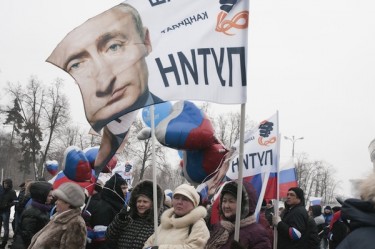
On Thursday, Feb. 23, ten days before the March 4 presidential election, the Russian Prime Minister Vladimir Putin addressed thousands of people at the Luzhniki Stadium in Moscow. The Guardian's Miriam Elder described the event as "a gathering reminiscent of Soviet spectacle both in rhetoric and style":

[...] Thousands of workers from the provinces were bussed in or rushed on to trains to attend the event. [...]


A rally in support of PM Vladimir Putin took place in Moscow on Feb. 23, ahead of the presidential election on March 4. Photo by Irina Firsova, copyright © Demotix (23/02/12).

A number of Moscow-based bloggers attended the Feb. 23 rally, too. Below is a selection of their photo reports and observations, along with some of the remarks from their audiences.

LJ user mi3ch posted 17 photos and wrote [ru]:

Absolutely ordinary people. Trusting. Good. Like my aunt. Like my next-door neighbor. Students, workers, [state employees], pensioners. Seven out of ten - women. Mothers and grandmothers. And they really like Putin. He is so brave and decisive. [...]

Their main distinction from [those who attended the opposition's rallies at Bolotnaya Square] are their faces. At Luzhniki, hardly anyone was smiling. And almost everyone walked silently. [...]

LJ user otshellnica rebuked the blogger [ru] in the comments section:

At Bolotnaya, you could find the same [unsmiling] faces in the multi-thousand crowd. Just as there were nice and smiling faces at this rally. You, of all people, shouldn't be playing with such cheap arguments.

LJ user maxsytch offered [ru] a different point of comparison between the anti- and pro-Putin rallies:

The difference was in the percentage of the people who came to Bolotnaya and Luzhniki voluntarily.

Ryazan-based LJ user tamrat elaborated [ru] on the definition of 'voluntarily,' citing her city's participation in the Feb. 23 rally as an example:

People from Ryazan enterprises came voluntarily - and joyfully. And whether they are for Putin or not is irrelevant. They had a tour of Moscow for free! They were taken there, got fed, listened to a concert. And all this for free! People came back home happy. And nothing will change in our country until a person can be made happy with free food and a trip!

LJ user vova-maltsev posted 14 photos [ru] and recounted his quick conversations with some of the rally's participants:

[...]

- Why are you here?
- We've been brought in here, [damn it].
- Are you for Putin?
- [Screw him], our salary's 17,000 [rubles a month, $580].

[...]

There were [Tajik migrant workers] sitting in one of the buses.
- Are you for Putin?
- [We work as cleaners in Izmailovo, damn it, and we are stuck here now. Will have to do our job all night.]

[...]

Nice [female] school cooks.
- What are you doing here?
- We've been dispatched here.
- To cook porridge [for the rally's participants]?
- Yes.
- Did you go to Bolotnaya?
- No, they didn't send us there.
- Are you for Putin?
- Yes, of course... Are you a journalist?
- Yes. I'm not for Putin.
- (whispering) We are all against him. All our teachers are against, too.

An anonymous reader left this comment [ru] to LJ user vova-maltsev's post:

[They are being drawn there forcefully.] They aren't even getting paid, the motivation is their fear of problems at work + 1 day off. This info is 100% true. Relatives work at a state enterprise, in Moscow.

LJ user panzicov (Alexei Vitvitskiy) posted 48 photos [ru] on his blog. Five of these photos, the blogger claims, show a group of people allegedly being paid for their participation in the rally:

[...] The conscience of the people costs 800 rubles [$27] for two hours, [the money] was being handed out at [Park Kultury metro station] right after the rally. [...]

Seven photos in LJ user panzicov's report show a group of young black men carrying handmade banners with pro-Putin slogans on them. Another blogger, LJ user drandin (Igor Drandin), talked with these men, asking them where they were from, and posted the video [ru, en] on his blog and on YouTube; one of the men explained, in English, that they were from Kenya.

LJ user pier_luigi, commenting on LJ user panzicov's post, wrote this [ru] about Putin's Kenyan supporters:

North Korea this is not - not yet... But the representatives of international Putinism are very impressive!

LJ user tushinetc posted 16 photos [ru] taken before most of the rally's participants took their seats at the Luzhniki Stadium. One of the photos shows empty seats with identical plastic bags on them. LJ user tushinetc explained:

[...] Some organizations took good care of their employees, making sure they do not get cold while sitting on plastic [seats]. In each bag placed on the seats there's a blanket, as well as a candy and a tangerine, and on the seat itself, there's [a cloth mat for sitting]. [...]

LJ user 2014imeretinka commented [ru]:

How mean! For a candy and a tangerine...

LJ user panfilosoff replied [ru]:

Not mean at all... If you don't attend, you'll have serious problems at work, and if you do attend, you'll get a reward and a tangerine. Everything's simple and logical.

This post is part of our special coverage Russia Elections 2011/12.