Showing posts with label [allenova]. Show all posts

Russia: "Anonymous Bomb" and "Random Scapegoats" of Domodedovo

Global Voices Online
Thursday, January 27, 2011


In the aftermath of the Jan. 24 suicide bombing at Moscow's Domodedovo Airport, which killed at least 35 people and left over 100 wounded, some Russophone bloggers are once again discussing the ominous patterns that grow more and more obvious with each new major terror attack in Russia.

LJ user dolboeb posed two questions (RUS) to his readers on Jan. 25: "Who must be held responsible for the terror attack at Domodedovo?" and "Who will be held responsible for the terror attack at Domodedovo?" More than 3,000 people have responded so far, and below are the current results (RUS) of this poll:

Who must be held responsible for the terror attack at Domodedovo?

The airport's managers - 941 (13.2%)

Interior Ministry's bosses - 1,944 (27.4%)

Domodedovo region's authorities - 165 (2.3%)

Police and security service officers who where on duty at the airport at the time of the attack - 1,420 (20.0%)

The country's leaders - 2,086 (29.4%)

Ramzan Kadyrov - 551 (7.8%)

***

Who will be held responsible for the terror attack at Domodedovo?

Nobody - 784 (26.5%)

Random scapegoats - 2,091 (70.7%)

Everyone who is to blame - 83 (2.8%)

@akazakov linked (RUS) to a blog post by LJ user graf-alter, written right after the Moscow subway blasts of March 29, 2010:

http://bit.ly/dOZf0r - observations made after the subway blasts, nine months ago. Fits today's situation 100%, every single letter of it.

Here is some of what LJ user graf-alter wrote (RUS) back in March 2010:

Explosions in our country have a number of special features [...]:

- Following a terror attack, no one claims responsibility for it, and no demands are being made. Which is very unusual compared to the practice of terror elsewhere in the world. Because we know the names of all sorts of Basque, Palestinian and other terrorist groups due to the well-established phrasing used in the news: "a blast occurred in the city of NN; terrorist group NN has claimed responsibility for it, demanding NN." Here, bombs are anonymous.

- Investigation usually declares certain bandits already killed in the course of a "special operation" as masterminds of the explosion. [...]

- Rarely, investigations of explosions reach trial stage. These trials appear very pathetic and unconvincing. The names of those who ordered [the attack] never surface, and only those who carried it out - not the principal players, though - end up being named. Information revealed during the hearing about the suspects' contacts with the secret services is somehow never of interest to the court. As the hearing proceeds, cases against lawyers who "attempted to bribe the investigators," etc., are being opened. [...]

- Explosions usually occur during periods when the secret services' position weakens or when they are being criticized by the public. Or before the elections.

[...]

An old, scratched vinyl record, it's making hissing sounds but continues to play.

A few dozen souls who had nothing to do with this music are off to heaven again.

And here is a post (RUS) written by the same blogger after the Domodedovo Airport blast:

[...] "God, forgive me for my personal daily contribution to the filling made of hatred that this bomb contained."

This is how it should sound in a society of thoughtful, mature people. A utopia, of course. An ideal. [...]

A utopia, indeed.

On Jan. 25, Moscow-based LJ user nataly-kuzmina re-posted a highly disturbing YouTube video that was initially shared on Jan. 22 by LJ user azadovsky (who describes himself as a Moscow-born, Moscow-based "Russian"). The video features a little boy, who is wearing a "Chechnya: Resisting the Russian Invasion" t-shirt (these words are written in Turkish: "Çeçenistan: Rus İşgaline Direniyor") - and is talking to an unseen adult male, saying this (as quoted by nataly-kuzmina), among other things:

Would you like an ice cream or a gun? - A gun!
What do you need a gun for? - To kill Russians!

The blogger concludes:

[...] Is there anyone else here who still wishes to be tolerant? [...]

In another post-Domodedovo bombing entry, she writes:

[...] I don't want to, I'm scared to live in this country. There's nothing to lose here, except life. And it's easy to life here - the state is working hard on it [...].

And here is what LJ user z-abdullaeva - a Moscow-based woman, too, whose "roots" (RUS), however, are in Dagestan, and who grew up in Grozny, Chechnya - wrote right after the news of the Jan. 24 attack began to appear:

35 people [dead]

On blogs, they are talking about 70.

I'm waiting.

I don't feel like reading anything.

Our [folks from the Caucasus] will now turn out [to be responsible for the attack] again.

Suitcase - train station - Canada?

* Mood: pessimistic

And a couple more comments from the same blogger and one of her LJ friends:

z_abdullaeva:

Here they're always eager to have us, people from the Caucasus, to bear the collective responsibility...

***

greenarine:

Tell me, how do they immediately recognize a North Caucasian appearance on a thoroughly blown-up person? He must have left a Quran with Russian translation somewhere nearby, right? And a passport with Grozny registration.

Will have to move stealthily around the city again for a while.

z_abdullaeva:

[...] I'd also like to make some noise about this issue, but I know that my fellow countrymen are capable of this. Alas. I don't have any illusions about it...

Shura Burtin writes more (RUS) on the issue of "anonymous bombs" on his blog at the Russkiy Reporter news magazine, explaining that it's now crucial to get "people to start talking, not shooting" at each other:

I had already expressed this seditious idea - that it's necessary to negotiate with rebel fighters. The answer was ["No"]. I feel that this is a completely irresponsible type of morality, and people who talk this way couldn't care less about those who were killed and their families. Moreover, it's nothing but a substitution of notions, because the original meaning of this principle is that the terrorists' demands shouldn't be met - in order not to encourage new acts of terror. But the problem here is that it's been a long time since suicide bombers from the Caucasus demanded anything from us.

We should realize that a civil war has been going on for many years in our country, in the North Caucasus - almost like in Afghanistan or Iraq. And it's not a metaphor. According to the data from open sources, 1,710 people were killed and wounded in armed confrontations in 2010. And these figures have been deliberately understated [...].

[...]

The Russian society has to decide what we want: war or peace. If we want peace, then the process of making peace has to begin. And there's only one way to make peace - which is to start making peace. [...] The state has to stop thinking in the "us vs them" terms, it has to recognize this conflict as social insanity that has to be treated. It's important to understand that all parties in this war are Russian citizens. The reason for this war isn't the mythical international terrorism, but our own domestic conflict. This is a tragedy, a mistake, a result of the lack of dialogue and mutual understanding between segments of our society. All parties in this conflict have their own truth - and the task is to help them reach a consensus. [...]

Olga Allenova - LJ user allenova, a special correspondent for the Kommersant daily, author of Chechnya is Close: War Through the Eyes of a Woman (RUS), a collection of the 1999-2007 war reportage from Russia's North Caucasus region - has not yet written anything about the Domodedovo tragedy on her blog. But she returned from a trip to Dagestan on Jan. 21, just a few days before the airport blast, and posted a short entry (RUS) about the oppressive atmosphere there and how the local people are coping with it:

I'm back from Dagestan, feeling as if I was at a war - but didn't get to see the war itself. I saw people who had someone [from the family] killed. Saw machine guns in the hands of plainclothes special forces officers. I was shocked by a story told by my good acquaintance Timur: his friend Magomed's brother, a riot police officer, had been killed, and on the day his brother's body was brought home, Timur's neighbors were also awaiting a body - of the man who had killed Magomed's brother. Timur says he feels that the ring keeps narrowing, and the war is now right outside his house.

But if you are driving around the republic, everything looks quiet. People are selling things at the market, go shopping, get married, have children. Perhaps, this is the meanest type of war, when you don't see the actual threat.

What shocked me most was that people remained human even in such conditions. Hospitable, polite, well-mannered - most of the people I met were like this. Even those not very educated - village police officers, for example - but they were still very friendly.

I asked one - "How do you live here, why aren't you leaving?" (he does have a place to go). He replied: "Sooner or later we'll all die, and it's better [to die] at home while trying to do something [good], rather than somewhere far away, like a vegetable."

There is something to learn from the Dagestanis.

Russia: War Reporter Blogs on Trauma and Politics of the Subway Attacks

Global Voices Online
Tuesday, April 6, 2010


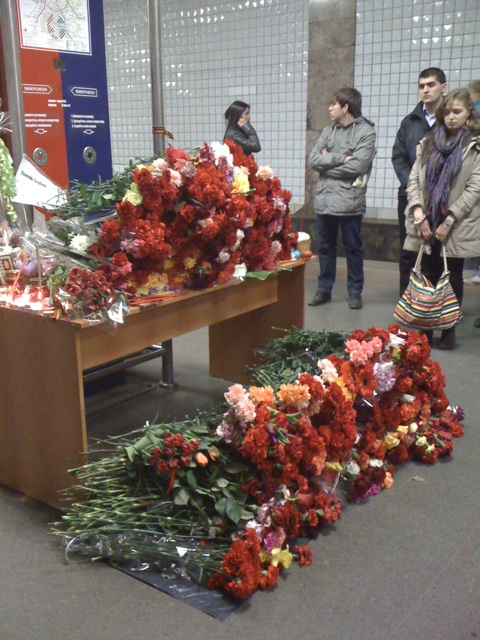
Flowers at Park Kultury subway station in Moscow - April 3, 2010 (image by Veronica Khokhlova)

Olga Allenova (LJ user allenova) is a special correspondent for the Kommersant daily, author of Chechnya is Close: War Through the Eyes of a Woman (RUS), a collection of the 1999-2007 war reportage from Russia's North Caucasus region. In the blog post (RUS) translated below, she writes about the March 29 subway bombings in Moscow and the 2004 Beslan school siege, the subsequent pain and trauma, and the resulting political and media responses.

Today a friend of mine [...] suddenly told me that she had been [avoiding subway and taking buses and other means of land public transportation] to work this whole past week. She works at [Kolomenskaya subway station], and lives at [Rechnoy Vokzal]. It takes her only 40 minutes to get from home to work. But since Tuesday, she's been leaving home two hours earlier - at 6 AM, that is - to be at the office by 9 AM.

I didn't get what she meant right away. That is, I could guess she was stressed out, like many other Muscovites, as a result of [last Monday's subway blasts]. But I didn't know her condition was that serious. And when I asked her why she was so sure something similar couldn't happen on [a bus], she started crying. And I suddenly realized that I had just told her a very cruel thing. The imaginary safety of land transportation was keeping her afloat, allowed her to continue going to work, to somehow plan her life. And now she was sobbing, saying this: "I can't live! I can't live! I can't descend into the subway! I can't look at the people!" And now I could understand her. I was in a similar state in 2004, in and after Beslan. Everything that used to give my life a sense of some universal justice had collapsed then. I couldn't sleep, couldn't eat or go out into the street. In front of my eyes stood black plastic bags, and the black women screaming above them. It's impossible to express this, the words that I'm writing now seem absurd. Even now I have a lump in my throat. I don't even remember how I got out of that. Many hours, weeks, I'd been talking to all kinds of people, friends, a priest, my husband, colleagues. It was then that I decided I wouldn't be seeing psychologists - they aren't of much help. They are just doing their job, staying outside - outside your pain.

Then a year passed, and I went to Beslan again. And again, there was this terrible hurt, and these symbols - white balloons over the school, white birds over the cemetery, an old woman saying tender words to a dove that chose to sit on her granddaughter's grave, children's faces on the cold gravestones, their teddy bears, their chocolates and cola. I'm a strong person, I know that. I've seen a lot in my 33 years. War, dirt, terrorist acts, corpses that no longer looked like people. I know that I've survived all that. But I know that deep inside I still haven't recovered from Beslan. I don't like to talk about it. I try not to think about it. Because when I do, I sob from despair, from fear. I sob because I still haven't understood why it happened. I sob the way my friend did today. She's just scared. There are many people like her now. People are scared to go inside subway. They are scared of women in headscarves, even though many of these women are Moscow natives. They are scared of their own fear. Fear is an enemy that destroys a person from within. If you are scared and you give up, the fear will take full hold of you. When I'm scared to go to the Caucasus, I realize that if I give in to fear and don't go once, I'll stop going there altogether - and I'll end up stuck at home, behind the closed doors, and I'll be scared even to pick up a phone. I know people to whom this happened.

I don't understand why they aren't discussing this problem on TV. Why there are no psychologists who would talk in prime time to people about the problems that are bothering them a lot. Not every person would agree to see a psychologist. Not everyone understands that it's a disease that requires treatment.

They'd tell me - what TV discussions do you expect when on the day of the attacks they didn't even air special newscasts on TV. I live in this country, so I'm not surprised. A year after Beslan, exactly on the anniversary, Moscow was celebrating its birthday. And when I wrote a text about it, outraged readers responded to me: "What, do you want us to forget our own birthdays, anniversaries, weddings?" My friend, by the way, was also celebrating her birthday on that day. And now she is sobbing from fear. It's just that at that time it all seemed too distant. And now it's very close. [...] And I'm not surprised by how the federal channels were covering the subway attacks. If you remember Nord-Ost [theater hostage crisis of 2002] and the live broadcasts on [NTV] - and what they did to NTV afterwards - it becomes clear that no live broadcasts are possible in this country under this regime. I'm not gonna get hysterical and scream about why the officials aren't showing me the truth - the way Beslan mothers did at one point. I simply despise this regime. I don't see them as authorities. For me, they are a cowardly bunch of people who couldn't even get out of the Beslan airport, but were sitting there, in the hastily set up headquarters (just in case, so that they could get out if the terrorists suddenly besiege the whole city) - at the time when the children were being shot at by tanks and grenade launchers. These same cowardly people were trying to convince the citizens whose relatives were taken hostage in the besieged Nord-Ost [theater]: "Colleagues! Calm down! All the terrorists are waiting for is for you to hold a rally on Red Square! We won't allow this!" A quote from [Valentina Matvienko]. They, of course, couldn't allow such a blow to their image. A rally against the war in Chechnya, and right on Red Square. Against the sacred and on the sacred.

I don't expect anything from these people. I even understand why they disliked the publications in the media claiming that the Moscow attacks were acts of revenge for the Caucasus. [Boris Gryzlov] is very displeased with hearing all the time about the regime's cowardliness. And about the mistakes they had committed but wouldn't admit to. [...]

But - again - this isn't what I wanted to say. I wanted to say that people need help. Professional psychological help as well as simple moral support from [family and friends]. If you have a friend who is scared to take subway, talk to him about it. Help him. Maybe you'll save him from trouble. We can only rely on ourselves, on our dear ones, on fellow citizens. Because there's no one else in this country that we can rely on.

Russia: Two Video Scandals

Global Voices Online
Saturday, March 27, 2010


In Russia this week it has been hard to miss the two scandals that, at first, appear to have only one thing in common: both are centered around amateur videos published online. What they also share is, perhaps, the feeling of incredulity and disgust that the viewers are left with upon watching the videos, and, in many cases, the outrage.

One scandal involves opposition activist Ilya Yashin (LJ user yashin), political analyst Dmitry Oreshkin, and the Russian Newsweek's editor-in-chief Mikhail Fishman (LJ user mfishman): footage made with a hidden camera shows them allegedly attempting to bribe Moscow traffic police officers, and there is also a video of naked Fishman sitting next to a woman and sniffing white powder off a table. (For a succinct yet comprehensive English-language account of this video scandal, please see the March 23 text by author Michael Idov, published at The Daily Beast: Russia's Amazing Drugs and Hookers Scandal.)

The other scandal takes place in Irkutsk region, where high school students in the town of Shelekhov repeatedly beat up their 73-year-old female PE teacher and then posted the videos of these sparring matches on the web; the teacher reportedly had no memory of the beatings. (A short English-language Sky News item on this, with a video sampling, is here.)

Heated discussions that these two scandals have generated in the blogosphere and in other online venues are taking place on quite different orbits - which nevertheless do have one or two overlap points.

Below are some of the reactions (RUS) to a news item about the PE teacher incident, posted by users of Zavuch.info, a Russian teachers' portal and social network:

Persikotik:

[...] I think the school's administration had to take some urgent steps to avoid a situation like this at the school - instead of being embarrassed to "wash dirty laundry in public." And it is scary that such a video spent a few months on the web, as a tutorial for morons.

***

ann_dro_id:

If we don't stand up for one another, if we don't hold protest rallies, if we don't stand up for our right to defend our honor and dignity, they'll keep on pushing us around! Even drivers don't let themselves be mistreated [e.g., Vladivostok drivers' protest in Dec. 2008]. These are the times when a being a teacher is turning into one of the most dangerous professions. [...]

***

Gritsun Dmitry:

[...] where is it all going if a school employs a teacher who keeps being beaten but doesn't remember anything about it. I'm not saying that the age of 73 is a diagnosis, but memory loss does seem like a pathology. I'm not going to justify the students. Horrible!!!!

Nemiro Lyudmila:

[...] and what if there is no other PE teacher at the school? What then? Who is going to work on this job for such [a miserly pay]? Your suggestions???? Our school hasn't had new teachers right out of college in a million years. Not a single one. They work for a year and [then leave]. And we are SOCHI, no less!!! [Sochi is a Russian city on the Black Sea coast, which, among other things, is preparing to host the 2014 Winter Olympics.]

***

Viking

[...] We should keep up with the progress! Nothing scary is taking place. The young followers of the [Nashi and Walking Together pro-regime youth movements] are practicing techniques of fighting against pensioners' rallies in the future, following instructions from the [ruling United Russia party]. [In Oct. 2009, Russian riot police used - during a drill - “water cannons, shock grenades, and tear gas” to disperse “a group of senior citizens that protested social injustice and blocked a federal highway.”]

***

Biokhimik:

[...] We should keep this situation under CONTROL. Where are the trade unions, where are the human rights activists? (I haven't just cursed, have I?) [...]

And here is a selection of posts on the Yashin/Oreshkin/Fishman affair.

Opposition activist Marina Litvinovich - LJ user abstract2001:

The day before yesterday, a user with an eloquent nickname kanal911 registered an account on YouTube - in order to post this video:


In this video, Oreshkin, Yashin and Fishman are trying to bribe [traffic police officers].

In my opinion, the footage is real, was done by [traffic police officers] themselves. The only question is - are they videotaping everyone like this or just some, those who have been "pointed out" to them? [...]

It is clear that due to the public movement against the police and [traffic police] these service have now gone on the offensive. And it's clear that the easiest way to fight the "oppositionists" is to catch them giving bribes themselves.

This, my friends, is exactly why whenever I write about the lawlessness of the cops and [traffic cops], I do this with clear conscience. And I've emphasized this multiple times - I do not just criticize those who give bribes, I call on you not to give bribes and I myself do not give bribes. I'll be honest - I stopped bribing [traffic police officers] after my trip to Beslan [a town in North Ossetia where the 2004 school hostage crisis took place], when I learned that the terrorists paid a bribe to pass one of the [traffic police] checkpoints. [...]

Mikhail Fishman, editor-in-chief of the Russian Newsweek - LJ user mfishman:

[...] A special operation has been carried out against me. It has been thoroughly planned. It was based on provocations, deceit, editing and long-term shadowing, and law enforcement officials participated in it. Who exactly and on what grounds is a separate question. It was carried out a long time ago, and now it has turned into a campaign.

Those who organized this campaign have succeeded in some things. Namely, they've poured a dirty puddle around me - and around themselves: they've dragged many decent people into a mean and petty discussion of someone else's private life. In the language of political technologies this is called the lowering of the discussion level.

This is a result, but not the one that they were counting on. The point of it was different: to force me to alter the editorial direction of the magazine that I'm in charge of. [...] This is a signal to all journalists: sit quietly.

I'm responding on behalf of our team: no, we will continue working the way we did before. Topics, stories, the principles and standards of our work will remain unchanged. [...]

Olga Allenova, special correspondent for the Kommersant daily - LJ user allenova:

[...] And the most disgusting thing is that Fishman has nothing to respond to this with? File a lawsuit? Against whom? A statement has to be submitted to the prosecutor's office, of course. [...] No one has canceled the right to private life in this country yet. [...] And THIS can happen to any human rights activist, journalist, politician, even regardless of whether it's him or not featured in this footage. This can be done to anyone who, for some reason, displeases [a top aide to the Russian president and PM Vladislav Yuriyevich Surkov], for example. You are responsible for this, Vladislav Yuriyevich, aren't you? Or, to be more precise, your Young Guardists [members of the Young Guard of United Russia, the youth wing of the ruling United Russia party]? [...] Who is the next one on your list? And aren't you afraid that eventually you'll find yourself on it, too?

Political activist Aleksey Navalny - LJ user navalny:

[...] Seriously though, I think that Yashin, Fishman [...] should not leave it as it is. Instead, they should start a decisive campaign against those who ordered this crap. Because it's a total mess. Next thing you know, they'll install hidden cameras inside apartments.

I think a campaign for the European and U.S. entry visa ban for Surkov [and his associates] looks rather realistic. [...]

[Sochi. Sukhumi. Skolkovo.] There many good places for recreation outside the EU.

It may work out, if we approach it seriously and don't drop it halfway, as is usually done by our human rights activists and liberal politicians.

The Young Guard has denied its involvement in the scandal, however:

[...] Finally, once more, for the idiots, in big and fat letters: "THE YOUNG GUARD DID NOT ORDER OR AUTHOR THE VIDEO ABOUT FISHMAN. WE DECISIVELY CONDEMN SUCH METHODS OF POLITICAL STRUGGLE. [...]

Maxim Kononenko - LJ user mrparker:

[...] I'd also like to support Fishman. A [KGB] provocation against Yashin and Oreshkin - that's normal. Yashin is a politician. Oreshkin is a grant-eater and traitor. These people are screwing my state, and the state is screwing them in return. That's a genuine and mutual hatred.

But Misha Fishman is the creator of meanings. A very good one. And to fight such opponents is possible only using the same methods that these opponents are using - i.e., with meanings. A meaning vs a meaning. A text vs a text.

But definitely not whores with cocaine vs a text and a meaning. A meaning isn't equal to cocaine, and a text isn't equal to a whore.

But an image isn't equal to a meaning and a text, either. This is why I suggest that everyone who supports Fishman (and I hope that this would be every normal journalist, author or media professional) records [his/her] own video with white powder and post it on YouTube.

[...]

LJ user ma79 is one of the Russian bloggers who has responded to LJ user mrparker's call and posted a video of himself and "white powder":


[...]

I wanted to wash my hair before shooting this video, but then decided it wouldn't be authentic that way.