Ukraine: Chaotic Ratification of the Gas-for-Fleet Deal

Global Voices Online
Thursday, April 29, 2010


On April 27, 236 Ukrainian MPs (UKR) voted in favor of the ratification of an agreement allowing Russia to extend the lease on its Black Sea naval base until 2042. In exchange, Ukraine would get discounts on Russia's natural gas "worth $40 billion over 10 years."

The ratification of the gas-for-fleet deal took place in a chaotic setting. Among other things, security guards were forced to employ two umbrellas to shelter parliament speaker Volodymyr Lytvyn from the eggs hurled at him by opposition members. Here is footage from Channel 5's April 27 newscast (UKR):


Below is some of the Anglophone blog commentary on the deal and its disorderly ratification in Ukraine.

Ukrainiana posts available footage from inside the parliament building, as well as a couple videos of the protest that took place outside, and writes:

[...] The unconstitutional treaty that gives Ukraine’s oligarchs gas discounts and extends the presence of Russia's Black Sea Fleet until 2042 gathered 236 votes.

That included absentee MPs Kivalov and Holovaty, members of the ruling Party of Regions.

Outside, thousands of people rallied against the treaty and wrestled with police.

Amid the struggle and mayhem inside, opposition leaders failed to communicate with the protesters outside. In the absence of live coverage, the protesters relied on cell phones and portable radios.

Thus, the protesters on the ground found themselves a little out of touch with the ones on the Rada [the Ukrainian parliament] floor. [...]

Kyiv Scoop writes this:

Eggs, smoke bombs, sirens and fisticuffs were not enough to stop Ukraine’s parliament from making a mockery of the democratic process on April 27. Without any debate or discussion, the legislature ratified an agreement that will allow Russian military maintain a presence in Ukraine until 2042 and adopted the state budget for 2010. [...]

[...]

[...] In post-Soviet Ukraine, MPs do not have to be physically present in parliament to vote: it’s enough for their “voting cards” to be in the right hands under the dome on Hrushevsky Street. For example, where was Regions MP Serhiy Holovaty when he voted to ratify the Black Sea Fleet agreement? In Strasbourg, France. Ukrainian democracy allows for elected officials to perform their duties virtually.

Ask a Ukrainian who represents their community in parliament and they won’t know, because the current Rada was elected according to a proportional, closed list system. There is no direct representation. All a voter saw on the ballot when he/she voted in 2007 were the first ten names of every party of electoral bloc. Ukrainians not only do not know who represents them, they don’t even know who they voted for. As a result, a bunch of no names responsible to nobody except their party boss, who bought their way onto their party list are in parliament. This is the worst Rada ever, making some of the worst decisions – ever.

[...]

Leopolis writes this:

[...] In the years of national democracy (or democratic chaos), fisticuffs in the Rada was a common occurrence. After Yanukovych promised to take Ukraine along a pragmatic course, today's bar fight is more of the same. [...] This time, eggs and tomatoes were launched and smoke bombs went off. AP picked it up. Ukraine is, once again, a laughing stock in the Western press. [...]

In all seriousness, there is a trend emerging -- the orangeists, now in opposition, appear to be employing the same tactics used by the blues during 2004-2009. [...]

[...]

While many will see this fight as some new development (the orange opposition behaving badly), it is hardly new. If anything, this egg-battle in the Verkhovna Rada is a wonderful example of the approval of "pragmatic" politics.

Marina Starozhitskaya wrote this at OpenDemocracy.net:

[...] The fleet was not on the agenda, and in fact it was not supposed to be on the agenda for another five yeas. There was absolutely no need to extend the term of stationing of the Russian Black Sea fleet at all – this is simply the best chance for the first “test of compliancy” of the new Ukrainian president. [...]

Streetwise Professor reviews some of the expert opinion on the issue and concludes:

[...] Remember the old Soviet joke: “We pretend to work and they pretend to pay us”? Well, I’d characterize this deal as “We pretend to give them a price break, and they pretend to extend our lease.” All this deal does is create more promises to be broken. And broken they will be.

Siberian Light comes up with a different conclusion:

[...] Well, actually, I think that today’s been a pretty good day for Ukraine. By extending the lease until 2042 in exchange for a 30% reduction in gas bills, Ukraine’s pro-Russian President Viktor Yanukovych has negotiated a cracking deal.

In real terms, 30% translates to around $4 billion per year – and over $120 billion over the lifetime of the deal. And all for a naval base that (a) Ukraine probably doesn’t really mind Russia having and (b) if Russia left, Ukraine would have to pay to decommission. [...]

Russia: War Reporter Blogs on Trauma and Politics of the Subway Attacks

Global Voices Online
Tuesday, April 6, 2010


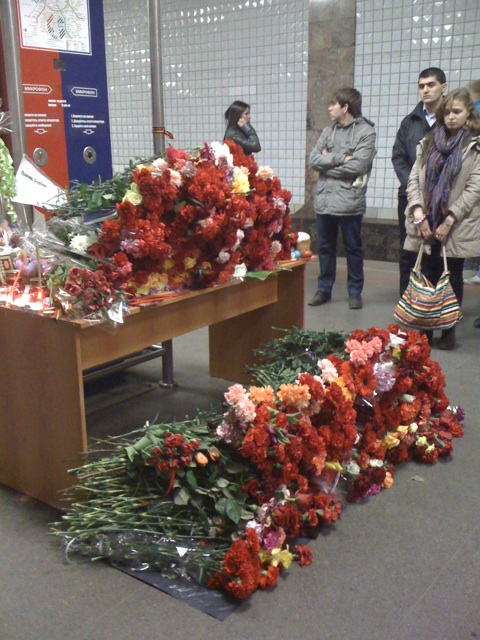
Flowers at Park Kultury subway station in Moscow - April 3, 2010 (image by Veronica Khokhlova)

Olga Allenova (LJ user allenova) is a special correspondent for the Kommersant daily, author of Chechnya is Close: War Through the Eyes of a Woman (RUS), a collection of the 1999-2007 war reportage from Russia's North Caucasus region. In the blog post (RUS) translated below, she writes about the March 29 subway bombings in Moscow and the 2004 Beslan school siege, the subsequent pain and trauma, and the resulting political and media responses.

Today a friend of mine [...] suddenly told me that she had been [avoiding subway and taking buses and other means of land public transportation] to work this whole past week. She works at [Kolomenskaya subway station], and lives at [Rechnoy Vokzal]. It takes her only 40 minutes to get from home to work. But since Tuesday, she's been leaving home two hours earlier - at 6 AM, that is - to be at the office by 9 AM.

I didn't get what she meant right away. That is, I could guess she was stressed out, like many other Muscovites, as a result of [last Monday's subway blasts]. But I didn't know her condition was that serious. And when I asked her why she was so sure something similar couldn't happen on [a bus], she started crying. And I suddenly realized that I had just told her a very cruel thing. The imaginary safety of land transportation was keeping her afloat, allowed her to continue going to work, to somehow plan her life. And now she was sobbing, saying this: "I can't live! I can't live! I can't descend into the subway! I can't look at the people!" And now I could understand her. I was in a similar state in 2004, in and after Beslan. Everything that used to give my life a sense of some universal justice had collapsed then. I couldn't sleep, couldn't eat or go out into the street. In front of my eyes stood black plastic bags, and the black women screaming above them. It's impossible to express this, the words that I'm writing now seem absurd. Even now I have a lump in my throat. I don't even remember how I got out of that. Many hours, weeks, I'd been talking to all kinds of people, friends, a priest, my husband, colleagues. It was then that I decided I wouldn't be seeing psychologists - they aren't of much help. They are just doing their job, staying outside - outside your pain.

Then a year passed, and I went to Beslan again. And again, there was this terrible hurt, and these symbols - white balloons over the school, white birds over the cemetery, an old woman saying tender words to a dove that chose to sit on her granddaughter's grave, children's faces on the cold gravestones, their teddy bears, their chocolates and cola. I'm a strong person, I know that. I've seen a lot in my 33 years. War, dirt, terrorist acts, corpses that no longer looked like people. I know that I've survived all that. But I know that deep inside I still haven't recovered from Beslan. I don't like to talk about it. I try not to think about it. Because when I do, I sob from despair, from fear. I sob because I still haven't understood why it happened. I sob the way my friend did today. She's just scared. There are many people like her now. People are scared to go inside subway. They are scared of women in headscarves, even though many of these women are Moscow natives. They are scared of their own fear. Fear is an enemy that destroys a person from within. If you are scared and you give up, the fear will take full hold of you. When I'm scared to go to the Caucasus, I realize that if I give in to fear and don't go once, I'll stop going there altogether - and I'll end up stuck at home, behind the closed doors, and I'll be scared even to pick up a phone. I know people to whom this happened.

I don't understand why they aren't discussing this problem on TV. Why there are no psychologists who would talk in prime time to people about the problems that are bothering them a lot. Not every person would agree to see a psychologist. Not everyone understands that it's a disease that requires treatment.

They'd tell me - what TV discussions do you expect when on the day of the attacks they didn't even air special newscasts on TV. I live in this country, so I'm not surprised. A year after Beslan, exactly on the anniversary, Moscow was celebrating its birthday. And when I wrote a text about it, outraged readers responded to me: "What, do you want us to forget our own birthdays, anniversaries, weddings?" My friend, by the way, was also celebrating her birthday on that day. And now she is sobbing from fear. It's just that at that time it all seemed too distant. And now it's very close. [...] And I'm not surprised by how the federal channels were covering the subway attacks. If you remember Nord-Ost [theater hostage crisis of 2002] and the live broadcasts on [NTV] - and what they did to NTV afterwards - it becomes clear that no live broadcasts are possible in this country under this regime. I'm not gonna get hysterical and scream about why the officials aren't showing me the truth - the way Beslan mothers did at one point. I simply despise this regime. I don't see them as authorities. For me, they are a cowardly bunch of people who couldn't even get out of the Beslan airport, but were sitting there, in the hastily set up headquarters (just in case, so that they could get out if the terrorists suddenly besiege the whole city) - at the time when the children were being shot at by tanks and grenade launchers. These same cowardly people were trying to convince the citizens whose relatives were taken hostage in the besieged Nord-Ost [theater]: "Colleagues! Calm down! All the terrorists are waiting for is for you to hold a rally on Red Square! We won't allow this!" A quote from [Valentina Matvienko]. They, of course, couldn't allow such a blow to their image. A rally against the war in Chechnya, and right on Red Square. Against the sacred and on the sacred.

I don't expect anything from these people. I even understand why they disliked the publications in the media claiming that the Moscow attacks were acts of revenge for the Caucasus. [Boris Gryzlov] is very displeased with hearing all the time about the regime's cowardliness. And about the mistakes they had committed but wouldn't admit to. [...]

But - again - this isn't what I wanted to say. I wanted to say that people need help. Professional psychological help as well as simple moral support from [family and friends]. If you have a friend who is scared to take subway, talk to him about it. Help him. Maybe you'll save him from trouble. We can only rely on ourselves, on our dear ones, on fellow citizens. Because there's no one else in this country that we can rely on.

Russia: Reflections on the Subway Bombings and Politics

Global Voices Online
Monday, April 5, 2010


It's been a week since the March 29 bombings on the Moscow subway, which killed 40 people and left over 100 injured. Below is a sampling from an ongoing discussion by Russophone bloggers.

LJ user matiutia wrote (RUS) about an encounter with Moscow police officers on the day of the attacks:

I'm on my way to work. One subway station is closed. I move to another one. At the entrance, I'm stopped by the cops. Six of them or so.

- Your documents.
- [Don't have them] (left them in another bag)
- Are you registered [here in Moscow]?
- [Propiska - the record of place of residence]. Bolshoi Karetnyi Pereulok.

(They talk to each other for a while):

- Detention until identification.
- Well, come on, she's alive, that means she's not a [suicide bomber], come on...

(To me)

- Any identification documents.
(I unbutton my coat, take out my [Christian] cross):
- The only ID that I've got.
- You're free to go.

LJ user dolboeb commented (RUS) on the official response to the attacks:

[President Dmitry Medvedev] has decided to spend some time fighting terrorism.

Considering the background of our jurisprudent, we should not be surprised that all countermeasures he has come up with are not practical (scanners, cameras, dogs, instructing the population, international cooperation), but exclusively legalistic. What's needed, it turns out, is to reconsider the articles in the criminal code that relate to terrorists, and the bad [shahids] will get scared right away.

"It is reasonable to revisit issues related to the proper administration of justice under terrorist legislation – under the 'terrorism' and related crimes article - and to talk about the need to improve such practices," said the head of state.

I wonder how it is possible to improve the practice of law enforcement under terror articles in order to punish, finally, those two female suicide bombers whose body parts have allegedly been found on Monday on the Moscow subway? How to optimize measures of penitentiary influence on the two [female suicide bombers] who blew themselves up [on board of the planes on August 24, 2004]? How should the articles in the [criminal code and the criminal procedures code] be corrected? Perhaps, some afterlife punishment provisions should be added to them?

[two photos of the dead perpetrators of the 2002 Moscow theater siege, also known as the Nord-Ost hostage crisis]

It would also be interesting to find out whether the extermination of the Nord-Ost [female suicide bombers] (who were killed while unconscious by shots in the head) helped obtain data on their accomplices, [those who ordered the siege], funding sources, or the circumstances of preparing for the terrorist act. Did the "improved practice" used on their commander [Movsar Barayev] (a shot in the head and a bottle of cognac placed into the corpse's left hand) help prevent [the 2004 bombing at Rizhskaya subway station], the double bombing of the planes that flew out of [Domodedovo airport in Moscow], and [the Beslan school siege]?

[...]

LJ user maratguelman wrote this (RUS):

Unfortunately, we do not trust the results of the investigations into the previous terrorist acts. We are either not shown these results, or we are shown the corpses of the terrorists. But practically, there hasn't been a single trial whose materials one can look at and say - "we understand who and why carried out this terrorist act." This is a fact. Hence the theories [implicating the Federal Security Service, FSB]. [...]

http://community.livejournal.com/ru_politics/28956469.html Here they are discussing why [the terrorists] aren't targeting FSB as they take revenge for [militant Said Buryatsky], but instead attack peaceful Muscovites. As if terrorism is a declared war whose goal is to destroy an opponent. It's not the opponents that they are after, but innocent victims. [...]

When Sasha Brener [performance artist Aleksander Brener], in response to the [invasion] of Chechnya, challenged [Boris Yeltsin] to a fight at [Lobnoye Mesto on Red Square], the police did not interfere for half an hour and only after all the [TV] cameras were done shooting him, he was arrested. When I was picking him up from the police department, I asked them - why? Why didn't they detain him right away - they couldn't have been scared of 50 students who stood in a circle around Brener. Their answer was this: well, maybe your crazy guy has just saved someone's life. They'll see over there in Chechnya that there is someone who is protesting against the war in Moscow.

[...]

LJ user yuozik made this political forecast (RUS):

[photo of president Dmitry Medvedev on the left, and of PM Vladimir Putin on the right]

Any terrorist act [...] is an operation carried out by special services. It may be carried out by a 50-year-old Chechen woman or even by a bear with a [balalaika] - not much difference. [...]

And today I'm interested in only one thing - whose special forces have been working today? Of the one who is on the left? Or of the one who is on the right?

[...] The algorithm of what happens next will allow us to understand just how horrible the current situation in the Russian Federation is. [...] Because no matter how sad it may sound, we've arrived to the point where the two heads of the eagle on [the Russian coat of arms] (also, a reference to the so-called Putin-Medvedev "tandem") are trying to devour one another to get on top.

[...]

1. If this was done by the new president's special services, then in the nearest future we'll see the weakening of the positions of [Chechnya's president Ramzan Kadyrov]. [...]

2. If this was the work of the team of the ex-president in co-authorship with the current president of Chechnya, then it is possible to expect a real bloodbath in the nearest months. [...]

Then the goal of today's terrorist attack is to intimidate the president of the Russian Federation and his young, reform-minded team. [...]