Showing posts with label 2010. Show all posts

Russia: Moscow Mayor's Dismissal and Some "Kremlinology"

Global Voices Online
Saturday, October 9, 2010


Back in April 2010, Brian Whitmore of RFE/RL's The Power Vertical wrote this about Moscow mayor Yuri Luzhkov's complex relationship with the Kremlin:

It's hard to imagine Moscow being run by anybody but Yury Luzhkov. But then again, it was hard to imagine Tatarstan being run by anybody other than Mintimer Shaimiyev -- until, of course, somebody else was running it.

[...]

There is little doubt in my mind that [PM Vladimir Putin] and [President Dmitry Medvedev] would like to remove Luzhkov, who has been able to operate as a more-or-less independent player in the capital for nearly two decades -- annoying three successive presidents in the process.

The problem is that while Medvedev could get rid or Luzhkov with the stroke of a pen, replacing him could literally become a bloody mess. The struggle for control of post-Luzhkov Moscow would likely descend into a vicious struggle among Kremlin factions for control of the economically lucrative capital. It could be the mother of all Kremlin clan wars, which is surely giving Putin and Medvedev pause.

It took about five months for Luzhkov to be "[relieved] of his duties as Moscow Mayor ahead of term" - by President Medvedev's Sept. 28 "executive order" - "in connection with the Russian President’s loss of confidence in him."

The subsequent discussion on the English-language Russia blogs focused as much on Putin and Medvedev (and their complex pre-election relationship) as on Luzhkov himself (and the future of his wife's business).

As Streetwise Professor wrote, "Kremlinology is back in vogue":

[...] You could argue that Medvedev and Putin are sufficiently confident in the stability of the country that it could withstand the messiness inherent in a transition to a new equilibrium. You could argue the reverse, that the political condition in the country is so fraught that Medvedev, or Medvedev and Putin, determined that extraordinary measures were required, even knowing that the immediate consequences bear their own risks for the system. You could argue that this is a unilateral political strike by Medvedev. Or you could argue the reverse yet again, that it is the result of an agreement between Putin and Medvedev.

In fact, I’ve seen people argue all of the above. Given the information at hand, the best we can do is advance hypotheses, and be sure to keep in mind that they are just that. It is very difficult to know exactly what is going on under the rug: what the dogs are fighting over, how the fight started, who is winning. [...]

Julia Ioffe wrote this in her Foreign Policy piece:

[...] Most voices have been praising Medvedev for proving his independence from Prime Minister Vladimir Putin, the man thought to be the real decider in this town. The theory goes that Medvedev wanted Luzhkov out but Putin wanted him to stay, causing a split behind the scenes. The fact that Luzhkov was fired, according to this school of thought, indicated that Medvedev won and Putin lost. [...]

But that explanation makes little sense [...].

[...]

Instead, Putin determined that Luzhkov needed to go and sent in Medvedev to do the dirty work, a move that not only knocks out a powerful rival but leaves his hands unsoiled in what has become a bloody fight. [...]

A Good Treaty responded to Ioffe's arguments:

[...] Ms. Ioffe’s central thesis is that firing Luzhkov does nothing to boost the power of President Medvedev, and that the entire bonanza was the “dirty work” of Vladimir Putin. She argues that people are wrong to say that Medvedev won and Putin lost. [...]

This is a scarecrow argument insofar as it assumes the relationship between the tandem partners is a zero sum game. Characterizing this interplay as a win/lose scenario forgets the fact that Vladimir Putin himself gave Medvedev his biggest credibility boost of all by promoting him as his successor. [...] The reelection of Medvedev, while far from predetermined, is a very real option under Putin’s consideration. That being reality, it’s over-simplistic if not foolish to dismiss the growth of President Medvedev’s influence on the grounds that it assumes his every advance comes at the expense of the Prime Minister. Medvedev’s gain is Putin’s gain, as it adds credibility to the tandem’s junior partner and preserves the choice ahead for 2012. [...]

Whitmore wrote this on The Power Vertical:

[...] Luzhkov's removal was not, as some media have reported, a sign of a split in the ruling tandem. And it was most certainly not, at least as far as I can see, a "victory" for President Dmitry Medvedev over Prime Minister (and national leader) Vladimir Putin.

It seems pretty clear at this point that Putin was on board with the decision to sack the Moscow mayor. [...]

The Ivanov Report wrote:

[...] [Luzhkov] picked a fight he could not win, and he did not.

[...]

But even today, it’s clear that by firing Luzhkov, Medvedev may have won the hearts and minds of millions of people—in Moscow and across the country—who would be willing to see him re-elected in 2012.

Vilhelm Konnander pointed out a rather inconspicuous yet important St. Petersburg connection:

[...] The struggle between Russia's two capitals, Muscovites and Pitertsy, is a major theme in Russian politics, that also Putin's road to power is part of. As a protegé of erstwhile St. Petersburg mayor, [Anatoly Sobchak], Putin is likely never to forget how instrumental Muscovite interests were for defeating Sobchak back in 1996, and the dire consequences this had for himself. Ever since, the Pitertsy have been longing to get back at Luzhkov, barely succeeding to keep him at bay in the 2000 presidential elections that brought Putin to the Kremlin. Of course, this is common knowledge for anyone following Russia. What is interesting is how little this has been the focus of attention recently. Instead, Luzhkov's dismissal is predominantly interpreted as part of a struggle between Medvedev and Putin for the 2012 presidential elections. [...]

The Pipeline had a quick look at Luzhkov's "last weeks" in office, and, in a four-part series, dissected various aspects of the Sept. 28 dismissal, covering the reactions of the markets and Russian political elite, bloggers and ordinary Muscovites, providing an overview of potential candidates for the post of Moscow mayor, and examining the impact of Luzhkov's ouster on Moscow's real estate and construction market. Here's an excerpt from Part 2 of the series:

[...] Luzhkov’s sacking provided a harvest for satirists and comedians and viral photos are spreading throughout the Russian internet. One features a photo-montage of a refugee Yelena Baturina saying to a small Luzhkov, “Let’s go Yurka [a diminutive for Yuri], somehow we will survive on $3,000,000,000!”

On GlobalPost, Miriam Elder wrote about an interview with Luzhkov (RUS) that appeared in The New Times magazine:

[...] The interview [...] gets at the heart of the matter when the question is given on whether Luzhkov understands that Inteko, the multibillion dollar business belonging to his wife, Yelena Baturina, is likely under threat. It also shows the degree of Luzhkov’s self-delusion.

“You know, why we’re so calm? Whatever has been said or written, we are honest people. Inteko and Elena, that is, my wife, have an honest business — the most honest and most transparent of all those, well, at the very least, that run a construction business.” [...]

Vadim Nikitin of FPA's Russia wrote:

However disgracefully he was forced out, let’s get one thing straight: Luzhkov was a dirty crook. [...]

[...]

In a hypercentralised country like Russia where most of the national wealth resides in the capital, Moscow and Muscovites had always lived like kings compared to their compatriots, and it’s certainly no big achievement of Luzhkov’s that he managed to keep it that way. [...]

Power&Politics World wrote:

[...] The prosperous business of [Luzhkov] – Baturina couple were repeatedly in the Moscow media attention. But many Russians – especially Muscovites – preferred to turn a blind eye to that, sharing a typical stereotype that corruption is an inevitable concomitant of power. Luzhkov’s efforts in improving life in the capital and his efficiency as a manager were believed to be outweighing all the negative nuances. [...]

Dmitry Sidorov of The Putin State Chronicles made this prediction:

[...] It seems to me that the former mayor will be let go without cut marks in exchange for his “voluntary” public silence. I am guessing that his wife eventually will be kindly asked to sell her business at the price stated by a well-connected purchaser. [...]

Writing about the family business component of Luzhkov's story, Konnander mentioned Putin's deputy prime minister Igor Sechin:

[...] The question now is if Luzhkov has reached a settlement e.g. with Sechin, giving him some sort of immunity in an ordered exchange for his wife's business empire, or if we will witness something similar to what happened to [Yukos]. [...]

Whitmore also made a mention of Sechin in his post about Luzhkov's dismissal:

[...] It does appear, however, that the decision to remove Luzhkov was opposed by Putin's powerful Deputy prime minister, Igor Sechin. [...]

In a follow-up post, he wrote that "Medvedev's real rival in the ruling elite is not Putin but Deputy Prime Minister Igor Sechin."

And Streetwise Professor, too, wrote in his Luzhkov post about another developing story that features Sechin:

[...] Sechin’s threat to invade Gazprom’s turf represents a major challenge to the status quo. [...] This is the Russian equivalent of Bugs Moran’s North Side gang hijacking Capone’s South Side gang’s bootlegging trucks. And we know how that turned out. (Chicagoans still hear about it on trips abroad:) [...]

Interestingly, Chicago entered the Luzhkov story through the front door, so to say, too - thanks to its mayor, Richard Daley, in a post titled A Tale of Two Mayors on Poemless (as well as in Ioffe's earlier Foreign Policy text, titled Moscow's Mayor Daley). Here's the closing section of the post by Poemless:

[...] While it’s popular to bemoan the joke that is the democratic process associated with Russia or Chicago, I hear few people complain that they’ve been robbed of the chance to vote their leader out of office. While a new era begins, and reform and “real politics” seem at least more possible now than it did a few months ago, I don’t see many people dancing in the streets. I hear lots of talk about legacies. About looming criminal investigations. About architecture and city planning. And, as if we’d regressed into ancients who’d just witnessed a comet, I hear people, bewildered, ask what it all means, and keep their fingers crossed that everything continues to work. Like those ancients, we will find new leaders, good or bad. The earth will keep turning. [...]

I suspect it will be some time, however, before we find a new Daley or Luzhkov.

Russia: Bloggers Discuss the Market Bombing in North Ossetia

Global Voices Online
Saturday, September 11, 2010


A suicide car bombing outside a market in Vladikavkaz, the capital of the Republic of North Ossetia-Alania, killed at least 18 people and wounded over 100 on Sept. 9. The attack is not the first one to occur at this location (62 people were killed there in 1999, 12 in 2008); it also came just days after the sixth anniversary of the 2004 school siege tragedy in Beslan, a town 15 km north of Vladikavkaz.

North Ossetian bloggers' initial reactions to Thursday's market blast reflected their exasperation with the ongoing violence in the region.

LJ user liza-valieva, a Vladikavkaz-based journalist, wrote (RUS):

An explosion at the central market, again. Half an hour ago. Could be heard even here.

There are the dead and the wounded.

Will it ever end?

Below is one exchange from the comments section:

maxialla:

I've never been a supporter of this point of view - "[the best way out is to move elsewhere]" - but right now it [appears rational] :( [...]

liza_valieva:

It is always possible to move, but people I care about will still stay behind, and no matter where I am, I'll worry about them just as much.

Moscow-based LJ user glazastikk wrote (RUS):

[...] My sister said that papa was fine, and then I got through to him myself, asked him to leave the market, because I was afraid there'd be a second explosion. [...]

And then I was scared for all those who have failed to get through to their folks on the phone. And I keep thinking of it ever since [...].

[...]

I'm sick of being scared and worried. And I don't see a way out. [...]

LJ user manavar, a Vladikavkaz-based medical student, was at the local hospital at the time of the blast. He wrote (RUS):

[...] Ambulances, [public mini-buses], regular cars were rushing in. We unloaded a woman whose arm had been blown off. Then there was another one, missing an eye. Seventeen people were brought in. Two corpses. One person, already dead, was lying on the floor of a yellow mini-bus. A man. One woman died at the ER. Most people had shrapnel cuts. [...]

As always, there was not enough medications. [...] For the first hour and a half, there was chaos at [the hospital], strangers were walking around. Things got better only when the police had cordoned off the hospital.

People were saying that at the school near the site of the bombing all the windows had been blown out and the children had been cut with shrapnel.

[Damn!] When will it all end!

In another post, LJ user manavar wrote (RUS) about his mother's experience that day:

[...] Mama was at the market at that time, she was walking around the aisles inside and was just planning to go to a store [...]. She stayed on [inside] for a second longer to look at the vegetables. The blast was so powerful that her ears got plugged. [...] Mama managed to squeeze herself into some niche and thus avoided the stampede. People ran, fell down, got up, ran again. Hundreds of people running from the area where black smoke was rising; only a few running towards that area. Some in order to help, others because they'd left their dear ones there. Only when the crowd receded, mama was able to get out of the niche and also went towards the exit.

Her hands are still shaking. And I can still see that woman with one eye missing. She is somebody's mother, too.

LJ user manavar's first post was featured (RUS) in the Radio Echo of Moscow's blog section. He admitted that such publicity upset him, but his post also sparked a discussion that highlighted a rather common perception of Russia's North Caucasus as a mismanaged "someplace else":

osokin:

You constantly have terrorist attacks over there! So why was there "not enough medications" then? Who is responsible for the supplies?

crafty:

I am a Muscovite. And it's OVER HERE in Russia that there are terrorist attacks and it's OVER HERE that there is chaos with medications. The fish rots from the head. Just imagine that the blast took place at a market in your neighborhood - there wouldn't even be enough [blood] plasma at the local hospital, let alone everything else.

LJ user gagloyev, a Moscow-based Ossetian blogger, detected a similar note of detachment in PM Vladimir Putin's statement on the Vladikavkaz market attack:

"They have all they need OVER THERE..."?
These are the words of Vladimir Vladimirovich Putin from his dialog with Russia's deputy minister of health care and social development Belov during today's [government] meeting (broadcast on all TV channels today).

A question: Mr. Putin doesn't consider North Ossetia part of the Russian Federation anymore?!

And this person wants to be the national leader?! [...]

Vladikavkaz-based LJ user alan_tskhurbaev wrote this, among other things, in a comment to LJ user gagloyev's post:

[...] All in all, why pick on their words when there are so many of their actions that we can be critical of [...].

LJ user firmozadasso commented (RUS) on the government's promise to pay 1 million rubles ($32,388) to the victims' families:

[...] Anyone needs a million in exchange for a family member's life?

One Radio Echo of Moscow commenter pointed out another financial aspect in the relations between North Caucasus and the rest of the Russian Federation, voicing his displeasure with the arrangement:

evgeniy_pak:

Does Russia need Caucasus at all?

Federal budget spending on the North Caucasus federal district - [annual] funding allotted per resident:

Kabardino-Balkariya - 12,000 rubles [$388]
Karachaevo-Cherkesiya - 13,000 rubles [$421]
Dagestan - 14,000 rubles [$453]
Ingushetia - 27,000 rubles [$874]
North Ossetia-Alania - 12,000 rubles [$388]
Stavropol region - 6,000 rubles [$194]
Chechnya - 48,000 rubles [$1,554]

Average spending on residents elsewhere in Russia - 6,000 rubles [$194]

There are good people living over there (and the majority doesn't even suspect how profitable this business - the Federation - is), but isn't it time to [stop it]? Is there no other way to spend billions?

LJ user chuchundrrra, in a comment to LJ user dondzendervish's post (RUS) on the alleged involvement of fighters from the neighboring Ingushetia in Thursday's bombing, explained the connection between federal budget spendings, corruption and terrorism:

After each terrorist attack, the money starts flowing - flowing where? To ensure security. Have you noticed strengthened security? I haven't. So where does the money go? Into somebody's pockets. And what has to be done to make sure that the money in the pocket is in good supply? Right, more money should be given for a new terrorist attack. [...]

The volatile Ossetian-Ingush relationship has been another recurring theme following the market blast. LJ user dondzendervish wrote this in the post linked to above:

Terrorists do have an ethnicity. They do have last names. A Volga [car] with the Ingush license plate. With the driver named Archiev, registered with Dobriev. Many people say that terrorists do not have an ethnicity, but why are they all from Ingushetia?!

It's time to set up a minefield, a tall electrified fence and watchtowers with machine gunners all along the perimeter [of the border] with Ingushetia. [...]

LJ user magas-dedyakov wrote (RUS):

[...] Close the border [with Ingushetia]. Completely. For five years, to begin with. Legalize border guarding by volunteers and [the Cossacks]. Allot salaries [to them].

Madina Sageeva wrote this (RUS) on the North Ossetian blogging portal region15.ru:

I know what has to be done to stop terror attacks in North Ossetia. Guests from Ingushetia have to be banned from entering the republic.

[...]

And if our neighbors start singing about their right to move freely around their beloved motherland - Russia - we can reply to them that the Ossetians have a right, too - the right to life.

[...]

[...] I'm not accusing all the Ingush people of [being involved in terrorism]. But, alas, the police officers at the checkpoint through which hundreds of Ingush are pushing their way into Vladikavkaz every day, cannot tell the terrorists just by looking at them. [...]

It would be good if the Ingush president came forward with such an initiative. [...]

LJ user kaloy (Kaloy Akhilgov, press secretary of Ingushetia's president Yunus-Bek Yevkurov) was planning to visit his grandfather's grave in the Ingush village of Dzheyrakh on the day of the bombing (which was also the first day of the Muslim holiday of Eid ul-Fitr) - and the best way to get there was by driving through Vladikavkaz. He wrote (RUS):

[...] The Ingush people are used by now that terrorist attacks in Vladikavkaz tend to turn into ordeals for them. Because any emergencies caused by explosions in Ossetia are tied to the Ingush, unfortunately. Perhaps, this happens subconsciously.

In any case, we decided not to drive through [Vladikavkaz]. Not because I'm afraid of the Ossetian cops [...]. But because I understand that one should not annoy the cops and the locals by having them see [Ingush license plates] [...].

We encounter [such violence] in our republic every day as well, and we understand perfectly well the pointlessness of [spilling innocent blood]. [...]

LJ user agunya - a Beslan survivor Agunda Vataeva, whose story was translated on GV on Sept. 4 - wrote (RUS):

A horrible provocation.

[...] I'm sick of seeing how we are being killed. I'm sick of being scared. I'm tired of calling all the relatives [...] with [a well-rehearsed speech]: "Are you ok? Is everything fine at home? No one is hurt?" No place to escape from this. Nowhere in the country.

[...]

I don't want to live in this country, in such a world. I hate the Ingush idiots who cheer other people's grief and are ready to dance on the bones and blood of the Ossetians [...]

[...]

My grandmother is Muslim, and I never say that all terrorists are Muslim, or that terror has an ethnicity. Terror has specific faces. And other people have to preserve human qualities, even if their enemies are being killed; they shouldn't cheer the deaths of innocent people. [...]

LJ user liza-valieva wrote this (RUS) in a follow-up post:

Because of the terrorist attack, all day today we've been getting calls, text messages and letters from friends in Moscow, Rostov, France, Italy, Slovakia, Turkey, Georgia and other places.

Friends, thank you for being there! Thank you for caring.

The things I've read today on the internet... Forums where Ingush were cheering the deaths of Ossetians [...], and Georgians were gloating along the lines "here you go, the Great Russia!", blogs where Russians were writing something like "Caucasus isn't Russia. The main thing is that this doesn't happen in the 'real' Russia, and who cares what's happening OVER THERE" [...].

After all this, it's hard not to get disappointed in people. That's why thanks again to those who care. It can happen to any of us. No one is safe.

Russia: Beslan School Siege Survivor's Account

Global Voices Online
Saturday, September 4, 2010


The first anniversary of the Beslan tragedy, 2005. Photo by Natasha Mozgovaya

Agunda Vataeva (LJ user agunya) was a 13-year-old girl about to begin her ninth-grade studies on Sept. 1, 2004, the day when she, her mother and more than 1,100 others were taken hostage at School #1 in the North Ossetian town of Beslan. She survived the three-day siege. Her mother, a teacher, didn't. Of the 334 hostages who lost their lives six years ago, 186 were children.

Agunda is a 19-year-old college student now. In the past three days, she has posted three installments of her recollections (RUS) of Sept. 1-3, 2004, on her LiveJournal and Radio Echo of Moscow blogs.

She writes this in the introduction to her first post:

While at the hospital, right after I got a notebook [computer], I began writing down what I remembered of those three days that I spent as a hostage. Six years later, I'd like to publish the notes I was writing then, [when the memories were still fresh]. [...]

On the Echo of Moscow blog, this Sept. 1 entry has been viewed 7,554 times and has generated 55 comments so far.

Agunda begins her account with the description of a festive yet ordinary morning, warm and very sunny, her walk to school with her mother, the final preparations for the welcoming of the new school year, and her casual chat with friends - which was suddenly interrupted by shooting:

[...] I turned around and saw three boys running towards the exit, and behind them a man in fatigues and with a thick black beard. He was running after the boys and shooting in the air. I thought: "Someone is making a bad joke, must be a prank or perhaps yet another drill." These thoughts vanished as soon as the shooting started from all sides and they started pushing us towards the boiler house. We were all huddled together. Trampled flowers, shoes and bags were strewn on the asphalt. [...]

Agunda and a couple of her close friends found themselves trapped in the school gym, together with hundreds of other hostages:

[...] People were panicking, we were hysterical. To quiet us down, They got one man up and threatened to kill him if we didn't fall silent. We were trying, but the fear and the panic prevailed. A gunshot was heard. They killed him... this is when the silence set in, dead silence, literally. Only the children's crying and screaming interrupted it. [...]

Soon enough Agunda's mother was allowed to join her daughter:

[...] We immediately started asking her what would happen, whether they would let us go or not. [...] Mama was talking very calmly, saying that everything would be fine, that we would be rescued. But as I looked at her, I knew that even Mama didn't know how it would all end, she was just calming us down, as her students, as kids. Kids - we were nothing but the scared kids then. [...] In a situation like that, even the most mature ADULTS were turning into cranky kids. [...]

Some more details from Day 1 of the siege:

[...] A gunman walked by, then stopped abruptly, [...] looked at Madina [Agunda's friend] and got very angry. He threw some jacket to her with these words: "Cover your shame!" She had bare knees, and, frightened, she covered herself right away. I felt a little bit better after this. "At least, they aren't going to rape us," I thought.

[...]

Time went by very slowly. It was hot, terribly hot. We took off all the clothes we could take off without looking indecent. There was little space, we sat on a bench. [...]

[...]

[...] It was around 8 PM when it started raining [...]. We sat by the broken windows and were catching raindrops with our mouths - this is how thirsty we were. Mama kept covering me and the girls with her jacket, but I kept getting out to get some rain. I felt so good - I think it's the best memory from that hell. [...]

Closer to lunchtime, by the way, They tried setting up a TV in the gym (to entertain the hostages with newscasts, obviously), but [it didn't work]. They told us that, according to the TV reports, there were 354 hostages. We felt [...] outraged. [...]

[...]

Throughout the night, we took turns sleeping in couples for an hour. While Madina and I sat on the bench, Mama and Zarina slept on the floor. An hour passed, and we'd switch. [...]

In the Sept. 2 entry (9,626 views, 92 comments on the Echo of Moscow blog), Agunda writes, among other things, about the hostage-takers' phone conversations, their demands (which included withdrawal of the Russian troops from the neighboring Chechnya and recognition of its independence), the visit of Ruslan Aushev, ex-president of the neighboring Ingushetia, and the resulting release of "11 nursing women and all 15 baby children" - an event that revived Agunda's hopes.

The account of Day 3 of the siege was the hardest for Agunda to write about - and is the hardest one to read:

[...] It was the day I remember best, and for too long these memories were causing me pain, keeping me from writing them down. [...]

As of now, this Sept. 3 entry has been viewed 16,185 times and has 178 comments on the Echo of Moscow blog (and these numbers continue to grow).

Agunda describes her own and other hostages' exhaustion, thirst and despair:

[...] All this time, Zarina's cousin, a first-grader, was with her, and she was very worried about him. On the third day, he was extremely weak and kept asking for water. Somewhere, she got some urine, in some broken cheap box, and she was giving it to him in small portions, wiping his and her own face with it. I couldn't overcome my squeamishness, or perhaps my thirst wasn't bad enough to drink this. [...]

Around 1 PM, Agunda writes, the hostage-takers announced that the Russian troops would withdraw from Chechnya and, if that information were true, they would start releasing the hostages soon:

[...] This was when I felt like crying for the first time in these three days, because there was some hope now that we would get out of there. And then... I just lost consciousness, and when I came to, the roof was burning over me, everything was falling, people were lying all around. The first thing I saw when I got up was a burning and burnt corpse of one of the terrorists, [...]. They started yelling that the ones who were alive should get up and get out of the gym into the hallway. I don't know why, but Mama and I got up and walked off. [...] By the door, I saw something that I still think about when I think about the terrorist act... I saw the body of a little, skinny girl, and when I looked above her neck, I realized that I just didn't see the upper part of her skull [...]. It was the most horrifying moment, and it was then, I guess, that I realized that this was all happening for real. [...]

The next few minutes brought another explosion, and more carnage and horror. Agunda was severely injured, but she was still capable of moving. Her mother wasn't:

[...] Mama was lying nearby. "My leg," she said. "Leave." I'll never be able to forgive myself for having obeyed her, for turning around and leaving. I don't know what it was. Where this betrayal came from.

I crawled to the broken window on all fours. There were some stoves by the window, and I reached the window sill. On one of these stoves lay two corpses of undressed, emaciated boys. They looked like brothers. Their eyes... [...]

I was one movement away from the street when my leg slipped into some hole. I could barely feel the leg at that point, couldn't find it, kept dragging it, but nothing came out of it. Our local militia and the soldiers were already waiting for me down below. They were yelling to me: "Come on, the golden one, come on, little sun!" But I couldn't. This feeling of weakness and hopelessness made me cry. For the first time in three days I was crying. But then I somehow pulled myself together and managed to free the leg. [...]

Agunda goes on writing about how she was taken to the hospital, how she learned about her mother's death. She writes about her friends and teachers who did not survive. She writes about living with the pain:

[...] People are still dying because of the consequences of the terrorist act. People are still reliving these events over and over again. I haven't told you even half of it, I guess. Memory is an amazing thing: one tries to forget everything that's bad, horrible, painful.

[...] I'm telling you my story. All that happened, happened in my dear school, with the people I love, and I think I have the right to tell you about my pain. What I used to call life back then was taken away from me. [...]

The people of Beslan are trying to let the truth be known. We aren't too good at it. The investigation has been going on for six years already, but it hasn't moved a bit. All the questions that we had then, remain today. [...]

Many bloggers have linked to and quoted from Agunda's posts in the past few days. Many people have written to let her know that they remember what happened six years ago and that they feel her pain and the pain of other survivors. According to some bloggers (RUS), however, neither President Dmitry Medvedev, nor PM Vladimir Putin, has issued any statements regarding the sixth anniversary of the Beslan tragedy. And on Sept. 1, one of Agunda's readers left this short comment (RUS) on her Echo of Moscow blog:

Will Putin's daughters read this?


The first anniversary of the Beslan tragedy, 2005. Photo by Natasha Mozgovaya

More of Natasha Mozgovaya's 2005 photos from Beslan are here; her Russian-language LJ blog is here.

Earlier GV posts on Beslan are here.

Russia: Anglophone Bloggers Discuss Social and Political Aspects of the Wildfires

Global Voices Online
Wednesday, August 18, 2010


Anglophone Russia bloggers have been discussing social and political aspects of the catastrophic wildfires and the ongoing firefighting efforts in central Russia since early August. Below is a selection of their views.

In an Aug. 4 post, Streetwise Professor noted that, for a number of reasons, Russia lacked much of what was needed for "effective firefighting" - "a good deal of contingency planning," significant "investment in equipment," "excellent communications," and "trained personnel who can act on the spot in response to sudden developments" - and concluded:

Not surprisingly, perhaps, the official response seems as much focused on appearing to be in charge and doing something, rather than actually being in charge and doing something. [...]

A Russia-based reader - mossy - responded in the comments section:

[...] It’s really, really, really bad. The most organized, prepared, well-funded and well-organized system wouldn’t be able to cope with this. On the other hand, we don’t have an organized, prepared, well-funded, and well-organized system. And people are idiots. My neighbor has his sprinkler on 24/7 even though he loses water because of it. People start bonfires to burn construction material and leave them unattended. So yeah, the authorities are really f*cking up. But yeah, it really is a miserable situation. There has never been anything like this in the recorded history of Moscow.

[...]

[...] On Putin “taking control.” This is a double-edged sword. [...] On the one hand, some people probably think: Molodets! Taking control from those local jerks who didn’t do their job. He cares about people. On the other hand, some people also think: So what happened to the power vertical? If you’re on the top with top-down command, why did you let it get this bad? And why is it that the only time problems get fixed is when you show up? Don’t we have any system of governance that works without the prime minister taking charge?

So I’m not sure how this is going to play out. I’ve been surprised at the ferocity of government criticism from “average citizen” types who usually support Putin. We had a smaller version of this horror in 2002, and I don’t remember any criticism of the government at the time. I don’t think this is the straw that will break the camel’s back, but I do think people’s general sense of being fed up is being pushed up another notch. [...]

On Aug. 5, Miriam Elder filed a GlobalPost dispatch from a burned-down village 140 km from Moscow and also blogged about burning her foot severely there:

[...] I was taking photographs of the remains of Kadanok, a village that had burned entirely, when one wrong step left me sinking into something that felt like a thousand boiling knives stabbing themselves into my foot.

Russia is burning. Whatever you’ve heard, multiply it by a thousand and that’s how bad it is. [...]

[...]

And there is no one to help. With three colleagues, I left Moscow at 7 a.m. and got to the hospital in Moscow at 7 p.m. Twelve hours and not one moving fire truck, army truck, official emergencies ministry vehicle. These people have been left to fend for themselves. In Beloomut, people, many of them pensioners, are picking up shovels and digging trenches for themselves.

This isn’t Siberia or the Far East. This is a suburb of Moscow, incredibly poor and totally forgotten. [...]

Also on Aug. 5, A Good Treaty translated from Russian the rynda/fire-alarm-bell exchange between LJ user top-lap and PM Vladimir Putin (a GV translation is here) and wrote this about it:

[...] I’m sure many will read Putin’s response as another installment in his epic book of cool [...]. [...] The actual content of his letter — its sarcasm and concluding offer to ‘return the fire alarm bell’ — seems to make light of a pretty serious problem, namely the embarrassing poverty of the Russian countryside. [...]

On Aug. 10, Vadim Nikitin of Foreign Policy Association's Russia blog wrote about the consequences of the disastrous situation for some of Russia's officials:

[...] So far the disaster has claimed the political lives of just one small and isolated group of mid-ranking bureaucrats: Medvedev sacked a few Defence Ministry officials for letting the fire destroy a top military installation. The Minister himself received only a mild rebuke.

[...]

[...] What’s the point of looking for blame when the damage has already been done? Like get over it and move on already, Russia!

Sublime Oblivion analyzed the climatic aspect of the current situation, in addition to the social and political ones, concluding that "the Great Russian Heatwave of 2010 as a mere herald of things to come." Below is a summary to this rather lengthy post (which has so far generated 46 comments):

[...] 1) There is nothing the Russian government could have done to contain a natural disaster of such magnitude, 2) many of the lectures about how Russia could have done better to prepare itself would have been counter-productive had they actually been implemented, 3) the hysteria about Moscow turning into a giant morgue from heat stress and smog or radioactive ash clouds is overblown, and 4) the real problem, or rather predicament, is global warming, the effects of which are expected to transform Russia’s heartlands into Central Asia within the next few decades. [...]

The Reference Frame also took a close look at the climate issue, asking - and answering - this question in regard to the current weather conditions: "Can a rare heat wave in a big city occur by chance?" According to the blogger, "the short answer is Yes." Below is a small part of "the long answer":

[...] Now, is it shocking that Moscow has experienced temperatures that are expected once in 2,000 or 15,000 years? Well, if Moscow were the only city that matters, if July were the only month in the year, and if the temperature were the only quantity that can excite us and that can drive the climate alarmism, the answer would be that it would be relatively unusual. [...]

[...]

But Moscow is not the only city, July is not the only month, and temperature is not the only quantity that can be interesting or that can look like a sign from the heavens to some sensitive individuals. [...]

[...]

But much like tens of thousands of years ago when people would invent new gods whenever they experienced a somewhat unusual event - solar eclipse, rainbow, hurricane - people remain irrational when it comes to events that only occur "a few times a life" or less frequently. People just can't "instinctively" understand that statistics also holds at time frames that are longer or much longer than our lives. [...]

Finally, Robert Amsterdam's blog translated a conspiracy theory explanation of the heatwave, offered by Komsomolskaya Pravda, a popular Russian tabloid:

"[...] Certain specialists suspect that the current temperature records are not the fault of global warming, but of the application by the Americans of military elaborations. [...]"

Russia: Towns and Villages on Fire

Global Voices Online
Sunday, August 1, 2010


Hundreds of forest and peat fires are raging across central Russia; thousands of people are being evacuated from the affected areas, and, sadly, there are reports of human casualties (at least 28, as of now).

In the video below, shot on July 26 in the village of Ulyishchi, 5 km away from the town of Kulebaki in Nizhny Novgorod region, a woman is asking: "Is this really the end of the world? Or is it just a fire?"


The organization of the firefighting effort has been inadequate in many cases, and local residents often choose to self-mobilize and defend nearby towns and villages with whatever means they happen have at their disposal.

LJ user vollove writes about and posts photos (RUS) from one such impromptu firefighting expedition, desperate, futile and dangerous, that took place on July 29 in the village of Verkhnyaya Vereya, close to the town of Vyksa, also in Nizhny Novgorod region:

Decided to cooperate with the guys from the Vyksa [internet forum], to participate in the firefighting effort. Left a message on the forum, people responded, I picked them up after work, one guy and two young women. We stopped by at a store, bought spades. Decided to go to Verkhnyaya Vereya. [...] Arrived. Walked to the forest, waited. Lots of people around, a fire truck, everyone with bottles of water and with spades. Everyone's waiting. Thick smoke is coming from behind the forest. This goes on for 20-30 minutes.

[photos]

Then the smoke grows blacker and more intense. [...] Gradually, everything turns really dark around, as if during some solar eclipse. Red light appears over the forest, like dawn. The noise grows and is approaching. Then the flames can already be seen over the forest above the trees. The wind grows stronger, gradually turning into something of a hurricane. All the dust starts to rise, blown into our eyes, and it's hard to see well in general. Then somehow the fire enters from everywhere ... from above. It looks like the flames the height of a 10-story building. And even though we are standing some 50 meters in front of the forest, we feel the heat from this flame. [...] All these little spades, hydrants and firehoses in front of the flames that are 20 meters high are like a toothpick next to an elephant. People understand it all and start running, and the firefighters are yelling to us, Run! We run down the street to the car [...]. The girls are there, they guy isn't. I call him and yell for him to get back to the car. Through the howling of the wind, he yells something about extinguishing the lower fire. What lower fire when so many burning branches [...] are falling down onto the houses because of the crazy fire up above. In general, it feels like hell all around. We understand that we might die ourselves if we wait for the guy and decide to ride further away from [the village]. We drive off, call him again - he has managed to jump onto a bus. There was a bus in the village and there were calls for everyone to evacuate. When we leave, a field and fences on our left are already on fire, right by the road. We understand that this is the end of [Verkhnyaya Vereya]. [...]

[photos]

LJ user vollove's post continues with an account of a similarly horrifying experience in another village, Borkovka:

[...] We run towards the cars. Incredibly difficult to breathe. I feel like lying down. Total dumbness comes over me, from the lack of oxygen. I make myself run to the car. It's strange around. Can't see a thing. Gray darkness and crazy wind that blows you off your feet. Burning branches and cinders are falling from above. [...] There's more oxygen inside the car than outside, and I manage to catch my breath. [...]

In another post, LJ user vollove re-posts somebody else's video shot from inside a car in the village of Tamboles, also near Vyksa in Nizhny Novgorod region. The video has had over 170,650 views so far. People in the car are swearing profusely as they try to escape from the fire, and LJ user vollove comments (RUS) that he had a similar experience on his way out of Borkovka - and was using the same language then:


Photos, video footage and written reports from the burning and burned down villages make one think about wartime chaos and destruction. LJ user vollove posted photos and wrote this (RUS) about his visit to Tamboles, the village featured in the video above, and about an encounter with one of the volunteers there:

The man is a former officer, says that he saw nothing like this [during the war in Nagorno-Karabakh], only in [Chechnya]. But, he says, there was aimed bombing there, while here... They were rushing back and forth down the streets, extinguishing lower fires here and there [...]. [...] The fire was jumping over houses and streets, hitting somewhat selectively. That is, we saw a burned down stone home, and next to it an undamaged wooden barn. He was praising those few firefighting crews that were there. Told us how he called the [local] administration, asking them to bring some food for the firefighters, and they were cursing him, told him to manage on their own. He asked us to drive around, take photos and post them on the web. [...] The scene looks surreal, as if there had been bombing there indeed.

This is how LJ user igorpodgorny explains (RUS) the poor emergency response to the fire catastrophe:

[...] In the recent years [regional, not federal, authorities] are responsible for fighting the fires, and that's why prompt exchange of resources and tools [between regions] is no longer possible (even though the fires do not recognize any administrative borders). Because of the organizational chaos and minuscule financing, the areas affected by the fires continue to grow. In the recent years, the state has been spending only about 1 ruble [$0.03] a year per one hectare of forest. For the same purpose, the United States is spending 100 times as much - over $4 a year.

Here's a short video of what's left of the aforementioned Borkovka village, posted by YouTube user bellyiup:


And here's some footage of the burned down barracks in the village of Mirnyi, by the same YouTube user bellyiup:


LJ user doctor-joy writes that his boss has just returned from the village of Kriusha in Ryazan region, where his relatives used to live, and told him this about the firefighting fiasco there:

[...] According to eyewitnesses, the firefighters arrived without water, asked where they could find water, took it once from there, then the place where there was water was cut off by the fire, and then everything was burning like gunpowder. Only a few buildings remained intact, the fire passed them by via the forest.

LJ user doctor-joy also posted this YouTube video (as YouTube user Pojarnet) of a car ride through the fires in the village of Kriusha, commenting: "On TV and internet they say that the fire has been extinguished, while this is what it looks like in reality!!! People aren't getting help!"


LJ user igorkomarov posted a photo report (RUS) of the joint firefighting efforts in the villages of Belgorod region. Here's some of what he wrote (RUS):

[...] A negative factor in this situation was that on the same day a column of modern firetrucks moved out of [Belgorod, the region's capital] to extinguish fires in Moscow region. [...]

[...]

We ran out of water and rushed to the river. But at this point a local woman brought out a herd of cows into the middle of the road. In general, it was hard to ignore the [selfish] position of the villagers - my house is on the edge, let the neighbor's house burn down [I don't care what happens to anyone but myself].

Local internet forums are bursting with discussions of the fires and information on how to help those who have lost their homes and other property. On LiveJournal, at least two communities (RUS) have been set up recently: pozar_ru and emercommunity.

Ukraine: Chaotic Ratification of the Gas-for-Fleet Deal

Global Voices Online
Thursday, April 29, 2010


On April 27, 236 Ukrainian MPs (UKR) voted in favor of the ratification of an agreement allowing Russia to extend the lease on its Black Sea naval base until 2042. In exchange, Ukraine would get discounts on Russia's natural gas "worth $40 billion over 10 years."

The ratification of the gas-for-fleet deal took place in a chaotic setting. Among other things, security guards were forced to employ two umbrellas to shelter parliament speaker Volodymyr Lytvyn from the eggs hurled at him by opposition members. Here is footage from Channel 5's April 27 newscast (UKR):


Below is some of the Anglophone blog commentary on the deal and its disorderly ratification in Ukraine.

Ukrainiana posts available footage from inside the parliament building, as well as a couple videos of the protest that took place outside, and writes:

[...] The unconstitutional treaty that gives Ukraine’s oligarchs gas discounts and extends the presence of Russia's Black Sea Fleet until 2042 gathered 236 votes.

That included absentee MPs Kivalov and Holovaty, members of the ruling Party of Regions.

Outside, thousands of people rallied against the treaty and wrestled with police.

Amid the struggle and mayhem inside, opposition leaders failed to communicate with the protesters outside. In the absence of live coverage, the protesters relied on cell phones and portable radios.

Thus, the protesters on the ground found themselves a little out of touch with the ones on the Rada [the Ukrainian parliament] floor. [...]

Kyiv Scoop writes this:

Eggs, smoke bombs, sirens and fisticuffs were not enough to stop Ukraine’s parliament from making a mockery of the democratic process on April 27. Without any debate or discussion, the legislature ratified an agreement that will allow Russian military maintain a presence in Ukraine until 2042 and adopted the state budget for 2010. [...]

[...]

[...] In post-Soviet Ukraine, MPs do not have to be physically present in parliament to vote: it’s enough for their “voting cards” to be in the right hands under the dome on Hrushevsky Street. For example, where was Regions MP Serhiy Holovaty when he voted to ratify the Black Sea Fleet agreement? In Strasbourg, France. Ukrainian democracy allows for elected officials to perform their duties virtually.

Ask a Ukrainian who represents their community in parliament and they won’t know, because the current Rada was elected according to a proportional, closed list system. There is no direct representation. All a voter saw on the ballot when he/she voted in 2007 were the first ten names of every party of electoral bloc. Ukrainians not only do not know who represents them, they don’t even know who they voted for. As a result, a bunch of no names responsible to nobody except their party boss, who bought their way onto their party list are in parliament. This is the worst Rada ever, making some of the worst decisions – ever.

[...]

Leopolis writes this:

[...] In the years of national democracy (or democratic chaos), fisticuffs in the Rada was a common occurrence. After Yanukovych promised to take Ukraine along a pragmatic course, today's bar fight is more of the same. [...] This time, eggs and tomatoes were launched and smoke bombs went off. AP picked it up. Ukraine is, once again, a laughing stock in the Western press. [...]

In all seriousness, there is a trend emerging -- the orangeists, now in opposition, appear to be employing the same tactics used by the blues during 2004-2009. [...]

[...]

While many will see this fight as some new development (the orange opposition behaving badly), it is hardly new. If anything, this egg-battle in the Verkhovna Rada is a wonderful example of the approval of "pragmatic" politics.

Marina Starozhitskaya wrote this at OpenDemocracy.net:

[...] The fleet was not on the agenda, and in fact it was not supposed to be on the agenda for another five yeas. There was absolutely no need to extend the term of stationing of the Russian Black Sea fleet at all – this is simply the best chance for the first “test of compliancy” of the new Ukrainian president. [...]

Streetwise Professor reviews some of the expert opinion on the issue and concludes:

[...] Remember the old Soviet joke: “We pretend to work and they pretend to pay us”? Well, I’d characterize this deal as “We pretend to give them a price break, and they pretend to extend our lease.” All this deal does is create more promises to be broken. And broken they will be.

Siberian Light comes up with a different conclusion:

[...] Well, actually, I think that today’s been a pretty good day for Ukraine. By extending the lease until 2042 in exchange for a 30% reduction in gas bills, Ukraine’s pro-Russian President Viktor Yanukovych has negotiated a cracking deal.

In real terms, 30% translates to around $4 billion per year – and over $120 billion over the lifetime of the deal. And all for a naval base that (a) Ukraine probably doesn’t really mind Russia having and (b) if Russia left, Ukraine would have to pay to decommission. [...]

Russia: War Reporter Blogs on Trauma and Politics of the Subway Attacks

Global Voices Online
Tuesday, April 6, 2010


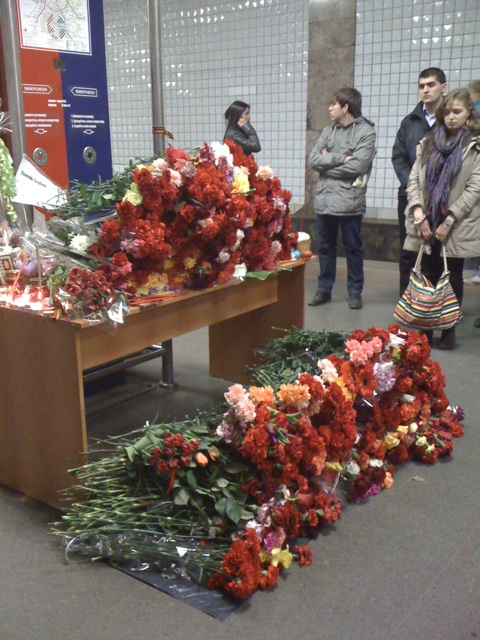
Flowers at Park Kultury subway station in Moscow - April 3, 2010 (image by Veronica Khokhlova)

Olga Allenova (LJ user allenova) is a special correspondent for the Kommersant daily, author of Chechnya is Close: War Through the Eyes of a Woman (RUS), a collection of the 1999-2007 war reportage from Russia's North Caucasus region. In the blog post (RUS) translated below, she writes about the March 29 subway bombings in Moscow and the 2004 Beslan school siege, the subsequent pain and trauma, and the resulting political and media responses.

Today a friend of mine [...] suddenly told me that she had been [avoiding subway and taking buses and other means of land public transportation] to work this whole past week. She works at [Kolomenskaya subway station], and lives at [Rechnoy Vokzal]. It takes her only 40 minutes to get from home to work. But since Tuesday, she's been leaving home two hours earlier - at 6 AM, that is - to be at the office by 9 AM.

I didn't get what she meant right away. That is, I could guess she was stressed out, like many other Muscovites, as a result of [last Monday's subway blasts]. But I didn't know her condition was that serious. And when I asked her why she was so sure something similar couldn't happen on [a bus], she started crying. And I suddenly realized that I had just told her a very cruel thing. The imaginary safety of land transportation was keeping her afloat, allowed her to continue going to work, to somehow plan her life. And now she was sobbing, saying this: "I can't live! I can't live! I can't descend into the subway! I can't look at the people!" And now I could understand her. I was in a similar state in 2004, in and after Beslan. Everything that used to give my life a sense of some universal justice had collapsed then. I couldn't sleep, couldn't eat or go out into the street. In front of my eyes stood black plastic bags, and the black women screaming above them. It's impossible to express this, the words that I'm writing now seem absurd. Even now I have a lump in my throat. I don't even remember how I got out of that. Many hours, weeks, I'd been talking to all kinds of people, friends, a priest, my husband, colleagues. It was then that I decided I wouldn't be seeing psychologists - they aren't of much help. They are just doing their job, staying outside - outside your pain.

Then a year passed, and I went to Beslan again. And again, there was this terrible hurt, and these symbols - white balloons over the school, white birds over the cemetery, an old woman saying tender words to a dove that chose to sit on her granddaughter's grave, children's faces on the cold gravestones, their teddy bears, their chocolates and cola. I'm a strong person, I know that. I've seen a lot in my 33 years. War, dirt, terrorist acts, corpses that no longer looked like people. I know that I've survived all that. But I know that deep inside I still haven't recovered from Beslan. I don't like to talk about it. I try not to think about it. Because when I do, I sob from despair, from fear. I sob because I still haven't understood why it happened. I sob the way my friend did today. She's just scared. There are many people like her now. People are scared to go inside subway. They are scared of women in headscarves, even though many of these women are Moscow natives. They are scared of their own fear. Fear is an enemy that destroys a person from within. If you are scared and you give up, the fear will take full hold of you. When I'm scared to go to the Caucasus, I realize that if I give in to fear and don't go once, I'll stop going there altogether - and I'll end up stuck at home, behind the closed doors, and I'll be scared even to pick up a phone. I know people to whom this happened.

I don't understand why they aren't discussing this problem on TV. Why there are no psychologists who would talk in prime time to people about the problems that are bothering them a lot. Not every person would agree to see a psychologist. Not everyone understands that it's a disease that requires treatment.

They'd tell me - what TV discussions do you expect when on the day of the attacks they didn't even air special newscasts on TV. I live in this country, so I'm not surprised. A year after Beslan, exactly on the anniversary, Moscow was celebrating its birthday. And when I wrote a text about it, outraged readers responded to me: "What, do you want us to forget our own birthdays, anniversaries, weddings?" My friend, by the way, was also celebrating her birthday on that day. And now she is sobbing from fear. It's just that at that time it all seemed too distant. And now it's very close. [...] And I'm not surprised by how the federal channels were covering the subway attacks. If you remember Nord-Ost [theater hostage crisis of 2002] and the live broadcasts on [NTV] - and what they did to NTV afterwards - it becomes clear that no live broadcasts are possible in this country under this regime. I'm not gonna get hysterical and scream about why the officials aren't showing me the truth - the way Beslan mothers did at one point. I simply despise this regime. I don't see them as authorities. For me, they are a cowardly bunch of people who couldn't even get out of the Beslan airport, but were sitting there, in the hastily set up headquarters (just in case, so that they could get out if the terrorists suddenly besiege the whole city) - at the time when the children were being shot at by tanks and grenade launchers. These same cowardly people were trying to convince the citizens whose relatives were taken hostage in the besieged Nord-Ost [theater]: "Colleagues! Calm down! All the terrorists are waiting for is for you to hold a rally on Red Square! We won't allow this!" A quote from [Valentina Matvienko]. They, of course, couldn't allow such a blow to their image. A rally against the war in Chechnya, and right on Red Square. Against the sacred and on the sacred.

I don't expect anything from these people. I even understand why they disliked the publications in the media claiming that the Moscow attacks were acts of revenge for the Caucasus. [Boris Gryzlov] is very displeased with hearing all the time about the regime's cowardliness. And about the mistakes they had committed but wouldn't admit to. [...]

But - again - this isn't what I wanted to say. I wanted to say that people need help. Professional psychological help as well as simple moral support from [family and friends]. If you have a friend who is scared to take subway, talk to him about it. Help him. Maybe you'll save him from trouble. We can only rely on ourselves, on our dear ones, on fellow citizens. Because there's no one else in this country that we can rely on.

Russia: Reflections on the Subway Bombings and Politics

Global Voices Online
Monday, April 5, 2010


It's been a week since the March 29 bombings on the Moscow subway, which killed 40 people and left over 100 injured. Below is a sampling from an ongoing discussion by Russophone bloggers.

LJ user matiutia wrote (RUS) about an encounter with Moscow police officers on the day of the attacks:

I'm on my way to work. One subway station is closed. I move to another one. At the entrance, I'm stopped by the cops. Six of them or so.

- Your documents.
- [Don't have them] (left them in another bag)
- Are you registered [here in Moscow]?
- [Propiska - the record of place of residence]. Bolshoi Karetnyi Pereulok.

(They talk to each other for a while):

- Detention until identification.
- Well, come on, she's alive, that means she's not a [suicide bomber], come on...

(To me)

- Any identification documents.
(I unbutton my coat, take out my [Christian] cross):
- The only ID that I've got.
- You're free to go.

LJ user dolboeb commented (RUS) on the official response to the attacks:

[President Dmitry Medvedev] has decided to spend some time fighting terrorism.

Considering the background of our jurisprudent, we should not be surprised that all countermeasures he has come up with are not practical (scanners, cameras, dogs, instructing the population, international cooperation), but exclusively legalistic. What's needed, it turns out, is to reconsider the articles in the criminal code that relate to terrorists, and the bad [shahids] will get scared right away.

"It is reasonable to revisit issues related to the proper administration of justice under terrorist legislation – under the 'terrorism' and related crimes article - and to talk about the need to improve such practices," said the head of state.

I wonder how it is possible to improve the practice of law enforcement under terror articles in order to punish, finally, those two female suicide bombers whose body parts have allegedly been found on Monday on the Moscow subway? How to optimize measures of penitentiary influence on the two [female suicide bombers] who blew themselves up [on board of the planes on August 24, 2004]? How should the articles in the [criminal code and the criminal procedures code] be corrected? Perhaps, some afterlife punishment provisions should be added to them?

[two photos of the dead perpetrators of the 2002 Moscow theater siege, also known as the Nord-Ost hostage crisis]

It would also be interesting to find out whether the extermination of the Nord-Ost [female suicide bombers] (who were killed while unconscious by shots in the head) helped obtain data on their accomplices, [those who ordered the siege], funding sources, or the circumstances of preparing for the terrorist act. Did the "improved practice" used on their commander [Movsar Barayev] (a shot in the head and a bottle of cognac placed into the corpse's left hand) help prevent [the 2004 bombing at Rizhskaya subway station], the double bombing of the planes that flew out of [Domodedovo airport in Moscow], and [the Beslan school siege]?

[...]

LJ user maratguelman wrote this (RUS):

Unfortunately, we do not trust the results of the investigations into the previous terrorist acts. We are either not shown these results, or we are shown the corpses of the terrorists. But practically, there hasn't been a single trial whose materials one can look at and say - "we understand who and why carried out this terrorist act." This is a fact. Hence the theories [implicating the Federal Security Service, FSB]. [...]

http://community.livejournal.com/ru_politics/28956469.html Here they are discussing why [the terrorists] aren't targeting FSB as they take revenge for [militant Said Buryatsky], but instead attack peaceful Muscovites. As if terrorism is a declared war whose goal is to destroy an opponent. It's not the opponents that they are after, but innocent victims. [...]

When Sasha Brener [performance artist Aleksander Brener], in response to the [invasion] of Chechnya, challenged [Boris Yeltsin] to a fight at [Lobnoye Mesto on Red Square], the police did not interfere for half an hour and only after all the [TV] cameras were done shooting him, he was arrested. When I was picking him up from the police department, I asked them - why? Why didn't they detain him right away - they couldn't have been scared of 50 students who stood in a circle around Brener. Their answer was this: well, maybe your crazy guy has just saved someone's life. They'll see over there in Chechnya that there is someone who is protesting against the war in Moscow.

[...]

LJ user yuozik made this political forecast (RUS):

[photo of president Dmitry Medvedev on the left, and of PM Vladimir Putin on the right]

Any terrorist act [...] is an operation carried out by special services. It may be carried out by a 50-year-old Chechen woman or even by a bear with a [balalaika] - not much difference. [...]

And today I'm interested in only one thing - whose special forces have been working today? Of the one who is on the left? Or of the one who is on the right?

[...] The algorithm of what happens next will allow us to understand just how horrible the current situation in the Russian Federation is. [...] Because no matter how sad it may sound, we've arrived to the point where the two heads of the eagle on [the Russian coat of arms] (also, a reference to the so-called Putin-Medvedev "tandem") are trying to devour one another to get on top.

[...]

1. If this was done by the new president's special services, then in the nearest future we'll see the weakening of the positions of [Chechnya's president Ramzan Kadyrov]. [...]

2. If this was the work of the team of the ex-president in co-authorship with the current president of Chechnya, then it is possible to expect a real bloodbath in the nearest months. [...]

Then the goal of today's terrorist attack is to intimidate the president of the Russian Federation and his young, reform-minded team. [...]

Russia: Two Video Scandals

Global Voices Online
Saturday, March 27, 2010


In Russia this week it has been hard to miss the two scandals that, at first, appear to have only one thing in common: both are centered around amateur videos published online. What they also share is, perhaps, the feeling of incredulity and disgust that the viewers are left with upon watching the videos, and, in many cases, the outrage.

One scandal involves opposition activist Ilya Yashin (LJ user yashin), political analyst Dmitry Oreshkin, and the Russian Newsweek's editor-in-chief Mikhail Fishman (LJ user mfishman): footage made with a hidden camera shows them allegedly attempting to bribe Moscow traffic police officers, and there is also a video of naked Fishman sitting next to a woman and sniffing white powder off a table. (For a succinct yet comprehensive English-language account of this video scandal, please see the March 23 text by author Michael Idov, published at The Daily Beast: Russia's Amazing Drugs and Hookers Scandal.)

The other scandal takes place in Irkutsk region, where high school students in the town of Shelekhov repeatedly beat up their 73-year-old female PE teacher and then posted the videos of these sparring matches on the web; the teacher reportedly had no memory of the beatings. (A short English-language Sky News item on this, with a video sampling, is here.)

Heated discussions that these two scandals have generated in the blogosphere and in other online venues are taking place on quite different orbits - which nevertheless do have one or two overlap points.

Below are some of the reactions (RUS) to a news item about the PE teacher incident, posted by users of Zavuch.info, a Russian teachers' portal and social network:

Persikotik:

[...] I think the school's administration had to take some urgent steps to avoid a situation like this at the school - instead of being embarrassed to "wash dirty laundry in public." And it is scary that such a video spent a few months on the web, as a tutorial for morons.

***

ann_dro_id:

If we don't stand up for one another, if we don't hold protest rallies, if we don't stand up for our right to defend our honor and dignity, they'll keep on pushing us around! Even drivers don't let themselves be mistreated [e.g., Vladivostok drivers' protest in Dec. 2008]. These are the times when a being a teacher is turning into one of the most dangerous professions. [...]

***

Gritsun Dmitry:

[...] where is it all going if a school employs a teacher who keeps being beaten but doesn't remember anything about it. I'm not saying that the age of 73 is a diagnosis, but memory loss does seem like a pathology. I'm not going to justify the students. Horrible!!!!

Nemiro Lyudmila:

[...] and what if there is no other PE teacher at the school? What then? Who is going to work on this job for such [a miserly pay]? Your suggestions???? Our school hasn't had new teachers right out of college in a million years. Not a single one. They work for a year and [then leave]. And we are SOCHI, no less!!! [Sochi is a Russian city on the Black Sea coast, which, among other things, is preparing to host the 2014 Winter Olympics.]

***

Viking

[...] We should keep up with the progress! Nothing scary is taking place. The young followers of the [Nashi and Walking Together pro-regime youth movements] are practicing techniques of fighting against pensioners' rallies in the future, following instructions from the [ruling United Russia party]. [In Oct. 2009, Russian riot police used - during a drill - “water cannons, shock grenades, and tear gas” to disperse “a group of senior citizens that protested social injustice and blocked a federal highway.”]

***

Biokhimik:

[...] We should keep this situation under CONTROL. Where are the trade unions, where are the human rights activists? (I haven't just cursed, have I?) [...]

And here is a selection of posts on the Yashin/Oreshkin/Fishman affair.

Opposition activist Marina Litvinovich - LJ user abstract2001:

The day before yesterday, a user with an eloquent nickname kanal911 registered an account on YouTube - in order to post this video:


In this video, Oreshkin, Yashin and Fishman are trying to bribe [traffic police officers].

In my opinion, the footage is real, was done by [traffic police officers] themselves. The only question is - are they videotaping everyone like this or just some, those who have been "pointed out" to them? [...]

It is clear that due to the public movement against the police and [traffic police] these service have now gone on the offensive. And it's clear that the easiest way to fight the "oppositionists" is to catch them giving bribes themselves.

This, my friends, is exactly why whenever I write about the lawlessness of the cops and [traffic cops], I do this with clear conscience. And I've emphasized this multiple times - I do not just criticize those who give bribes, I call on you not to give bribes and I myself do not give bribes. I'll be honest - I stopped bribing [traffic police officers] after my trip to Beslan [a town in North Ossetia where the 2004 school hostage crisis took place], when I learned that the terrorists paid a bribe to pass one of the [traffic police] checkpoints. [...]

Mikhail Fishman, editor-in-chief of the Russian Newsweek - LJ user mfishman:

[...] A special operation has been carried out against me. It has been thoroughly planned. It was based on provocations, deceit, editing and long-term shadowing, and law enforcement officials participated in it. Who exactly and on what grounds is a separate question. It was carried out a long time ago, and now it has turned into a campaign.

Those who organized this campaign have succeeded in some things. Namely, they've poured a dirty puddle around me - and around themselves: they've dragged many decent people into a mean and petty discussion of someone else's private life. In the language of political technologies this is called the lowering of the discussion level.

This is a result, but not the one that they were counting on. The point of it was different: to force me to alter the editorial direction of the magazine that I'm in charge of. [...] This is a signal to all journalists: sit quietly.

I'm responding on behalf of our team: no, we will continue working the way we did before. Topics, stories, the principles and standards of our work will remain unchanged. [...]

Olga Allenova, special correspondent for the Kommersant daily - LJ user allenova:

[...] And the most disgusting thing is that Fishman has nothing to respond to this with? File a lawsuit? Against whom? A statement has to be submitted to the prosecutor's office, of course. [...] No one has canceled the right to private life in this country yet. [...] And THIS can happen to any human rights activist, journalist, politician, even regardless of whether it's him or not featured in this footage. This can be done to anyone who, for some reason, displeases [a top aide to the Russian president and PM Vladislav Yuriyevich Surkov], for example. You are responsible for this, Vladislav Yuriyevich, aren't you? Or, to be more precise, your Young Guardists [members of the Young Guard of United Russia, the youth wing of the ruling United Russia party]? [...] Who is the next one on your list? And aren't you afraid that eventually you'll find yourself on it, too?

Political activist Aleksey Navalny - LJ user navalny:

[...] Seriously though, I think that Yashin, Fishman [...] should not leave it as it is. Instead, they should start a decisive campaign against those who ordered this crap. Because it's a total mess. Next thing you know, they'll install hidden cameras inside apartments.

I think a campaign for the European and U.S. entry visa ban for Surkov [and his associates] looks rather realistic. [...]

[Sochi. Sukhumi. Skolkovo.] There many good places for recreation outside the EU.

It may work out, if we approach it seriously and don't drop it halfway, as is usually done by our human rights activists and liberal politicians.

The Young Guard has denied its involvement in the scandal, however:

[...] Finally, once more, for the idiots, in big and fat letters: "THE YOUNG GUARD DID NOT ORDER OR AUTHOR THE VIDEO ABOUT FISHMAN. WE DECISIVELY CONDEMN SUCH METHODS OF POLITICAL STRUGGLE. [...]

Maxim Kononenko - LJ user mrparker:

[...] I'd also like to support Fishman. A [KGB] provocation against Yashin and Oreshkin - that's normal. Yashin is a politician. Oreshkin is a grant-eater and traitor. These people are screwing my state, and the state is screwing them in return. That's a genuine and mutual hatred.

But Misha Fishman is the creator of meanings. A very good one. And to fight such opponents is possible only using the same methods that these opponents are using - i.e., with meanings. A meaning vs a meaning. A text vs a text.

But definitely not whores with cocaine vs a text and a meaning. A meaning isn't equal to cocaine, and a text isn't equal to a whore.

But an image isn't equal to a meaning and a text, either. This is why I suggest that everyone who supports Fishman (and I hope that this would be every normal journalist, author or media professional) records [his/her] own video with white powder and post it on YouTube.

[...]

LJ user ma79 is one of the Russian bloggers who has responded to LJ user mrparker's call and posted a video of himself and "white powder":


[...]

I wanted to wash my hair before shooting this video, but then decided it wouldn't be authentic that way.

Ukraine: Tons of Fish Die; Fishing Enthusiasts Start Grassroots Campaign

Global Voices Online
Wednesday, March 24, 2010


Numerous volunteers and fishing protection agency employees worked hard for over a month this past winter, breaking the unusually thick ice that covered the Kyiv Reservoir, enriching the water with oxygen - in order to save the fish in the reservoir from suffocating. When in early March the ecological emergency seemed to have almost passed, it turned out that these people's efforts had been in vain: hundreds of tons of fish ended up being trapped and crushed to death by the ice, after Ukrainian authorities, in an attempt to reduce the impact of an anticipated spring flood, abruptly lowered the level of water in the reservoir, which is located to the north of the Ukrainian capital and known locally as the Kyiv Sea.

Some experts doubt whether such a drastic measure was justified and consider the damage done to the reservoir's ecosystem catastrophic. Also, as the dead fish is beginning to rot, the quality of Kyiv's residential and drinking water supplies may, at some point, be affected (RUS).

In the wake of the disaster, a group of Ukrainian fishing enthusiasts who frequent Rybalka.com (Fishing) - "an interactive portal for fishermen and hunters" (UKR, RUS) - launched a grassroots campaign to "consolidate experts and scientists (ichthyologists, hydrobiologists, ecologists), as well as active representatives of the fishing community" - and to ensure that further damage is avoided and the government takes steps to restore the ecosystem of the reservoir as much as possible over the next few years.

Ihor Tykholaz, an employee of the Kyiv branch of the state fishing protection agency and one of the initiators of the campaign, whose nickname is dozvil, wrote about the natural emergency made worse by the negligent and corrupt authorities (RUS) on his Rybalka.com blog - and posted some photos there as well:

[...] For over a month, hundreds of people were working on the Kyiv Reservoir suffocation problem, breaking ice in three steps: manually, with ice axes, with chainsaws; they were making thousands of holes with air filters made of canes, they were drawing air under the ice with compressors, pouring water over ice into the holes, [...] deforming the ice cover.

[...]

We managed to stabilize the situation by the beginning of March, the level of oxygen in some spots even began to rise. And the thaw and melted water gave hope that [...] it would be possible to avoid the death of fish!

But [warm weather] brought with it a trap for dozens or perhaps even hundreds tons of fish. Schools of fish began moving towards fresh water - the so-called "sweet water" - enriched with oxygen due to the melting of snow, the water that started to appear in the shallow parts of the reservoir (and shallow waters make up 40 percents of the reservoir's water space, approximately 50,000 hectares). In that desperate situation that was the only option for the fish: at the end of winter, fish migration always occurs in the areas with higher levels of oxygen in the water...

And here a soulless bureaucrat was waiting for the fish, someone who signed the decision to drain water from the reservoir to the level that was even lower than the "dead point." An explanation: the usual average water level in the reservoir is 102.5 meters (above the level of the Baltic Sea), the "dead point" is 101.5 meters (below this mark, irreversible processes start taking place in the [water ecosystem]).

We wrote dozens of appeals to all kinds of authorities, spoke at all meetings about the situation with the flooding, but no one listened to our advice and requests.

[...]

It was all in vain, because at stake was the safety of rich [real estate developers]: the flood is ahead of us, and owners of the legendary Koncha-Zaspa mansions [expensive real estate south of Kyiv] perhaps fear it more than others. We aren't likely to ever find out who lobbied the interests of [the owners of] these elite plots. But there was pressure on members of the inter-departmental commission, some of its members told me about it [off the record] (I personally took part in two of these meetings).

[...]

Then it only gets worse. The inter-departmental commission of the [state water agency] decided to lower the level of water in the reservoir to 101 meters by April 1 - i.e., even lower than the "dead point" - what awaits us??? This cynical slaughter of the fish is taking place with the silent approval of dozens of officials who seen nothing but paperwork in their offices and jump up when their bosses call them on their phones... This half a meter will simply kill whatever remains alive [in the reservoir]...

This is truly a planned ecological catastrophe [...]. [...]

The fishing enthusiasts' campaign initially started online - in this thread (RUS, UKR) on Rybalka.com, on March 15; as of now, the thread is 34 pages long. Some 70 people have now joined the campaign's Organizing Committee, following an offline meeting in Kyiv on Saturday, March 20 (photos on user vladf's Rybalka.com blog; video and some paperwork (UKR, RUS) on user org's blog). An online petition (RUS) - "Save the Future of the Kyiv Reservoir" - has already been signed by more than 1,400 people. An appeal to the country's leadership has been drafted; outreach and fundraising efforts are gaining speed.