Showing posts with label [larinax]. Show all posts

Russia: Lenin's Mausoleum

Global Voices Online
Wednesday, November 15, 2006
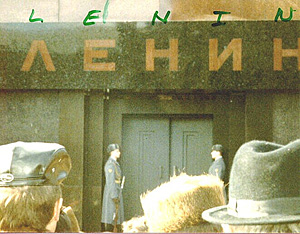


Lenin's Tomb, Moscow, USSR, 1985 - by JoeBlogger

Three months before the collapse of the Soviet Union, the legendary "sound-manipulator" Sergei Kuryokhin proved quite convincingly (albeit facetiously) that Vladimir Lenin had been a mushroom and a radio wave.

Kuryokhin died on July 9, 1996, at the age of 42. His widow explained what had inspired him to expose "the leader of the world proletariat" the way he did (RUS, Komsomolskaya Pravda, Aug. 18, 2005):

[...] Sergei [Kuryokhin] once saw a program on [Sergei Yesenin]'s death. The author of the program was supporting his claim that the poet had been assassinated with some absolutely absurd things. They were showing photos from Yesenin's funeral and saying this: "Look where this man is looking, and this one is looking in the opposite direction, and this means that Yesenin was murdered..." Sergei watched the show and told me: "This way, you can prove just about anything." [...]


On Nov. 7, 2006, eighty-nine years since the 1917 Lenin/mushroom-led revolution, which resulted in the birth of the Soviet Union, LJ user valkorn posted links to the 32-minute video of Kuryokhin's famous prank (RUS, here and here), originally broadcast on May 17, 1991, on the Pyatoye Koleso ("The Fifth Wheel") TV show, in the city whose name would change from Leningrad to St. Petersburg on Sept. 6, 1991.

Like Leningrad, cities and streets have been renamed, some of the Soviet history got erased, but Lenin still lies in his Mausoleum in Moscow's Red Square, in relative obscurity most of the time. Recently, however, a little bit of a spotlight fell on him due to the renovations about to take place in his abode.

LJ user warsh writes (RUS):

Interesting fact #2088

[Radio] Ekho Moskvy reports that Lenin's Mausoleum is closing down for a month and a half for [restoration work]. Experts say that "scheduled biochemical work" would be carried out in order to preserve the leader's mummy. Thanks to the newest scientific achievements, Lenin's body, embalmed in 1924, can last many more years. The revolutionary leader only needs to have his suit changed. The state used to fund [preservation work] at the Mausoleum, but now the money comes from one of the scientific funds.

Reminds me of Knyshev: "on this day many years ago, the brain of the Secretary General of the CPSU's [Central Committee] refused to cooperate with the organs."


Since the state can no longer support Lenin, bloggers suggest ways to make the Mausoleum profitable:

stereobase: Lenin's Mausoleum is closing down for a month and a half and will be temporarily re-equipped to provide tire replacement services to drivers, due to the enormous workload that such services are currently suffering.

warsh: ...and due to the high death rates on the roads.

tchnr: They should make the Mausoleum self-reliant. [One way] is to borrow suits from popular boutiques and fashion designers, and charge them for advertisement. Change suits almost every day, using imagination. People will no doubt queue to see [Lenin] dressed like Elvis or in a [civil war military outfit]. There should be an entrance fee.

Or they should finally bury the corpse like human beings do.

warsh: Why don't you draw up a business plan. And toss it over the cogged [Kremlin] wall.


LJ user larinax is also wondering (RUS) what could be done with Lenin and his tomb:

Kuryokhin proved that Lenin was a mushroom and a radio wave (a masterpiece of a show with Sholokhov in 1991!).

Stas Namin's idea was to take Lenin's mummy around the world like that of Tutankhamun, before he is buried (real income for the Motherland! we'd earn billions).

Marat Guelman (if I'm not mistaken) served Lenin as an 80-kg cake (by Yuri Shabelnikov), which was devoured with pleasure with spoons by those who were invited for the act (in 2000, I guess, and Marat should correct me if I'm wrong).

It was Yeltsin who was supposed to bury him - at that time, no one would have made a sound. Though no one knew where [to bury him] - Volkovo cemetery didn't want him then and doesn't want him now. [...] "When a decade and a half ago they first began talking about burying [Lenin] at Literatorskie Mostki," writes Ogonyok, "the then head of the [cemetery] rebelled. 'Do you want him to keep getting exhumed all the time?" Mr. Mishchenko kept asking rhetorically. "Do you want us to begin every morning with searches for the body: where is it today?"

Bulgarians did away with their corpse (Dimitrov's Mausoleum) immediately and without referendums - leveled it, period. And Dimitrov's body was cremated and re-buried in his parents' grave.

After the "velvet revolution" in Czechoslovakia, the mausoleum was closed and the bodies (there was a bunch of them in there) were re-buried.

In Albania, they re-did the mausoleum into an international cultural center.

Russia: Independence Day Surveys

Global Voices Online
Tuesday, June 13, 2006


One day after Russia marked its Independence Day, LJ user larinax - Ksenia Larina, Radio Ekho Moskvy host - found herself mystified by the results of a survey conducted on one of the Ekho shows (RUS):

[...] To the question "Where would you like to live? - In the Soviet Union or in today's Russia?" 62 (!!!) percent of the audience responded - in the Soviet Union. I find it incredible. And no nostalgia, and no protest against Putin will ever make me choose this road to darkness. I wonder if the internet voting will be different. It's a different audience, after all. Though young people, too, shock me by their delusional notion of the USSR. And no documentaries, no feature movies will ever convince them of the opposite. [...]


Here is the tiniest fraction of the responses that Larina's entry drew (139 so far):

daisy_gorgeous: I was both surprised and not by this percentage. But there used to be good things, too, Ksenia! I talked to a friend in the States the other day and he gave me a mathematical proof that, despite all the minuses of the structure of the USSR, despite the nonsense of [having to be like everyone else], etc., the idea made lots of sense. :) [...]

larinax: You know, there used to be this cartoon - bum-looking, emaciated Marx and Lenin are begging for money in the street. Marx tells Lenin dreamily: "But still, the idea was indeed pretty good!.."

[...]

elesin: Strange the figure isn't 95 percent. People want to be 20-30 years old, not 40-50. Everyone was younger in the USSR.


LJ user drugoi cites another survey whose results are even more mystifying (RUS). The survey was conducted by the Yuri Levada Center; 1,600 Russians, aged 18 and older, were surveyed in 128 cities and towns, 46 regions):

Six percent of the Russians expect Russia to win the World Cup in Germany.


These are some pretty high numbers, considering that Russia is not playing in the World Cup at all this year.

Below are some responses:

mikheich: And we expect Kazakhstan to win!!!)))

drugoi: I'm for Norwegians.

yulchataj: Since you're at it - TURKEY - FOREVER!!!

[...]

In one Astana backyard, there's a terribly moving graffiti on the drain pipe, still there from the previous World Cup: "Kazakhstan - Brazil 8:0"

deodan: Imagine: what if Russia does win!:)

lenkins: It's already won :)

quappa: Russia won't lose in a single game - isn't that victory?

[...]

duke-igthorn: Ireland - go go!

stormoff: This means that 6 percent of the Russians have a good sense of humor.

[...]

d-falcon: Russia is represented by only one person at the World Cup: V. Ivanov, a referee, we all place our hopes on him :-)

[...]

pechenie: In a way, our team has as many chances as it did during the previous World Cups.


And, finally, this response, most likely, sends the readers back to the Russia vs. Soviet Union survey:

radiocat: Not much. It would've been logical if 40-60 percent were expecting this - I'm judging by some other surveys.

Russia: Tear of Grief; Intro to Orthodox Culture

Global Voices Online
Wednesday, September 13, 2006


In Moscow, Zurab Tsereteli's works seem ubiquitous - and disliked by many. In New Jersey, his first one was dedicated on Sept. 11 in Bayonne: a gift from the Russian government, the 100-foot, 175-ton bronze monument "To the Struggle Against World Terrorism" - aka the Tear of Grief. High-profile guests at the dedication ceremony included former U.S. President Bill Clinton and Chair of the Upper House of the Russian Parliament Sergei Mironov; a note from President George W. Bush was read by U.S. Homeland Security Secretary Michael Chertoff.

LJ user larinax (Ksenia Larina, Radio Echo of Moscow host) has no kind words (RUS) about the monument and its creator - and the fact that Tsereteli used an outdated list of names of the 9/11 victims doesn't help: 43 names of those who were not killed have been carved into the monument's base:

What horror has Tsereteli [squeezed] into New Jersey! It looks extremely indecent. And this is what poor Clinton has hinted at unambiguously: "It's impossible to ignore Tsereteli's sculptures in Moscow." Thirty meters tall, weighs 175 tons. All material, transportation, setting up and fixing has been funded from the Russian budget. He dreamed of [giving] this [monster] to New York, but the city turned around and ran from such a generous gift. He's messed all the last names on the mournful list on the [monument's] base (more than 40 have nothing to do with reality!) And he laughs loudly into the cameras. Shame for the whole world to see.


Bloggers commenting on larinax's post appear to be no less cynical and even more straightforward: some call the teardrop soplya, a snot, while others write that the monument reminds them of a female body part. LJ user ivan_agurov, however, thinks that the Tear of Grief will become part of the landscape eventually:

They'll get used to it. And in 200-300 years, tourists from faraway countries will be coming over to stare at "soplya." Just like they stare at the Statue of Liberty and the [Eiffel] Tower in Paris.


***

LJ user larinax is also highly critical (RUS) of the inclusion of the compulsory Orthodox Christianity courses into school curriculum in Russia's four regions: Bryansk, Kaluga, Smolensk and Belgorod (in 11 more regions, Introduction to Orthodox Culture will be taught as an elective subject):

[...] Once again, good intentions turn ugly, just like everything else touched by the dumb, illiterate herd of our bureaucrats [...]. Is there a need for a separate course on the history of religions and cultures? It's necessary to have one. In what form? As an elective, voluntary, without grading and exams, in the form of conversations and lectures. Who should be teaching it? Definitely not members of the clergy. Though... Do the current ones have the likes of [Aleksandr Men] in their ranks?

I've had a look at A. Borodina's OPK [Osnovy Pravoslavnoy Kultury, Introduction to Orthodox Culture] course. Openly xenophobic, semi-literate reading, stuffed with quotes from Dostoyevsky (torn out of context and thus acquiring horrendous meanings). [Joseph Goebbels] with his propaganda [cannot compare to this]. I feel embarrassed and [disgusted] when I read these simple thoughts addressed to Russia's schoolkids:

"People not familiar with the basics of Orthodox culture have many questions regarding the Russians' attitude toward other nations and to the material world. Why do patriotism of the Russian people and their dedication to the [Orthodox Church] go so well together with tolerance of other religions and a certain indifference toward material losses? Why is it that Orthodoxy doesn't force anyone into converting into Orthodox faith - and is at the same time so open? Why is it that Orthodox Russians don't shut themself off from people of other nations and ethnicities, but accept them heartily into their church, state and civil community, even though it is not "profitable" more often than not? Perhaps, the Orthodox Church and the Russian people carry inside the ideals that are incomparably higher and more significant than the instantaneous profit, material values and earthly life. But it is only possible to understand it after studying the history of Christianity and the basics of Orthodoxy. The notions of "Russian" and "Orthodox Christian" used to be inseparable in [Russia] until the 20th century, and they shared one meaning: those belonging to the Russian Orthodox culture." (A. Borodina)