Showing posts with label [remetalk]. Show all posts

Ukraine: Bureaucracy and Incompetence at Defense Ministry

Global Voices Online
Saturday, December 12, 2009


Sergei Maximishin (LJ user remetalk), an award-winning Russian photographer, has recently tried to get the Ukrainian defense ministry's assistance in doing a photo story on the Ukrainian navy and army for the German Stern. He and his colleague, Stern's correspondent Tilman Müller, ended up defeated by the Ukrainian bureaucratic monster. On his blog, Maximishin has posted a detailed account of the ordeal (RUS; the dialog parts of the post are in Ukrainian):

[Sergei Maximishin's photo from Sevastopol]

Spent two weeks working in Ukraine - together with Stern's correspondent Tilman Müller [who was doing the writing], we were working on a large overview story about the country. Politics, economy, the army, religion, culture, sports, Euro 2012, the upcoming election, the Russian fleet, swine flu, ultra-right forces, social issues, everyday life. St. Petersburg-Moscow-Donetsk-Kyiv-Lviv-Kyiv-Donetsk-Kyiv-Sevastopol-Kyiv-St. Petersburg.

Before we started working, we met with the editor of the English-language newspaper [Kyiv Post] - and asked for advice: how to get here, and how to get there. To the question on how we should go about shooting something about the Ukrainian army, this wise man recommended not wasting energy and time - it's not going to work anyway.

Overconfident, I neglected this advice and started calling Mr. Khalyavynsky - "head of the press service of the Ministry of Defense of Ukraine." For three days, [he] wasn't there, and, asked how it was possible to get in touch with him, his secretary replied, "How would I know?" On the third day, the secretary had mercy on us and gave us his fax number. I wrote a letter in English, asking to help us with shooting on two objects: we were interested in the Ukrainian fleet based in Sevastopol and the Kyiv-based honor guard unit. Emailed the letter to Hamburg, asked to print it out, have the managers sign it and fax to Kyiv.

A day later, I called the press service again:

- Good afternoon, my name is Serhiy Maksimishin, photographer with the Stern chronicle, Germany. I'd like to ask if there's been any reaction to our fax letter.
- What fax letter? There haven't been any fax letters from Germany.
- What do you mean there haven't been any? Our newsroom said they had sent one yesterday...
- They couldn't have sent anything, because we couldn't have received anything.
- How come???
- Because we've been out of fax paper for a week already.
- Oh God, when will you get it?
- Actually, we do have it, but the person who knows how to insert it isn't here.
- And when will this person appear?
- Call us back on Monday, maybe someone will show up...

I call them Monday. Fax paper has been inserted. I call the Germans, ask them to re-send the fax and confirm via phone. The Germans call back, say that everything has been sent. I call the press service.

- Ms. Svitlana, this is Serhiy Maksimishin again, photographer with the Stern chronicle, Germany. Tell me please, have you received our fax?
- Yeah, some kind of thing has come through...
- What do you mean, "some kind of thing"???
- Oh, but it's in a foreign language, so who can read it?..
- What, not a single person in the entire press service knows English??? Aren't you ashamed?
- Well... Hold on... I'll ask...

Five minutes later:

- No, the head [of the press service] said Stern should send a letter in Ukrainian.
- May I translate it myself?
- Hold on.

Five more minutes:

- Mr. Khalyavinsky says that, as an exception, you may come over to our office and translate it here.

Tilman and I take a ride across the city to the press service. We find ruins there: the impression is that they started doing renovations some two years ago, and ran out of money a year later. First of all, Svetlana the secretary demands to see our foreign affairs ministry accreditation cards. Tilman had left his at the hotel. The secretary says no one would bother talking to him without accreditation. I say that since I do have accreditation with me, let the boss speak with me. The secretary disappears behind her boss' door. Then comes back: the boss said that if you've come together, there should be two accreditation cards - otherwise, there'll be no conversation. Tilman calls the hotel, asks the receptionist to go up to his room, find the piece of paper and fax it to us. Fifteen minutes later, the accreditation gets out of the fax machine. The secretary asks us to show her our passports. Spends a long time comparing photographs to the originals. Finally, she hands the letter faxed from Stern to me, as well as two sheets of paper, and asks me to do a written translation of the text. I ask her where I could sit down. "Right here" - she brings a chair to the construction trestle in the hallway. She doesn't offer a seat to Tilman. I begin translating. [She] glances over my shoulder and protests: "Why are you translating into the Russian language? The boss said it should be in Ukrainian!" I start over, this time in Ukrainian. Who the hell knows what "honor guard unit" is in Ukrainian. At last, I give the fax letter and the hand-written translation to the secretary, she takes it behind the door covered with black fake leather. Ten minutes later, we are allowed to proceed to Mr. Khalyavinsky's office. Judging by how well-fed [he] is, his rank must be no lower than lieutenant colonel; he doesn't get up from his desk, is hiding his feet in blue rubber slippers under the table.

In English, Tilman delivers a ritual spiel about Stern and its 8 million readers. I translate it into the nightingale language [Ukrainian]. Khalyavinsky shines with friendliness. [He] barely speaks Ukrainian, gets the words mixed up. Apologizes for this, says that he has spent his whole life as a correspondent with the [Russian/Soviet] Northern Fleet newspaper, and now he is forced to learn Ukrainian anew. Says that he'd be happy to help us, but he's surprised why such experienced journalists of such an esteemed magazine don't know the basic things and have taken the wrong path. The right path, according to Khalyavinsky, is this: "Let the Germans talk to their military attache, who has to write a letter to Mr. Miroshnichenko, head of the defense ministry's committee for international cooperation, and Mr. Miroshnichenko has to issue a resolution and address it to the minister [of defense], and then the minister would give orders to Khalyavinsky, and then there'll be no problems whatsoever, work as you please."

Tilman called the German embassy right from [Khalyavinsky's] office, they spend five minutes looking for the attache, the German spends a long time explaining "the right path" to his compatriot, then hands over the phone to Khalyavinsky, who, once again, this time in Ukrainian, describes the trajectory of paperwork. The attache promises to help. As I say good-bye, I ask Khalyavinsky for [his] cell phone number and that of Mr. Miroshnichenko, whom I'm not acquainted with - "head of the committee for international cooperation." The attache calls the next day, says that he's sent the letter out, but doubts this will bring any results. One day later, I call Khalyavinsky - he says that "unfortunately, the minister [of defense] has fallen ill" and recommends calling Miroshnichenko. Miroshnichenko's phone is turned off. I call Khalyavinsky on his cell phone again: "The number you are trying to reach is unavailable at the moment." I call Svetlana on her landline phone:

- Mr. Khalyavinsky isn't there.
- When will he be in?
- How would I know?

All this, for an entire week.

We ended up deciding to fly to Sevastopol and shoot whatever's available. At the embankment, I hired a boat for 450 hryvnias [approx. $56] and, for 100 hryvnias [$12.50], two midshipmen of the Russian Navy, who promised to show us all the Russian ships, including the fleet's flagship cruiser Moskva, which is currently laid up at a floating dock. Already on the boat, I ask the midshipmen:

- And where is the Ukrainian fleet stationed?
- Ah, it's not here, they've all gone to Bulgaria for tomatoes, - the midshipmen laugh at their own joke.

P.S. If some of you think that the Russian defense ministry's press service employs a different type of people, you are mistaken.

As one of my acquaintances used to say, "we are working from inside a tight circle of [morons]."


In one of the comments to Maximishin's post, Kyiv-based LJ user vi_chanceux wrote (RUS) that he was ashamed for his country, which is "ruled" by such incompetent individuals. Maximishin responded:

You shouldn't be ashamed for the country: the country and the state are different things, but alas, not everyone understands this.

Russia: Roma Wedding and Christmas

Global Voices Online
Friday, January 26, 2007


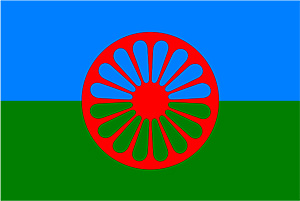
The flag of the Roma people. According to Wikipedia, it "was approved at the First World Romani Congress in 1971, held in London, UK. The flag consists of a background of dark blue and green, representing the heavens and earth, respectively. The flag also contains a red chakra, or spoked wheel, in the centre, representing the Indo-Aryan heritage of the Romani people."

Of the 8 to 10 million Roma people living all over the world today, more than 180,000 live in Russia. Photographer Tanya Kotova (LJ user tanyakotova) has recently posted two wonderful photo stories about the Roma population of Peri, a village located not far from St. Petersburg.

The first entry contains 15 photos and this text about a local wedding celebration (RUS):

"Tabor" [the camp] is how the Roma call their settlement in the village of Peri. They moved here from Moldova over 30 years ago. The local government built houses for them - a whole street named after cosmonaut [Yuri Gagarin]. Then the relatives of the Roma arrived, and relatives of the relatives, and the houses expanded... Currently, over 500 Roma families live in Peri. Live is tough here, but also bright and unusual - a true [Emir Kusturica] movie. Women's dresses of incredible beauty, the kids' curious black eyes, golden teeth of honorable men and silver threads in the long braids of the elderly - the endlessly beautiful old gypsy women. What's striking is the open-mindedness and hospitality of the young housewives with little kids in their arms, how they welcome you into their houses. Here, people smile a lot more often than they are sad, though they face a lot more everyday problems than their Russian neighbors do.

[...]

The Roma born in the village have never been to the motherland of their ancestors, but they treasure the traditions of the Moldovan Roma: they speak the Moldovan [Romanian] language and interlace their hair with red ribbons during weddings...

The Roma don't marry for love. Their fate is determined by their parents. The wedding is paid for in full by the relatives of the groom. They buy food and alcohol, prepare gifts for the relatives, dress the bride up. Moreover, they pay a big enough dowry to the bride's parents. After the ransom has been paid, they begin to prepare for the wedding.

They cook lots of food, since the whole tabor will be celebrating the wedding. They begin to eat, drink and have fun in the morning. A red flag is hung outside the house - a Roma wedding symbol. Also, every guest at the wedding gets a red ribbon, too.

The most solemn moment is when the wedding dress is carried out of the groom's house. A crowd of women and children runs towards the bride's house, holding with the snow-white dress, yelling "Hurray!" and opening champagne as they run. Once there, they stand tightly around the bride, the women dress her up, make her hair, put on old jewelry on her.

First, everyone has snacks at the bride's house, and by the evening the guests move to the grooms residence. Tables are about to collapse from all the bottles of champagne, vodka and other beverages. Plates with fruit and meat are everywhere. But the Roma drink very little, they raise their glasses only symbolically - to the newlyweds' health and to the birth of many children in the new family.


And - a tiny post scriptum in response to a comment:

tanyakotova: [...] By the way, I've learned today that they got this boy married recently. Just imagine, at the age of 12!!! The Roma found an eye doctor somewhere (the boy has big problems with his eyes) and the doctor said that the kid needs sexual life, so that the blood flows away from the head, and this should improve his vision :-)) Urgently, they brought a bride from Chudovo for him, a little bit older, and it happened. Yesterday I saw him, a child like any other, attends school, grade 4, and he probably still doesn't understand what's happened to him :-))


The second photo report shows how the Roma celebrate Christmas (RUS, 14 photos):

tanyakotova: This is how the Roma celebrate [Orthodox Christmas]: they lay the tables but no one really touches anything on them - it's like a shop window. They start cooking on [Jan. 6] and celebrate on [Jan. 7], but the peak of the celebration is Jan. 8. They dress up in the early morning and spend the whole day walking from house to house, congratulating each other and giving each other gift, yelling "Ure!" I asked why "ure" and not "ura" [Russian for hurray], and the kids told me that "ure" is "ura" repeated many times over :-) Christmas and Easter are the most favorite holidays. They buy presents half a year in advance. Dresses, jackets, sweaters, headscarves. And, of course, bottles of beer and champagne.

dervishli_duzu: So is it just a day for celebration to them or do they attend church service? If yes, where do they go? I'd like to watch )

tanyakotova: No, they don't go to church. The celebration goes exactly the way I described it above and it takes place on Jan. 8. They go to church (in Devyatkino) for Trinity, to baptize children. Sometimes on Epiphany, but it's cold then, so more often on Easter. We did take some photos there, but the light was very bad :-(


***

Notes:

- Tanya Kotova is a student of the award-winning Russian photographer Sergei Maximishin (LJ user remetalk), who was mentioned in a Global Voices translation in June 2006 - here.

- I found Tanya Kotova's blog thanks to a link in kunstkamera's LJ; kunstkamera's photos and text on the Nenets people were featured on GV earlier this month - here. She also has an absolutely unforgettable series of photos from the Republic of Georgia - Encyclopedia of Georgian Life - here and here (each entry has more pictures under the cut).

- LJ user gipsylilya runs several Roma-related LJ communities (RUS): romanykultury, freegipsyschool, and romanopedia.

- These English-language LJ sites are about the Roma people as well: Roma (Gypsies) and Friends, Romani Legend and Culture, and Romany Women.

Russia: Limonov and Copyright

Global Voices Online
Friday, June 2, 2006


Russia is notorious for its disregard for copyright laws. According to anti-piracy organizations, it is the second-biggest source of pirated software, music and film in the world. China is the first.

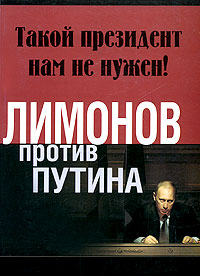
The discussion translated below (RUS) takes on the issue of piracy in a somewhat ironic vein: Sergei Maximishin (LJ user remetalk), an award-winning Russian photographer whose brilliant work appears regularly in many leading publications, discovered that one of his best-known photos - an ambiguous portrait of the Russian president Vladimir Putin - was used without permission on the cover of a book by one of the most controversial Russian politicians, Eduard Limonov, founder of the National-Bolshevik Party. The book's title is "We Don't Need a President Like This: Limonov vs Putin."

The irony is that trying to sue Limonov or his publishers would, in a way, be like casting the first stone: Maximishin admits to having used unlicensed software himself - simply because he, like the multitudes of other Russians, couldn't afford the licensed product.

remetalk:

About theft

limonov\'s book cover

The cover of Limonov's book. I think this picture of mine has already become a folk picture [author unknown; in public domain].

[...]

At Moskva bookstore, [a 1 m-by-60 cm poster] in a golden frame was on sale last summer. I asked: So, are people interested? The seller said: It sells like pasties!

Communists pasted this image onto a cardboard, attached a stick to it, drew Hitler's mustache and an armband with a swastika and carry it around as an [Orthodox Christian banner] at rallies.

And someone sent me a link to the site where the persona is wearing a baseball hat with the McDonald's letter on it and there's a bubble coming out of his mouth with the words, "This cashier's free!"

[...]

fresquete: Isn't it like the highest reward for a creator when his creation [becomes familiar to everyone]. :))))) Seriously, though, have you tried to fight [this outrageous behaviour]? And is it possible to fight it at all?

remetalk: This is exactly what I'm talking about. I'll start suing when I buy myself Photoshop for $700. And for now I think that those who steal, don't pay, and those who pay, don't steal.

[...]

kostiki: Two hundred years ago historian Karamzin visited France. Russian emigrants asked him:
- In two words, what is going on at home?
Karamzin didn't even need two words.
- Stealing, - he replied...

P.S. Perhaps if [copyright law is respected], you'd be able to afford not just the licensed Photoshop, but [everything else]?

aka_lacerda: It's not about Photoshop specifically, but about the general situation in the country. As long as every computer has stolen Windows and Photoshop, any other intellectual property will be stolen just as well. They don't realise it yet. And aren't likely to anytime soon.

[...]

onemorepash: The game is called "Find your own way to talk Maximishin into suing Limonov." Photoshop, GIMP, [$]700, [$]300... maybe there are people out there who, for this purpose, are ready to buy Sergei Yakovlevich [Maximishin] Photoshop? :))

bpatuiiika: I can steal it and give it to him as a gift. Then it'd be a "presented" copy [not stolen].