Showing posts with label eu. Show all posts

Poland, Ukraine: Euro 2012 and Racism

Global Voices Online
Friday, June 1, 2012


Football fans across Europe have been presented with quite a list of reasons not to travel to Poland and Ukraine for Euro 2012, which is scheduled to begin in a week. Ukraine "options" to choose from include mass killings of stray animals, hotel price gouging, the threat of "beautiful Ukrainian women," homophobia, and the plight of Yulia Tymoshenko, Ukraine's jailed ex-PM. The newest item recently added to this extensive and diverse negative publicity menu is racism - and it is relevant for both Poland and Ukraine.

On Monday, May 28, BBC One aired Panorama's Euro 2012: Stadiums of Hate, a documentary that, according to BBC, "reveals shocking new evidence of racist violence and anti-Semitism at the heart of Polish and Ukrainian football and asks whether tournament organiser UEFA should have chosen both nations to host the prestigious event." After watching the footage that "Panorama spent a month filming at matches in both the joint host nations," Sol Campbell, a retired English footballer, advised fans to "stay at home" and "watch it on TV": "Don't even risk it… because you could end up coming back in a coffin."

The BBC documentary has caused many heated discussions online. The article on Campbell's advise to fans, mentioned above, has generated over 950 comments. The Periscope Post reviewed tweets by "some key sports commentators [who] insisted that the film has irresponsibly overstated the countries’ societal problems, while others welcomed the BBC’s expose."

Below is a selection of excerpts from English-language blogs commenting on the BBC documentary and the issues it raises.

LEvko of Foreign Notes commented on the Ukrainian Foreign Ministry's inept response:

[...] A spokesperson for the Ukrainian Minister of Foreign Affairs, Oleh Voloshyn, today stated the BBC should apologise for the programme. He claimed 'the British side' has never officially protested about the racist displays by Ukrainian fans.

[...]

He should have declared: there will be zero-tolerance at Euro 2012 of racist behaviour, either by home fans or by visitors, and left it at that. His statements will merely dissuade even more England fans from travelling to Ukraine.

Polska Dotty wrote about the need to address the problem of football racism:

[...] On the one hand there has been criticism of the programme that it caricatured the problem, giving the impression travelling to Eastern Europe would be like stepping back into the Third Reich. [...] Some of the many bloggers in the two days since Panorama was shown have suggested Poland has concentrated too much on the stadiums and other infrastructure needed for Euro 2012 and not enough on clamping down on the racism/hooliganism amongst fans. I think that has to be right. In UK we had terrible football hooliganism in the 70s, but it was addressed. To be fair, it took time, so we should be careful how we judge others. If the Poles stamp out the unacceptable behaviour quickly from now on, encouraged to act by the spotlight that has been shone on them, this will be a result. [...]

Odessablogger explained the use of the word "negr" in Russian and Ukrainian:

[...] Now there is no denying that there is a racist element amongst certain fans and in particular those associated to certain football clubs in Ukraine.

[...]

However, this heated debate between the Ukrainian Expat community and traveling English fans has now centred over the word “nigger/negro” (негр).

It is time to be crystal clear. In Ukraine and Russia there is no racial derogatory slur attached to the word “nigger/negro”. It is not an insult here and neither is it meant to be insulting!

Despite the negativity attached to the word in the UK and other nations, historically and currently, the word nigger has no such undercurrent in Ukraine or Russia. It is not a word that Ukrainians or Russians would use to insult a black person.

[...]

Cultural, linguistic and historical awareness is a necessity if you are looking for an excuse to call racism over words like nigger in Ukraine. Wonder if the BBC or UK media will actually highlight this, or whether they will simply be so ignorant as to see it as a racial insult – that it isn’t?

On Thenews.pl's Euro 2012 Blog, Peter Gentle wrote, among other things, about a seemingly minor cartography blunder and the effect it might have on the audience:

[...] And Panorama would never have got off to a bad a start in its pomp as Stadiums of Hate does, by displaying a map at 2.28 minutes into the programme of Poland sharing a border with … Austria! Unless there have been huge changes in borders and peoples around Europe, in secret, that only the BBC knows about, then Austria does not border Poland. Meanwhile, the Czech Republic has slipped south, and borders with a large country which appears to be Yugoslavia.

Maybe, Panorama's confused idea of the map of Central Europe is not such a big deal in the context of the vile imagery the programme presents: but imagine if you are a Pole watching this [...] and having to take seriously a programme that doesn't even know which countries Poland borders with. [...]


A screenshot of the map shown in BBC Panorama's documentary, which misplaced and misnamed some countries.

In her "Letter from Tennessee to Poland and Ukraine," Kim Green wrote:

[...] Poland and Ukraine, it isn’t going to be easy to do this. But I implore you: sit down and watch the video. Get mad. Get embarrassed. And then, move on. Clean house. Let your wrongheaded rednecks know that you think they’re complete jack@$$es, and you’re not going to put up with the swastikas and the ridiculous anti-semitic t-shirts and the incoherently designed hatemongering banners. And then, you can welcome the world to your cities for Euro 2012 and show them who you really are. [...]

Michał Zachodny, who writes about Polish football on his blog and on Twitter, had this to say on The Independent's sports blog:

[...] But there is something Poles and Ukrainians can thank the BBC for. By making the problem much bigger than it is in reality, by showing that both countries are struggling with the issues, by compromising the governing bodies, they made them react. Strong reaction, even if forced, is needed to help fans prove that their response to, and disgust at, the Panorama show, is not based on empty promises and hopes. Because however scandalous and unfair the treatment was perceived to be during the programme on Monday night, it is now up to the hosts to prove the BBC wrong and the European championships are just the start.

At Polandian, Paddymokotow wrote:

[...] Poland shouldn’t be afraid of the world’s attention. We should be glad the world is holding a mirror up to this wonderful country. Now let’s show the world its true reflection.

[...] The Polish Government has taken the policing and security of this event extremely seriously – they know how important it is to Poland’s reputation. You should take the same care you’d take visiting
any unknown city as a tourist, but not more.

Which reminds me of my trip to South Africa for the World Cup. The UK media spent a lot of time talking about the rampant crime, terrifying HIV rates and extreme poverty in the run up to the football- saying some England fans were ‘virtually certain to die.’ But not one
England fan was arrested or killed in that month. But proving the media wrong about South Africa doesn’t prove them wrong about Poland –
that’s up to everyone Polish person when kick off begins. [...]

On The Guardian's Comment is free, Natalia Antonova wrote this about the situation in Ukraine:

[...] Law-enforcement officials are keenly aware of the possibility of scandal. My source in the Ukrainian police told me this week: "People being picked up by the police for crimes are being told that should they cause any trouble during the tournament, there will be hell to pay. And officers themselves are being cautioned to think twice about harassing foreigners."

It may be that during Euro 2012, Ukraine will be a safer place for foreigners than for citizens. As a friend of mine who is a former prosecutor told me this week: "Some parents are worried that their children will fall prey to foreign sex-tourists during the tournament! As you can see, these kinds of safety concerns can go both ways. But Kiev is ready for the fans, the city is spruced up, and I think all will turn out well." [...]

One of the 220 comments to this post, by Definatelynotashark, reads:

Can anyone name me a major sporting event that didnt have these headlines in the run up?

Are people in Europe watching documentaries showing the Tottenham riots and warning them of the dangers of London in advance of the Olympics?

Go to Ukraine, take reasonable precautions, act sensibly, enjoy!

Ukraine: Yulia Tymoshenko's Plight and Euro 2012

Global Voices Online
Thursday, May 17, 2012


There must be some corners on the web (e.g., here and here) where football fans are still having apolitical discussions of the 2012 UEFA European Football Championship, scheduled to take place in Poland and Ukraine from June 8 to July 1. For the past few weeks, however, the upcoming sporting event has featured prominently in arguments and discussions among those who seem more interested in the Ukrainian and European politics than sports.

Earlier this month, several European politicians, including the EU Commission President Jose Manuel Barroso and German Chancellor Angela Merkel, announced their plans to boycott Euro 2012 in protest against the imprisonment of ex-PM Yulia Tymoshenko. However, there is no consensus among the EU officials yet on whether "to call a political boycott of the Ukraine half of the Euro 2012 football championships."

Tymoshenko's arrest came on August 5, 2011, a little over a month after the beginning of her first trial on June 24. She was kept at Kyiv's Lukyanivska Prison (GV texts about this facility are here and here) until December 30, when she was transferred to the Kachanivska Penal Colony in Kharkiv to serve a seven-year sentence for exceeding her powers as Prime Minister. Reports of Tymoshenko's health problems and her 20-day hunger strike have dominated the recent coverage of her case. On April 19, another trial of Tymoshenko began in Kharkiv, but she refused to attend it. The hearing of this second case, in which Tymoshenko is charged with evading taxes in the 1990s, has been postponed until late May.


The Euro 2012 trophy presentation ceremony in Kyiv, Ukraine. Photo by ALEKSANDER PEREVOZNIK, copyright © Demotix (May 11, 2012)

While the preparation for the tournament in Ukraine was marred by a number of other controversies (e.g., the cruel treatment of stray animals; accusations of hotel price gouging; and, of all things, the threat posed by the "beautiful Ukrainian women"), this latest international scandal seems to have done the most harm to Ukraine's image so far.

On May 3, the Economist asked readers in an online poll if they supported the calls to boycott the games held in Ukraine:

The apparently brutal treatment of Yulia Tymoshenko, an imprisoned Ukrainian opposition leader, has led to calls for European leaders to stay away from Ukrainian matches in the upcoming Euro 2012 football tournament, which the country is hosting jointly with Poland.

The Economist agrees with these calls. Do you?

Of the 1,834 votes cast so far, 68 percent are in favor of the boycott and 32 percent are against it.

Odessablogger - who believes that "the football is the wrong stick to hit Ukraine with given the need for EU personalities to interact directly with the Ukrainian people" - recounted some of the examples of sports and politics "colliding" in the past, and quoted from the April 28 Der Spiegel interview [en] with boxer and politician Vitali Klitschko, who opposes the boycott of Euro 2012:

"[...] This tournament is the biggest sporting event in the history of Ukraine. It has to happen. It is even an excellent opportunity to draw the world’s attention to the maladministration in our country. [...]"

Odessablogger also noted Yulia Tymoshenko's stance on the boycott:

[...] In case you are wondering, the current position taken by Ms Tymoshenko herself over the matter, is that there should not be a boycott because of her, and that the Ukrainian people should see the EU leaders in Ukraine as it will encourage them to look to the EU rather than think they have been written off. [...]

Marek Siwiec, a Polish politician and Member of the European Parliament, explained on his BlogActiv.eu blog why he did not support the boycott:

[...] In Poland we need to understand (and I repeated it many times) that the football championship for Ukrainians is a national question – a source of pride, regardless of political views. Ukrainians deserve to have this tournament in their country in an atmosphere of festivity, in spite of all. [...]

[...] Besides, as a whole political class, just as we act together in defence of Yulia Tymoshenko, in this case we should separate sport from politics. If there was somebody in Poland who would like to take this opportunity to rob something from Ukrainians, I warn – the political costs in the mutual relations will be long lasting and serious. [...]

Jonathan Hibberd of Chicken in Kiev wrote about Germany's stance on Euro 2012 in Ukraine:

Merkel boycotts Ukraine? Business as usual.

Germany has been boycotting Ukraine's interests for some time. [...]

[...] Germany should in fact, albeit indirectly, accept some responsibility for what has happened here since 2010. As one leading commentator said a couple of years back, it would have meant an awful lot if Chancellor Merkel had come to Kiev and made a speech in support of Ukraine's European ambitions. Don't forget how narrowly Tymoshenko lost the Presidential election. German endorsement of a European and Euro-Atlantic choice for Ukraine might well have been enough to swing the election for her, but instead it was held against a background of resignation, that Europe didn't want Ukraine and rapprochement with Russia was paramount. Merkel was not there for her then. [...]

At OpenDemocracy.net, Valery Kalnysh, deputy editor of the Kommersant Ukraina newspaper, shared this possible explanation for the German leader's position:

[...] But why, on the other hand, is Germany so active in taking up the cudgels against Ukraine? During the course of a conversation, a German journalist commented ‘It’s quite easy for Merkel to attack Ukraine and demand respect for human rights. Unlike Russia, you have no oil or gas and you’re not as strong and influential as China. It’s convenient to criticise Ukraine and it does great things for [her] popularity rating.’ [...]

LEvko of Foreign Notes explained "why Ukraine's Euro 2012 [would] not be as big a success as hoped":

[...] In previous tournaments, in my experience, many fans have made an extended holiday of their visits to countries hosting such events; days between matches being spent on the beach, sightseeing, etc. etc. In countries such as Austria/Switzerland or Portugal, where tourism is highly developed, this was an attractive proposition..but, no disrespect intended...Kharkiv? Dontesk?

Europe is currently in the deepest economic crisis since WW2. There is little cash around..not enough to pay the Ukraine's rip-off hotel prices.

Then there's the Olympic games in London later in the year - an attractive draw for sports fans.

[...] But the tsunami of bad press in Europe's mass media over the Tymoshenko affair will be the final turn-off. Fans will rather stay at home, or, at best, fly in and out for matches, just like they do for European club matches.. [...]

Olga Mrinska of Regional Accents reflected [uk] on the Euro 2012 boycott scandal in the context of the general social and political situation in Ukraine:

[...] The repressive race aimed at the opposition leaders has reached its apogee in the past year, and domestic politics has become the center of attention of world leaders. [...] Today's Ukraine is, above all, associated with the jailed opposition, lack of freedom of speech, kleptomaniac and lying officials. Our president must have naively (???) believed that [it's possible to endlessly mislead these "spineless" European leaders and feed them with "mañana" [empty promises] at any mention of the democratic reforms - the leaders who live in ordinary houses in the city center (Germany), ride bicycles (the Netherlands), fly regular commercial flights (Finland) and have incomparably fewer guards that he does (choose any EU country).] And when these Europeans have finally stood up [...], [the Ukrainian leaders began talking] of the Cold War era and bias. In my opinion, this is a lousy excuse...

The problem isn't with the Europeans, but with the Ukrainians - the voters who have brought to power people without the intellect, without a strategic vision and without the belief in the better future for the country and its people. The problem is with the so-called elite that, just like those hotel owners, lives only in the present, without giving any thought to the future.

Despite the avalanche of negative information about Ukraine in the world media, justified in most cases, we still have a chance to [show Ukraine in a positive light] to those football fans who would attend the Euro. Out people are the last frontier and the last hope. The end result and the final assessment of the event depends on their open-mindedness, decency and hospitality. [...]

Finally, a few words about the aspect of Euro 2012 that has gone largely unnoticed - [the view that the Ukrainians themselves have of the event]. Five years ago, we were promised an ocean of private investments, a new and shining infrastructure that would serve host cities for decades, an influx of tourists and billions for the economy. Instead, residents of Kyiv and other cities have experienced mainly negative consequences - destruction of parks, totally dug-up cities, closed streets, altered public transportation routes, [...], growing prices, etc. [...]

Ukraine: “We Are Europeans”

Global Voices Online
Saturday, October 29, 2011


In September 2008, Ukraine seemed headed towards signing an Association Agreement with the European Union the following year, in 2009. Three years later, in 2011, the Agreement has still not been concluded.

The latest obstacle to finalizing the process is the Oct. 11 sentencing of former Prime Minister Yulia Tymoshenko. A resolution passed by the European Parliament on Oct. 27 describes the 7-year jail sentence given to Tymoshenko "as a violation of human rights and an abuse of the judiciary for the purpose of the political suppression of Ukraine's leading opposition politician." The resolution also warns of the potential consequences for the EU-Ukraine relations:

[...] a failure to review Yulia Tymoshenko's conviction will jeopardise the conclusion of the Association Agreement and its ratification, while pushing the country further away from the realisation of its European perspective [...]

It remains to be seen whether the Ukrainian authorities manage to successfully contain the geopolitical fallout of their domestic policies. Meanwhile, ordinary Ukrainians are beginning to take some of the matters into their own hands, voicing their commitment to democratic values, urging fellow citizens not to remain silent, and searching for optimal ways to interact with Ukrainian and European politicians on a grassroots level in order to help make the country a better place to live in.

On Oct. 20, a group of about 200 people, many of them journalists, gathered in front of the Ukrainian Parliament in Kyiv to convey this short message to the authorities: "We are Europeans."

The turning point for many of them must have been the EU's Oct. 18 decision to postpone President Victor Yanukovych's visit to Brussels for Association Agreement-related talks (the Ukrainian leader ended up paying a visit to Cuba instead) - as well as the looming prospect of Ukraine joining Russia, Belarus, and Kazakhstan in the so-called Eurasian Union.


The logo of the "We are Europeans" Facebook group (features the EU flag and the Ukrainian coat of arms)

Yevgeniy Ikhelzon [uk, ru], one of the organizers of the "We are Europeans" rally, wrote [ru] that it had taken just two days and "not a single phone call" to bring the people together: online social networks and blogs had been used to spread the word. As a follow-up to the Oct. 20 event, a Facebook group [uk, ru; 1,620 members] and a Facebook community [uk, ru; 596 'likes'] were set up, and later a number of much smaller regional Facebook branches were registered as well (uk, ru: Lviv, Crimea, Zaporizhzhya, Volyn, Kherson, Kharkiv, Ternopil, Dnipropetrovsk).

On his Ukrainska Pravda blog, Ikhelzon offered these explanations [ru] for the "We are Europeans" initiative:

Oct. 19, 2011:

[...] We want to live by the European laws, we don't need a new Iron Curtain. [...] Even though Europe is indeed facing a crisis now, it is just an economic crisis, not a crisis of values. [...]

***

Oct. 20, 2011:

[...] - European values do resemble what free people call common sense. [...]

- The Association Agreement with the EU includes a number of legislative requirements, which [if implemented] may really change the situation in Ukraine. [...]

- There is nothing that prevents Ukraine from fitting the criteria. Serbia, which had a war a very short time ago, will soon get an EU candidate status. We didn't have a war, we didn't have ethnic cleansing. All that needs to be done is replacing the occupation-style governing system with a human and humane one, turning the state around so it faces the citizens. [...]

- Joining [Vladimir Putin's] Eurasian Union will not bring about any changes for deregulation of the economy, human rights and civil liberties. [...] That is, [the President of Kazakhstan Nursultan Nazarbaev] is not going to mind accepting Ukraine into this organization because Tymoshenko is still in jail. Basically, this gathering of former communists and KGB people do not care about such "trifles" - for them, [gaining profit] is the main thing. [...]

Here is what some members of the "We are Europeans" Facebook group are saying about Ukraine and the EU:

Oleksandr Oleks. [uk]:

Ukraine's EU aspirations mean very little on their own. If this happened tomorrow and we got a chance to move freely and work in Europe, perhaps half of Ukraine's population would [re-settle there] the day after tomorrow. As for the middle class, all 100 percent would probably move [out of Ukraine]. It has to be emphasized that the most important thing isn't joining the EU, but adopting the European values in Ukraine: first of all, the ability to defend one's property rights, the right to vote in fair elections, to control the work of the authorities, of the police and others. This is when the issue of joining the EU would not be that urgent anymore, and Europe would be more interested in us than we are in it.

***

Adriana Bubnovska [uk]:

[...] I don't want to join anything, neither the United States, nor Russia. I want to live in a normal country with normal values and normal civil rights and liberties. The EU happens to personify this value-based choice. For me personally, it is absolutely not important whether we join the EU or not. What matters to me is that the Ukrainian society grows to understand that it's bad to steal, impossible to falsify the elections, nonsense to jail political opponents - instead of arguing with them during the elections, and that a democracy [cannot select certain convenient rules to play by, while refusing to observe the inconvenient ones].

Some of the group's members are debating the necessity of cooperating with Ukrainian politicians to implement their Europe-oriented goals. Journalist Vakhtang Kipiani wrote this [uk] on his Facebook page:

[...] a single protest isn't going to change anything. We need to form a group of people that will delegate their pro-European value-based interests to another group of people. This is called politics. Without pro-European politics we will not become part of the environment where the law comes prior to the wishes of a particular official. [...]

Some Ukrainian politicians seem interested in cooperating with the "We are Europeans" group, too. Iryna Gerashchenko, an MP from Our Ukraine–People's Self-Defense Bloc, suggested [uk] that the group's most active members take part in the upcoming meeting of the parliamentary committee on the European integration that she is a member of, to "express their position and concern about the reverse processes in this sphere."

So far, there is no consensus in the group on whether it is worth it to allow politicians into this grassroots movement. In a comment to Gerashchenko's note, Ostap Kryvdyk thanked her for her initiative, which he considers useful - "a window to the legislative process, and a link to Western policymakers." Oleg Zavada, on the other hand, is one of those who feel they do not share any common ground with the Ukrainian MPs:

[...] I'm afraid of catching the [virus] of conformism, narcissism, [euro-loserism] from them, and losing whatever remains of the European prospects, because some of them have as much to do with the European standards as I have with Sharia law.


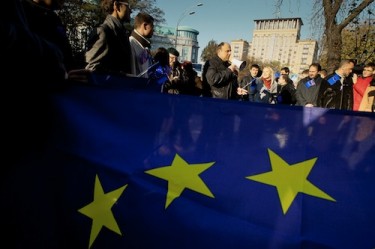
"We are Europeans!" rally in Kyiv, Ukraine. Photo by Sergei Svetlitsky, copyright © Demotix (26/10/2011)

The second "We are Europeans" rally took place on Oct. 26 in Kyiv. Even though, according to reports [ru], it was less numerous than the first one, the activists managed to draw attention of some of the European diplomats to their cause, by handing the group's Open Letter on the State of Relationships between Ukraine and the European Union [en] to Miroslav Lajčák, the EU's External Action Service's Managing Director for Russia, Eastern Neighbourhood and Western Balkans, who was in Kyiv at the time.

Yevgeniy Ikhelzon posted a link [uk, ru] to the Ukrainska Pravda article [uk], which quoted Lajčák saying that "the desire of the majority of Ukrainians to move towards the European Union is very important, and every demonstration of this is very important and significant." Ikhelzon concluded [ru]:

This is the message that we need to get out into the streets and that this is what is expected from us.

EU: Russophone Bloggers React to Dairy Farmers' Protest

Global Voices Online
Thursday, September 17, 2009


On Wednesday, LJ user drugoi re-posted two Reuters photos of Belgian farmers spraying their fields with fresh milk in protest over low milk prices, and summarized the situation this way (RUS):

[...] Belgian farmers, drawn to despair by low prices offered for their produce, decided that it was more profitable for them to dump 3 million liters of milk than sell it for nothing. Currently, the milk price is approximately 18-20 euro cents per liter, while the production cost is 33 euro cents. To make dairy farming business solvent, they believe that farmers should be able to sell milk for 50 euro cents per liter. But for now they can only dream about such a price. Earlier, farmers had already blocked roads and given away the milk for free. And now here's their latest decisive action - fields near the Belgian town of Ciney have been fertilized with millions of liters of milk that no one needs. [...]


And here is drugoi's post scriptum (RUS) to this post:

[...] They should've asked LJ users. Our experts always have recipes for all possible situations. For example, here the experts' council could suggest giving the milk away to the starving children in Africa. Let's see who responds in the comments - and what recommendations we'll get.


LJ user drugoi has 41,453 readers among registered LiveJournal users alone, and, needless to say, many people have responded: there are 774 comments so far, and here's a translation of just a handful of them:

a_brosimov:

Would've killed them if I were God.

***

flymanager:

Indeed, they should have given it away to the needy. To export to Africa would be too costly.

lenin75ka:

Africa wouldn't allow European products in, just like Russia. The problems with sales that the local farmers are facing are much worse than those of the European farmers.

[...]

The price isn't going to go up if they give it away to the needy, because this would diminish the demand.

***

sokolhan:

It's better to sell it for 20 cents than to dump it.

***

lavradar:

Last century, during the over-production crisis, they were just dumping it into the river, so here they've actually done a pretty practical thing.

lenin75ka:

In the years of the great famine in the USSR, Stalin was offered American products for free, because the demand wasn't there at all. We were too proud and categorically refused - and showed off our "abundance" by staging feasts. So the farmers were forced to burn grain and dump milk into rivers. It seemed to have helped as a result - the demand returned.

lavradar:

Haven't heard about the "free offers" - but it's true about farmers giving away for free, only there are no sponsors to deliver it to Africa.

lenin75ka:

There were rumors in the West that many people in the USSR are starving to death, even newspapers were writing articles about it. But the USSR was denying these rumors were true. They were even staging huge feasts for European and American guests, to demonstrate that there was no food shortage in the USSR. And the West believed it. Offers of humanitarian aid from the U.S. government to Stalin stopped coming.

[...]

http://www.garethjones.org/soviet_articles/bernard_shaw.htm

In the open letter to the editor of the Manchester Guardian, Bernard Shaw calls the reports of the famine in the USSR false. (Thursday 2 March 1933)

pashyrey:

Famine in the USSR was caused by the fact that the harvest was being taken away from the peasants and sold to the West. They needed currency for industrialization, and gas and oil weren't so popular then, grain had much more value.

lenin75ka:

Yes, the were selling. And - it was also rotting in the fields. Moreover, the West refused to buy - they had plenty of their own and the prices were collapsing towards zero.

***

denver07:

Well... Let's take Sudan, for example. Where people are dying off like flies. And they are dumping the milk... This mentality is somewhat alike to ours.

lavradar:

Well, so why don't you sponsor the delivery to Sudan.

***

onlymax:

http://www.rg.ru/2009/07/30/moloko.html [An article published in Rossiyskaya Gazeta on July 30, RUS]

An unprecedented action is planned for tomorrow in Ust-Labinsky region of [Kuban]. Villagers drawn to despair by low milk prices intend to publicly dump their produce into manure.

Same stuff in Stavropol region.

***

pashaman:

This did happen before... In England... Some 100 years ago... But with vegetables. They were drowned in the sea.

[...]

And our [Russian] farmers are also selling their produce for 10 rubles [22 euro cents], and in stores it costs 30 rubles [67 euro cents].

daily_winegraph:

Ten rubles sounds like a good price. According to the info I have, it's from 4 to 6 rubles [8-13 euro cents].

kolbaska:

Four rubles per liter [8 euro cents].

***

zanozanet:

They should have dumped the milk into a swimming pool and then charged 50 euro cents for tickets there.

***

leo_nardo:

Don't they have orphanages and other preschool institutions in Belgium?

mcsdwarken:

I don't think Belgian orphanages and other institutions suffers from a shortage of milk.

***

tatti_anna:

Aren't they making anything out of milk nowadays? [...] Like, division of labor - farmers are producing milk, other farmers are making cheese and cottage cheese [...] People are too lazy to produce something, it's such a Russian way - to gather, have it rot, ask for more money... This has always been the cheapest option...

incogn1too:

Socialism does lead to this. Everyone wants subsidies from the state.

***

sergey_sht:

By the way, in 2002, when the EU refused to buy powdered milk from Ukraine, which resulted in a similar situation, our folks slaughtered the cows - so radical. And this reflects on the raw products market still. And [the Belgians] are just dumping the milk, drawing attention to themselves, but they aren't SLAUGHTERING the herd! It remains to be seen who is acting smarter in such a situation.

***

red_tengu:

They used to get good subsidies from the national government and the EU, and now the subsidies have been significantly cut (WTO and the crisis) - and the farmers' revenues have fallen. No one wants to buy such expensive milk. In Latvia, by the way, milk prices are even lower - approximately 6 euro cents, and there were cases when farmers weren't getting anything for their milk - like, not fat enough, etc.

***

golovach_igor:

Why do they need so many farmers if no one needs milk? All Belgian farmers should urgently turn into citizen journalists, bloggers, sell their tractors, buy a camera with a laptop, and they'll have enough money left to buy a ticket to [Perm] - quite a competition that's gonna be!!!!!!!!

***

rolliks:

A good way to get money for the milk:

Day One. In a convoy of milk trucks, we drive into Brussels - and water the streets [with milk].
Day Two. In a convoy of milk trucks, we drive into Brussels. It smells. We still water the streets [with milk].
Day Three. We approach Brussels. The stench is terrible. Brussels residents meet us at the city edge with money. We sell the milk.

Central & Eastern Europe: Trademark on ;-) and Other Internet News

Global Voices Online
Thursday, December 18, 2008


Below is a selection of recent posts by bloggers from around Central and Eastern Europe on social networking, participatory media, online activism and other related issues.

Eternal Remont writes about Russian businessman Oleg Teterin, who claims to have trademarked the ;-) emoticon:

[...] Seeing that the Russian patent agency will grant a trademark for just about anything these days, Eternal Remont is attempting to trademark "Oleg Teterin," (trademark pending) and will expect payment whenever anyone speaks, writes, prints, or otherwise uses this phrase in all media known to humanity, existing or future. [...]


Streetwise Professor has chosen a different approach:

[...] To Mr. Teterin, I say: ;-) ;-) ;-) ;-) ;-) ;-) ;-) ;-) ;-) ;-) ;-) ;-) ;-) ;-) ;-) ;-)

So sue me.


Russian Blog writes about the Russian Facebook look-alike, vkontakte.ru - which, among other things, appears to be a good language learning tool:

When learning a foreign language communication is crucial. [...] I tell my Russian students of Swedish to join Swedish online communities, and the same advice goes for you who are studying Russian - join a Russian online community! Not only will you find lots of interesting (or uninteresting) clubs as well as people, or be able write to strangers from one sixth of the Earth’s ground (that’s just how big a country this is), but for those of you who are only beginning to study Russian joining in itself will be a challenge. After all - one must join in Russian. [...] There’s a Russian version of Facebook, though it’s completely independent, and in no way connected to Facebook, except for one thing - it is an almost exact copy of the way Facebook used to look before (the old Facebook), translated into Russian. [...]


Siberian Light interviews Dmitry, the owner and manager of Expatriates.ru, a new social networking site with fast-growing membership:

[...] What inspired you to develop expatriates.ru?

During my studies abroad many people asked me a lot of questions about Russia. I decided to create a community where all people will find the answers to their questions about Russia and where they can talk and discuss issues related to Russia. [...]


Siberian Light also discusses some of the challenges that a blogger writing on sensitive geopolitical issues - in this case, Russia - often has to deal with:

[...] Over the past few months, I’ve written posts that have both criticised and praised Russia. I write them because I think that Russia is often right, although it’s also far too often wrong.

And, far too often, I take crap from people. Usually because of what they think I have said, in the context of their tiny little world views, rather than what I have actually said, in the context of an entire blog post, or a series of posts. [...]


Gray Falcon, a blogger focusing on the Balkans, seems to share Siberian Light's frustration:

It has been almost ten years since I started publishing commentary on-line, and it never ceases to amaze me that people seem to possess a remarkable capacity of completely missing the point of entire articles to zero in on one particular sentence or phrase and make a huge deal of it.

[...]

Look, I'm routinely attacked by Albanians because I'm a Serb (it doesn't matter what I say, really - unless I endorse the KLA somehow; then I'm a poster child for what needs to be done). I get grief from Greeks, because I dare say "Macedonia" instead of FYROM or what have you (look, Alexander was a barbarian, OK? Just because he embraced the culture of Hellas and spread it around the known world doesn't make him any more Greek than my Orthodox faith makes me one).

And now I'm marked for malice by Macedonians for daring to point out that hey, today's Macedonia exists within the boundaries of the territory liberated from the Ottoman Empire by the Kingdom of Serbia. [...]


Belgraded writes about the Facebook group celebrating the 1995 Srebrenica massacre (the group is now closed; an earlier GV text on it by Sinisa Boljanovic is here):

[...] What struck me as interesting is that the vast majority of members were not even born when the Yugoslavia breakup wars started and were still in pre-school when it all ended. So where do they get their ‘knowledge’ and information about the past from? Who makes the biggest influence on how they see the past – their parents, media, their friends, the whole society?

[...]

There are no similar hate groups in English, presumably because the facebook admins can react swiftly if they can understand what some group is all about without waiting for numerous people to hit the ‘report’ button and translate ‘Ubij [insert nationality here]’ for them. I know also some would like to blame facebook and other social media for making hate speech so available, but remember – it’s not guns that kill people.

I guess that facebook is still not considered to be so influential or important by mainstream media, at least not in the Balkans. All this despite the fact that both Serbia and Croatia have around 170.ooo members on facebook each, a respectable number which is only going to grow in the future, with Bosnia lagging behind with about 50.000 members. Despite the fact that it’s mostly teenagers. Despite the fact that members post things under their full names with their photos attached – without having any fear or feeling no responsibility that the things they are posting could be dangerous and are wrong. [...]


In another post, Belgraded welcomes a new arrival on Serbia's online magazine scene:

White City magazine is "Belgrade’s first English-language domestic urban magazine. It is written entirely in English, entirely by local Serbian writers for a Serbian readership." Check it out - it looks good, the articles are very well written, hopefully it will survive in this tough competition.


Scraps of Moscow reviews some of the new arrivals in "Moldovasphere":

Moldovaphiles should check out this new website, Moldovarious, which has been set up by a couple of Austrians. Curiously, the guys behind another interesting project related to Moldova (well, related to the PMR) profiled here are also Austrian.

[...]

And, via barabanch, I learned of another newly launched project, this one initiated by Moldovans and called ThinkMoldova (also available in English) [...].

One of the people involved in the project is Barabanov's wife and fellow New Times journalist Natalia Morari. [...]


Hungarian Spectrum writes about the blog of the Hungarian PM Ferenc Gyurcsány:

[...] Quite a few Hungarian politicians decided at one time or another to write a blog but after a few days, or at most after a few weeks, they gave up the ghost. Ferenc Gyurcsány is an exception. He began writing a blog about two and a half years ago, just before the 2006 elections. [...] Even in the midst of a grueling campaign the Hungarian prime minister wrote his blog practically every weekday. Moreover, he didn't stop after the election that he managed to win practically single-handedly. [...] I think one reason that he didn't stop is that the readers of the blog were so enthusiastic and so supportive that he felt it his duty not to disappoint the team that supported him with words and deeds. Eventually Gyurcsány and his readers organized personal meetings where people revealed their pseudonyms, where they met each other as well as the prime minister. The fact is that he is a good blog writer. His notes are interesting. Very often he reveals government plans that the readers of the blog are the first to know. By now the members of the media visit the blog every morning to see what's going on in Gyurcsány's head. [...]


Meglena Kuneva - a Bulgarian politician, the European consumer affairs commissioner, and a blogger - writes this about "the realities of cross-border e-commerce for consumers in Europe":

Some of you have complained through this blog that you cannot buy over the internet from certain stores located in other EU countries. I share your frustration. The Internet has the potential to bring the single European market to a whole new level, and to provide consumers with the chance to buy the very best that is on offer within the EU in terms of choice, price and quality.

But the fact is that although a third of EU citizens already shop on the internet, only 7% shop online from other Member States than their own. [...]


Cyrus Farivar writes this about Estonia's advanced voting practices:

The Estonian parliament [...] has just approved a bill to let Estonian citizens vote via their mobile phone. This makes the country the first country in the world to do so, and comes about 20 months after Estonia held its first nation-wide election where the electorate could cast their ballots online.

[...]

Update (Dec 17.): I spoke with Silver Meikar, an Estonian MP, who told me that this actually isn’t quite mobile phone voting. In fact, this is using Estonia’s digital ID card infrastructure to use your phone as an ID tool instead of your ID card and reader. You still need a computer and an Internet connection to vote online, but you now can just have your phone instead of your ID card. So, not as sexy. [...]


Window on Eurasia reports on what appears to be a move in the opposite direction for Russia:

In the name of fighting extremism, a group of United Russia Duma deputies has proposed new legislation that would allow the government to impose sanctions on those who distribute what Moscow believes are “extremist” materials via the Internet and to close down the sites they post them on.

[...]

And even though the nature of the world wide web is such that Russian government efforts in this area are unlikely to be fully effective, such moves against what many consider to be the last free media space in Russia represent a further act of intimidation by Vladimir Putin and his associates against the embattled members of civil society in that country. [...]


In Latvia, too, the state seems to be taking a proactive approach in its dealings with the online world. Free Speech Emergency in Latvia wrote this last week:

According to unconfirmed reports, the Latvian Security Police have detained Valdis Rošāns, a self-proclaimed neo-Nazi who has been writing his views extensively on the internet (in Latvian) using the nickname FENIKSS.

[...]

By harassing a young neo-Nazi crackpot, the Security Police may be trying to restore their image after their detention of economist Dmitrijs Smirnovs and questioning of musician Valters Frīdenbergs. This caused an international uproar.

I don't think too many people will rally around Valdis Rošāns, but his case should be put on the record. [...]


Earlier this month, Aleks Tapinsh of All About Latvia wrote on GV about Dmitrijs Smirnovs' case and the economic crisis dimension of the freedom of speech situation in Latvia. On his blog, he posted a picture of a t-shirt featuring a mock message to the Latvian security police:

Notice to the security police: I admit that yesterday I withdrew money from my bank. Please don’t arrest me. I did it to buy milk and bread, and not to destabilize Latvia’s financial system.

The Balkans: Macedonia and Montenegro Recognize Kosovo

Global Voices Online
Wednesday, October 15, 2008


On Oct. 9, Montenegro and Macedonia recognized Kosovo's independence.

Douglas Muir of A Fistful of Euros noted that "coincidentally, this raises the number of countries recognizing to exactly 50." He described the significance of the event in general terms:

[...] Macedonia and Montenegro are small countries, but they have outsized importance because (1) they’re neighbors of both Serbia and Kosovo, (2) they’re EU-members-to-be, and (3) they’re former Yugoslav Republics. So while this is no surprise, it’s still interesting. [...]


Viktor Markovic of Belgraded (a blog formerly known as Belgrade 2.0) presented a humorous "short version of what happened and what could happen":

[...] Now, both Montenegro and Macedonia decided to recognize Kosovo. Kosovo will probably return the favour by recognizing them back. While they’re at it, they could decide to recognize South Ossetia and Abhazia, provinces who decided to declare independence from Georgia (not the American one, but the one next to Russia) this year. That way Kosovo would support Russia in helping South Ossetia and Abhazia break away, but it would upset the United States and the rest of the world who oppose Russia, but support Kosovo, Montenegro, and Macedonia in their independence efforts. Serbia should support Georgia because we know what it’s like to be deprived of territory, right, but that way we would upset Russia, our best friend when it comes to not recognizing Kosovo. Georgia, US already recognized Kosovo, but Georgia (the country) should definitely not recognize it, because they clearly do mind provinces breaking away from countries. But if they don’t recognize it, they could upset the US and the other countries who recognized it.

Russia first said that it’s not ok for a province to break away, but now says it’s ok. USA first said that it’s ok for a province to break away, but now says that’s a bad thing and a big no-no. [...]


One of the readers, Owen, posted this comment to Viktor's post:

I think you’ve over-simplified.


Viktor responded by proposing a way "to make things even more confusing and interesting" - which would be for Serbia to "un-recognize Montenegro and Macedonia":

[...] I don’t know if that’s even possible, to un-recognize a state, but that’s what we are trying to persuade other countries that recognized Kosovo to do, right? So we should set an example and un-recognize Macedonia and Montenegro. [...]


Vitaly of The 8th Circle mentioned some of the consequences of Serbia's neighbors' decision to recognize Kosovo - clashes in Montenegro and the expulsion of the two states' ambassadors from Belgrade - but ended his post on a rather positive note:

[...] My guess is that the protests are an immediate expression of rage, and should not become a problem in the long-run, but that may change depending on whether the animosity is permitted to crystalize and become imprinted in people’s memory. Or, will the parties choose to look to the future where borders, under the auspices of the EU, matter little?


Jonathan Davis of LimbicNutrition Weblog wrote that he is "for an independent Kosovo," wants "Serbia in the EU as soon as possible" - but is "sickened by lies, foul play, hypocrisy and bullying" of "the EU/US/Kosovo bloc." To him, the prospects of Macedonia and Montenegro did not seem too bright:

[...] Now, however, they will also have to live with the anger of their largest trading partner and the destabilising effect that their recognition will have on their internal political situations. [...]


Writing about "the massive vote in favour of allowing Serbia’s challenge to Kosovo’s legality at the International Court of Justice" that preceded the recognition of Kosovo by Macedonia and Montenegro, Jonathan suggested that "the pre-prepared plan to force Serbia’s two tiny neighbours [...] to recognise Kosovo within a day of the vote" was "designed for psychological and propaganda effect":

[...] (1) To ruin the party for the Serbs and (2) to reset the frame by getting the global media’s focus away from Serbia’s UN victory and focussed on Serbia supposedly by being “stunned” by Montenegro and Macedonia’s “betrayal”. [...]


He also wrote about "the follow-up insult-to-injury gambit":

[...] the Nobel Peace Prize being awarded to Martti Ahtisaari, a loathed figure in Serbia, widely considered to be blatantly pro-Albanian and the man who handed Kosovo its (illegal) independence. The prize was expected to be awarded to imprisoned Chinese dissident Gao Zhisheng, but the committee decided instead to continue its tradition of politically motivated awards, almost certainly in my opinion as part of the co-ordinated response to Serbia’s UN victory. [...]

Ukraine, EU: A Closer Relationship?

Global Voices Online
Sunday, September 21, 2008


The EU's plan to finalize an Association Agreement with Ukraine in 2009 was made public at the EU-Ukraine Summit in Paris on Sept. 9. The media and bloggers greeted it with mixed reactions.

"EU offers reassurance to Ukraine," read a BBC headline. "EU offers no promises to hopeful Ukraine," wrote the Irish Times. "EU Makes Positive Noises But Offers Only Vague Deal to Ukraine," stated Deutsche Welle. "Nervous EU offers Ukraine hope for the future but no seat at the table," concluded The Times.

The negative part of the assessment of the Summit's results stems from the EU's decision not to include the term “membership perspective” in the description of Ukraine’s future relationship with the EU - a phrase, which, according to Vitaly of The 8th Circle, "would identify Ukraine’s EU aspirations as something more than a hypothetical idea":

[...] To myself, I thought that this is not surprising. With the EU still digesting the 2004 and 2007 enlargement waves, experiencing the Romania-Bulgaria fatigue syndrome, and dealing with an internal problem caused by Ireland’s vote against the Lisbon constitution treaty, any talk of further enlargement perspective for other states, especially those like Ukraine with 46 million citizens or Turkey with 70 million, must be nauseating. Although, smaller states, like Serbia with a population of 7 million, have a more realistic perspective as we have recently learned from Mr. Barroso [...].


The 8th Circle points at another alleged reason for deciding against Ukraine's "European perspective" - the ongoing political crisis in Ukraine - but argues that "what Ukraine is going through right now SHARES quite a bit with the European values":

[...] Furthermore it is puzzling why the withdrawal of one section from the ruling coalition, and the consequent potential for a pre-term election is NOT an example of shared values between the EU and Ukraine. As a democracy with competitive, free and fair elections, Ukraine is attempting to find an institutional solution that will accommodate all of its political actors.

It is a democratic process through which every democratic state must pass through if it is to move beyond the adjective - “transitional.” Well consolidated democracies, such as Canada and Japan are currently going through the same coalition formation/pre-term election process, and Belgium in the past year took 196 days to form a coalition, which almost beat their 1977 record of 208 days. [...]


J Clive Matthews of Nosemonkey's EUtopia thinks that the EU should adopt a more practical approach to dealing with Ukraine:

[...] So Ukraine’s less welcome than tiny Albania and Macedonia? Less welcome than Serbia, a country built on a genocidal civil war and still in dispute with much of the EU over the status of Kosovo?

Yeah, cheers for that. Really encouraging. Nice one.

The promise of future EU membership can be a force for good, inspiring positive shifts towards greater democratic freedoms. But the promise has to be made. Taking a carrot and stick approach is a tried-and-tested method for getting people to do what you want - and that goes for countries too. Yet in the case of Ukraine, the EU’s carrot would appear to be largely imaginary - while at the same time, Ukrainians know that Russia has both stick and carrot, and isn’t afraid to use either.


Taras of Ukrainiana takes a harsh stance on the performance of Ukraine's politicians:

[...] Sure, Euro-beggars can’t be Euro-choosers. Especially if you come to the negotiation table in such a grotesque disarray.

In the meantime, let our oligarchs buy a little more of Monaco. Maybe then we’ll have our chance to join the EU? [...]


Part of the passage above is actually a reaction to Victor Yushchenko's seemingly awkward and inappropriately positive response to what Nicolas Sarkozy reportedly said on behalf of the EU at the end of the Summit. Ukrainiana posted a news report broadcast by one of Ukrainian TV stations and provided an English translation of the Ukrainian voiceover translation of Sarkozy's words:

French President Nicolas Sarkozy: This association agreement [to be signed in 2009] does not close any paths, nor does it open any paths. That’s all we could give.

Ukrainian President Viktor Yushchenko: We very much appreciate what we reached today.


It turns out, however, that Sarkozy's remark has been mistranslated, and the incorrect translation was then featured prominently in the Ukrainian and a few Western media outlets (more about it - here). The original statement - "[...] cet accord d’association ne ferme aucune piste, que même il en ouvre" - apparently translates as "[...] this association agreement does not close any route, it even opens some."

"Well, let's see what that means in practical terms," concludes Ukrainiana after posting a correction.

The 8th Circle believes that the EU should "stay engaged with its Eastern Neighborhood" and that the Polish-Swedish Eastern Partnership project might be "a good small step in that direction." Here is why:

[...] This partnership more than anything will show that the EU retains its leadership role in Europe by staying actively engaged with “neighborhood countries” that are at various stages of democratic and economic development.

[...]

Note that the question is not about making a promise of membership or candidateship - like the one made by Barroso vis-a-vis Serbia - rather it is about signaling to politicians in Kyiv and the Ukrainian population that if they want to and if they reform accordingly, then the EU is a viable option. [...]

Kosovo: Views from the Russophone Blogosphere

Global Voices Online
Wednesday, February 20, 2008


According to the Yandex Blogs portal, over 3,700 posts on Kosovo independence have appeared in the Russian-language blogosphere in the past three days. Some of these posts have received dozens, if not hundreds, of comments.

Below are a few snippets of this lively discussion, all translated from Russian.

LJ user iraan reported from Kosovo on Feb. 15:

[...] In Kosovo, everyone is promising independence - even this hotel ad.


A picture of a roadside ad for a hotel in Kosovo's capital Priština accompanied the post; the ad read:

INDEPE
NDENCE

HOTEL AFA IS READY


On Feb. 17, the day Kosovo declared independence, LJ user iraan wrote:

...Priština. Today
...celebrations are in full swing here already. Here you go, my dear ones


In the comments section, she later added two photos of happy-looking men waving Albanian flags. LJ user cqdx - who served in Kosovo (RUS) as part of Russia's peacekeeping mission, but is currently based in Geneve, Switzerland - noted:

[...] If at one point Yeltsin's Supreme Council hadn't chickened out and instead accepted Serbia as part of Russia, there wouldn't have been today's [orgy] in Kosovo. [...]


In another Feb. 17 post, LJ user iraan made this observation about the flags she was seeing in Kosovo's capital:

...there are more stars and stripes in Priština than even the black eagles. It is obvious who the papa is and who is directing the process.


LJ user vikrussia left this comment:

How sad. I am speechless. There was hope until the very last moment. And now there's only one thought in my head: this is what they are going to do to us, too - "in a civilized manner," [pretending to observe principles] of "legality" and "law." The Slavic world has died. God has turned away from us. We have to figure out what for.


Serbia-based LJ user sanielisse wrote this on Feb. 19:

I've been reading and watching the news non-stop for the second day in a row. [...] Kosovo, an independent state?
On Friday and Saturday, they began sending SMS's - "pray fro Kosovo... [...]"
Where were you before? Why didn't you pray every day in Serbian temples for the rescue of Kosovo and its relics, and its Serbian people?
A female student at the university declared to me today: "I want to live and not to think about Kosovo..."
It's easy to sell your past. But then you'll be walking through a swamp.
After these words I joined the protest rally with my friends. My heart was aching...
Is this a protest, or a funeral of Kosovo, or a holiday? Not very clear... God, what can one understand here, in Serbia, when the president declares, "Be peaceful..." How could those who carried out the pogroms on Sunday night stay peaceful if the country's heart and soul had been torn out?
And if today you stopped those who were yelling "Kosovo is Serbia's heart" and asked WHAT IS KOSOVO, would many of them have an answer?
And no one but [Bishop Artemije] has mentioned that it's not just an attack on Serbia. It's a new blow to Orthodox Christianity.
[Abkhazia's Sergei Bagapsh] and [South Ossetia's Eduard Kokoity] said beautifully today: Serbia is a country well-established politically, it's not in turmoil, and a piece of it is being cut off only because two ethnic groups look at each other through gun muzzles... And what can be said about Georgia, a country that isn't well-established yet, which is permanently on fire, and into which North [sic] Ossetia and Abkhazia are being squeezed? [...]


LJ user dreamy_tanger left this comment:

[...] Why wasn't your heart aching when [Slobodan Milošević] organized the genocide of Albanians and Bosniaks? Was Orthodox Christian "compassion" an obstacle? As for Kosovo, there's no use worrying about it anymore, it has not been part of Serbia de facto for a long time, now at least they'll be obliged to observe minorities' rights as an independent state.


LJ user drugoi, on Feb. 16, posted five photos of the pre-independence celebrations in Kosovo, titled his post, "Farewell, Serbia?" - and received four pages of comments. Here are some of them:

drakon_1 [Israel-based]:

Hurrah!!!

dtxysq [Russia-based]:

Hurrah?

sergey_sht [Ukraine-based]:

He doesn't live in Kosovo.
"Freedom and land to Palestine!"

drakon_1:

Palestinians, too, should have a state of their own, with clearly defined borders - I don't see any contradiction in this.

sergey_sht:

Albanians also should have a state of their own with clearly defined borders. But for some reason they want Kosovo, too, just like Arabs want Jerusalem.

Don't you understand that it can't be just 'We want it and that's it.' It's not as simple over there.

dao_b [Russia-based]:

Russians also should have a state of their own with clearly defined borders. But for some reason they want a small Russian republic on the territory of Moldova, too.

Don't you understand that it can't be just 'We want it and that's it.'

***

polinsky_yard:

[...] Well, good luck to them.
Why are we saying farewell to Serbia as if it's something that belongs to us? We have no more rights for it than Americans.

terskiy_kazak:

Oh-oh, are you serious?! [Count with me]: faith, language, history... Damn, we are the same people with Serbs! It's somehow awkward to even discuss this subject: it's like proving that the Earth is round...


LJ user shupa (originally from Belarus, currently based in Prague, Czech Republic) wrote this in the yugo_ru LJ community, whose focus is on "culture, history and literature of the former Yugoslav states":

Someone has reminded us here today: "I'm reminding you that Kosovo is a historically Serbian territory, which, in the past half a century, has become dominated by Albanian population."

What kind of term is that - "historically XXX territory"? If we start looking for all the historical territories and all those who are occupying them now, then Russians should be kicked out from behind [the Urals] or even closer (definitely [Smolensk], [Prussia], [Ingria]). And I'm not even talking about [the Americans]. Anyway, let's all return to the borders of the 14th century, when [the Grand Duchy of Lithuania] stretched from one sea to the other :)

The most important thing now is for them not to start killing one another again. As for all this screaming - we are not giving Kosovo away, Moscow is behind us - these are indeed [calls to action]. There must be plenty of them on the other side, too, only we don't see or hear them, and "the other" side isn't really advertising them. [...]


LJ user michail wrote this:

[...] Serbian [dear brothers] deserve our sympathy, of course. But, honestly, would all that's happened be possible if Serbs hadn't exchanged their resistance will for the sweet promises of the Eurocommissars? One's gotta pay for "the European choice." [...]

I suspect that we need the proverbial solidarity with [dear Serbian brothers] more than Serbs do. I haven't forgotten yet that the [Russian mass awakening] began with the [1999 NATO bombing of Belgrade]. We were throwing stones at the U.S. embassy then and singing [Kosovo Front] all together - was it in vain? Cannon fire in Serbia awoke the Russian bear, ridding him of a whole package of the most dangerous illusions of the 1990s. [...] And, thank God, it was someone else's war that served as a catalyst for national awakening. [...]


LJ user michail ended his post with a video of a Corsican band "L'Arcusgi," which included a Corsican female singers' performance of "the famous 'Hegoak' - a patriotic anthem of [the Basque Country]."

Israel-based LJ user aristocrate was not sincere when he congratulated Europe on the birth of its "new child":

I congratulate Europe with a new child - Kosovo!

And since the EU has so happily supported the unilaterally declared independence of a new Muslim state on its territory, I'm also wishing it to have many, many more kids: independent Catalonia, Corsica, Wallonia, Flanders, the Basque Country, Wales, and, somewhat later, Normandy, Ruhr, Gascony, Wallachia, Prussia, Sicily, etc.

You deserve it, idiots. [...]


LJ user varfolomeev66, a Russian journalist, was "more concerned" with the fate of Russia than with that of "the USA and the leading European states. He wrote:

I'm trying to understand: our diplomats and those who sometimes listen to their recommendations - are they fools or enemies?
I'd like to have a look at the authors of the thesis on the "precedent-making nature of Kosovo case," about which Putin and [Russia's foreign minister Sergei Lavrov] have been talking incessantly for the past few months. Do they understand what they are doing?
I assume they [...] were trying to intimidate Europe and America this way: like, Wales and Montana will follow Kosovo's example. But [they] ended up prescribing treatment that's worse than the disease itself.
The president, who has called the unilateral separation of Kosovo a precedent, has given [freedom to act] to our own, home-grown separatists. If, for example, Ingush, Karelian or [Primorye] comrades decided to split from Mother Russia, they would remind those who'd try to stop them that Putin himself had shown them the way! Wasn't it Putin who said that other peoples may follow after Kosovars - and we are following them!
[...]
Instead of emphasizing the uniqueness of the Kosovo case along with the countries of the West and talking of the impossibility of repeating it, our regime is voluntarily provoking our own secessionists. [...]


LJ user freetatarstan - which is actually a "journal for those who support the idea of independence of [the Republic of Tatarstan]" - wrote:

KOSOVA!

Remember how some observers used to assert that as soon as Russia starts being nice to Abkhazia and Ossetia in response to Kosovo's independence, the national autonomies of the Russian Federation will raise their voices as well...
Well, what can you say to this... We wouldn't want to disappoint them... [...]

Ukraine: A Porous Border

Global Voices Online
Thursday, January 24, 2008


On Tuesday, Ukrainian news site Korrespondent.net posted a translation of Mark Franchetti's recent Sunday Times story on Ukraine's porous borders and illegal migration.

"Britain is target in Ukraine’s people smuggling bonanza," the article's headline declared. "With most border controls in Eastern Europe now gone, people smuggling has become easy business in the Ukraine."

The English-language original has received 16 reader comments so far, the Russian translation - 88 comments.

While many readers admitted that the problem of illegal migration existed in Ukraine and that corruption among border guards and other officials contributed greatly to it, most did not seem too happy about Franchetti's piece. Quite a few were offended by the lead sentence, which described an anonymous Ukrainian people smuggler, who was "chewing slices of pork fat at his house less than two miles from the border with Slovakia," his "grin studded with gold teeth."

Here's one comment, which pretty much sums up other readers' initial reaction:

inn

[...] As for [salo, pork fat] and gold teeth - this is how they imagine us [Ukrainians]. If the article were about the Russo-Finnish border, there'd be [valenki, felt boots] and [balalaika, a musical instrument] in it. [...]


The very first comment, which appeared less than ten minutes after the translation was posted, expressed exasperation with president Victor Yushchenko's pro-Western stance:

Yushchenka na kol:

In Europe, they perceive us as savages, and we continue to faithfully lick their [behinds]. Keep it up, [orangeoids].


Another reader was wondering about Yushchenko's efforts to curb labor migration from Ukraine:

:):

Has Yushchenko accomplished anything with creating jobs at home? I remember there was some talk about it during the 2004 elections...


While some displeased readers automatically concluded that the British journalist had been bribed into writing this article, others were more reasonable:

oleg:

I don't think this article is planted - who would need that? Europe doesn't need us, they don't care about us anyway. Though perhaps the point is to get Europeans to feel hostile towards Ukraine and to make border control tougher. [...]


Naturally, at least one exchange did occur between a reader suffering from Soviet nostalgia and a sort of a realist:

Kievlyanin:

Shame... There was nothing like this in the USSR, and there was no reason to drag yourself to the West when the Iron Curtain was in place, there used to be at least some prosperity, before the collapse under Gorbachev. And now people are prepared to give their last money to Ukrainian officials in order to be able to work as dishwashers at a McDonald's in Poland.

ahimas:

In the USSR, they'd shoot you at the border without much thought, that's why there weren't too many people willing to cross (though some desperate ones did exist). Don't take [this article] too seriously: [the journalist] wouldn't be able to tell a Pole from a Ukrainian, and there are plenty of those over there. Slavs, just as Arabs, aren't too welcome there, even [Russian billionaire Roman Abramovich] is unable to [create positive publicity]...


A number of readers pointed out that Ukraine cannot be held solely responsible for the massive illegal labor migration:

maks:

That Ukraine is the main supplier of immigrants to Britain is nonsense. Where is Ukraine and where is Britain? And how do they [non-Ukrainian illegal migrants] get here from Moscow? Maybe it's Moscow that's the main supplier of immigrants? And what about the rest of the countries through which immigrants make their way to reach Britain - are they not responsible? [...]

***

newsash:

Border guards will understand all the complexity of it when the money for deportation will be taken from their budget - and this is when the boom will quickly stop. In its turn, the EU also has a sufficiently good motivation for border control. So this story has been written to scare the British mommies... P.S. What's needed is border regulations with Russia, this is where the true HOLE is. One doesn't even have to arrange things there, you are free to run back and forth as much as you want.


Here's another suggestion on what should be done to relieve the grave situation along Ukraine's border - and a note that inspires some optimism, pointing out that ignoring illegal migration may soon become unprofitable for Ukrainian officials:

Aleksandr:

They should be firing officials and everyone who gets caught in people smuggling and other dirty business - and give them long-term jail sentences. But we would need the rule of law in this country - something that isn't there. And won't appear anytime soon.

***

):

[...] Now that Ukraine has signed a readmission agreement with the EU, it is responsible for covering all the costs incurred by the stay and extradition of all those who entered the EU illegally from Ukraine. To put it differently, if half of China enter the EU through Ukraine, Ukraine will be obliged to pay all the extradition-related expenses. [...]


Finally, a few comments from two readers who seem to have a firsthand knowledge of the people smuggling business in Ukraine:

Sasha Uzhgorod:

[...] I stopped doing this business four years ago [...] Let's start with the prices. All the calculations used to be in dollars, and now they are in euros. I won't name the specific prices, but [the ones mentioned in the piece] definitely do not correspond to what we charge. The guides were mainly border guards themselves, but also rangers and hunters (they are cheaper) - but not small kids ["boys," as the Sunday Times article states]. It's true that there are plenty of deaths at the border, especially in wintertime. As for who controls this business, it's not criminal gangs but cops together with SBU [Security Service of Ukraine]. I left when they took control of the business. As for the hack who wrote this piece, he must have talked to some drunk at a bar, someone who had heard some bits and pieces, but who is not a real guide. [...]

***

111:

[...] A few times, my work has brought me into contact with people involved in [people smuggling] to Europe. There were no underaged there - the greens [border guards] serve as guides, as well as rangers and hunters, Sasha is absolutely right here. And only the local ones, draftee soldiers are scared to get involved. [...] People from the East [of Ukraine] and Kyiv dominate the business, the locals get involved only because they know the border area. This business is controlled by the police and SBU - it's a big business, after all. [...]

Russia: "The Abduction of Europa"

Global Voices Online
Wednesday, November 1, 2006

LJ user kuzma-diary - Alexei Zimin, editor-in-chief of Afisha-Mir travel magazine, former editor-in-chief of GQ's Russian edition - reports (RUS):

The Abduction of Europa

Afisha-Mir magazine has been receiving alarming signals.

It appears as if consulates of European countries are using the slightest pretext this fall to refuse issuing [Schengen visas] to Russian citizens.

They say that no one is even trying to obtain a one-year, multiple-entry visa anymore. Problems arise even when attempts are being made to request a month-long entry stamp.

They say that the fiercest at it is the consulate of France.

They say that multiple one-year visas in the passport mean nothing to the French anymore, even when they were the ones who issued those visas.

They say that the French are ruthlessly stamping rejections into passports with three earlier one-year Schengens.

Due to this drama, Afisha-Mir has decided to carry out its own investigation of this harmful activity.

Editors are interested in all rejection stories and other recent cases of consulate genocide.

Perhaps someone knows the reasons for this toughening up?


Here are some comments to this post:

lalamey: I got a rejection from the Greeks, along with two other girls. We were flying to Athens for a conference, some 70 people. But then boom, and the three of us got rejected - with this note: "the embassy reserves the right not to explain the reasons." And I've traveled around Europe for 12 years without any problems, I can't even count all these Schengen visas. Anyway, I'm confused.

[...]

tornwave: Insider information

There's a new consul at the French embassy, and he began his work by [introducing some tough measures]. A few people were fired because they allegedly used to provide help in obtaining visas. Some left without waiting to be fired. But it seems to have calmed down now.

[...]

calabaxa: It is getting tougher, definitely, and not just with the French. Since I get my invitation from Hachette, usually we don't have problems getting a multiple-entry, work visa through the French consulate. But this year, after two one-year visas in a row, the French gave me only a half-year one. (And I've been told I'm lucky - many of our employees have been given visas only for three months. With no explanation.)

Italians are now demanding a confirmation that there's at least 3,000 euros on your bank account (for a one-year visa - 6,000 euros). A year ago, they were not asking for any confirmation.

Germans have refused to issue a visa to my friend, explaining that last year she "visited Germany twice on a multi-entry work French visa issued in Italy and not France, as the rules require."

msmetana: And you really give them your bank info?!

calabaxa: No, I get my work visa through the French and they aren't asking for any of it yet (though for some reason they demanded a copy of my press card this time, something that never happened before!). But my colleague - a very law-abiding miss - she really did accumulate 3,000 euros on her card and then did a print-out for the embassy.

Is there a way to do without this paper? I was assuming it's required.

msmetana: I don't know if it's possible to do without it and I'm not planning to find out ))) It's just too humiliating.

[...]


And here is a rejection story (RUS) from kuzma-diary's colleague, LJ user mxl (Maxim Balabin, art director of Afisha magazine):

i hate france // je deteste la france

I've got two visa rejections stamped into my passport - by the French embassy )

The first time, we came there as honest citizens with all the papers, a pile of certificates, bookings, tickets.

Rejection.

The second time, we came with a press note.

I have to admit that it's been a long time since someone was so outright rude to me - the way that woman behind the window [in the wall] spoke with me.

"You've got a press note, are you a journalist or what?" she asks me. I give her my press card.

"You're an art director! And what if you work as a cleaner in the press - are we supposed to give you a visa, too?"

I told her politely that photography and a photographer are as related to the press as a journalist.

"A journalist is the one who writes," she tells us.

Then at some point, as she is thoroughly examining my passports, the old one and the new, she all of a sudden starts turning the passport around, checking against the light the hologram on one of my five Indonesian visas.

At the end, she tells us solemnly to stop by after lunch break: "We'll be checking your documents."

After lunch break, they stamped another rejection into my passport.


And a few comments:

horsey: That's because they had a few of their people arrested, for visa fraud - for bribes and theft, right before the World Cup. Nothing to do about it - wait half a year, change your passport and hire professionals who will have you a visa issued - and before that, they'll erase your [name] from the computers.

mxl: It's easier for me to forget about the existence of the European Union, you know.

[...]

iren: So there's no way for cleaners to get to France, right?