Showing posts with label [markgrigorian]. Show all posts

Georgia, Russia: Cyber Attacks on Blogger 'Cyxymu'

Global Voices Online
Sunday, August 9, 2009


A year ago, the Russo-Georgian war coincided with the 2008 Beijing Olympics, diverting some of the public attention from the peaceful sporting event. This week, cyber attacks on LiveJournal, Twitter and Facebook, targeting Tbilisi-based LJ/Twitter/Facebook user cyxymu, have added an extra dimension to the coverage of the first anniversary of the war - and even re-focused it to some extent.

Initially, the Russo-Georgian connection was not evident. On Aug. 6, LJ user mhwest posted this note (ENG) in the lj_maintenance LJ community, announcing that the blogging platform was "under attack":

Wonderful World of DDoS

As some of you may know, LiveJournal has been under attack this morning from 6:00am PST until ??? We have taken steps to mitigate the DDoS but some users may still experience site connectivity problems. [...]


This post has received over 250 comments, but there is only a handful of mentions of the geopolitical cause for the outages. Here is a sampling:

lavvyan - Aug. 6:

The Russians are coming!

No, wait...

[...]

nysidra - Aug. 7:

I remembered seeing this comment yesterday.

Just so you know, you were right. ^_^

Twitter's Meltdown: Blame the Russians


Also on Aug. 7, Eternal Remont quoted from a BBC piece (ENG), explaining the situation:

Yesterday, as blood poured down from the heavens, the seas boiled and the Earth was ripped apart because of the Denial of Service attack against Google, Twitter and Facebook (“OMG, I can’t tweet about the fact that Twitter is down!) we pondered one alluring possibility: is Russia involved?

Maybe. We do know that the disruption of all social networking on the planet was directed at one person:

BBC: "The massively co-ordinated attack on websites including Google, Facebook and Twitter was directed at one individual, a pro-Georgian blogger known as Cyxymu… Specifically, the person is an activist blogger and a botnet was directed to request his pages at such a rate that it impacted service for other users." [...]


And so, on the eve of the first anniversary of the war, LJ user cyxymu - whose nickname is a latinized version of the Russian spelling of Sukhumi, the capital of Abkhazia - became a celebrity of sorts.

Cyrillic LJ users - diana-ledi, taki-net, markgrigorian and many others - reported (RUS) not being able to publish posts and comments containing cyxymu's nickname.

His primary LJ blog and two backups - cyxymu1 and cyxymu2 - are currently inaccessible (some of his recollections, however, were translated by Global Voices' author Lyndon in Oct. 2007 and July 2008: The War in Abkhazia - ‘Cyxymu' Remembers, and Abkhazia, Georgia: "Home.”)

Cyxymu also has a Blogger blog, Twitter account, a public Facebook page, and a Facebook group with more than 750 members, created by someone else to support his cause.

Evgeny Morozov of the Foreign Policy's Net.Effect blog wrote (ENG) that he'd been "calling attention to CYXYMU's problems for months now, and this brought no results." Here is Evgeny's take on the recent cyber attacks:

[...] In short, I think that the current wave of attacks had one objective: to flesh attackers' cyber-muscles by revealing the kind of leverage that CYXYMU's detractors have on the Internet's most popular sites. Make no mistake: these attacks on Twitter and Facebook were NOT about silencing him down or thwarting the distribution of information that would Kremlin feel uncomfortable. [...]

If you carefully look at CYXYMU's Twitter account (most of it in Russian), you will see that there is really no information of ANY political significance there. He's been tweeting since late December 2008, produced 41 updates, and most of them had nothing to do with politics (here are some typical updates: "Summer is good!", "Life is great! I am recalling all the jokes about mothers-in-law", "Oh those bureaucrats").

This is definitely not the kind of stuff that threatens Kremlin. [...] His blog is also somewhat of a news hub: he has done an amazing job of keeping his followers in the loop as to what happens in Abkhazia and Georgia, the two regions that are not exactly in the center of media attention (even in Russia). He's definitely NOT the blogosphere's version of Anna Politkovskaia; it is his opinions and visibility - rather than his revelations - that have made him an important target.

Thus, I think that the attackers' real goal was humiliation, not censorship (however, more on the censorship part at the very end). A secondary goal was to generate awe-inducing headlines about Russia's cyberpower all over the Web; there is no better way to do it these days than to make Twitter inaccessible for a few hours. [...]


Ostap Karmodi wrote (RUS, link via LJ user drugoi) that "the attackers" would have probably thought twice before doing what they did if only they had been capable of foreseeing the outcome of their attacks:

[...] The result of yesterday's attack is that cyxymu, so disliked by some hackers, has become known to the whole world. The Spanish El Pais has written about him, and the French Liberation, and the German Spiegel, and the British Guardian, and the American Washington Post, and the Japanese Yomiuri. In short, all the main papers of the world. Some of them have even done short interviews with cyxymu. From now on, if a conflict between Russia and Georgia breaks out again, the world media will know who to talk to.

From now on, cyxymu's opinion on Russian politics will be interesting to the whole world - the opinion of a person who caused a crash of a hundred million accounts is always interesting.

The day before yesterday cyxymu was known to no more than ten thousand people. Today he is known to - what's the audience of the world media? 500 million? A billion? And most of these people sympathize with him - people do tend to sympathize with victims of mass persecution. [...]


Here is one of Evgeny Morozov's theories on who might be behind the attacks:

[...] The amateurization of cyberwarfare has been one permanent feature of virtually all recent cyber-attacks that somehow implicated Russia; it may be part of a broader Kremlin effort to "crowdsource" its defenses and offenses to groups of nationalistic vigilantes, not just in cyberspace. Thus, recent news reports suggest that Nashi, Kremlin's youth arm, will soon be recruiting up to 100,000 problematic teenagers to form ARMED militia units that would patrol the streets. It would make some sense if they also invest into units of "cyber-vigilantes" who would be patrolling cyberspace, particularly given the rising importance of the Internet in Russia's public life. [...]


And LJ user dolboeb felt, too, that "the recent initiative to create street 'militia units' in Russia" and the idea to attack cyxymu's blogs could have originated from the same source. He wrote (RUS):

[...] Indeed, why would the regime torture itself, trying to come up with some general anti-internet laws, the way the naive Kazakhs and the old-fashioned Chinese did, when a pack of patriotically-minded thugs is close at hand, ready to crash any service or resource [as soon as they are ordered to (or even without being ordered to)]. [...]


LJ user drugoi pointed in a slightly different direction in this very short and sarcastic post (RUS):

A request

Comrade [officer], I've written a post about The Beatles. Will you allow me to publish it? There's not a single word about Georgia in it. Will you please turn off your hurdy-gurdy for five minutes?


(The Beatles post (RUS) is here, by the way - it commemorates the 40th anniversary of the famous Abbey Road photo.)

Russia: Remembering Anna Politkovskaya

Global Voices Online
Tuesday, October 7, 2008


Oct. 7 marks two years since the assassination of journalist Anna Politkovskaya. No one has been jailed for the crime so far, but three men are expected to go to trial soon for their suspected involvement in the murder.

Below is a selection of today's commemorative posts from the Russophone blogosphere.

LJ user emarinicheva wrote (RUS):

Anna Politkovskaya was killed two years ago. I remember that the day of the funeral was just like today - rainy. Many, many people came to the cemetery. Familiar faces, recognizable. To some extent, it was comforting to be next to them... Why was it so painful? People like Anna stood against trouble, lies and hypocrisy that were coming upon us (and which have eventually prevailed). She didn't fit into the "new world order" in this one country STYLISTICALLY. Now we live just like that, without Anna, without her existence on the earth. It is tough. [...]


LJ user viking-nord wrote (RUS):

Two years ago Anna Politkovskaya was murdered. A true Journalist and a real Citizen, a Patriot of Russia.

In general, we have an extremely perverted and, I'd say, a wild notion of what patriotism is. Many people consider it patriotic to beat up a Caucasus native in the street, to bomb Georgia, to show [their] behinds to the USA. No, that's not patriotism, that's husk, which will be causing nothing but shame in our offspring.

What Anna Politkovskaya was doing was patriotic. It is patriotic to tell the truth, to expose the liars among officials, to fight for world peace, to walk alone through a mob of crazed thugs who have small and great power, and, the main thing, not to be scared of them. The bullet was the only thing that they could stop her with. Because she didn't need to make a career, nor did she need the regime's favors, the status of a courtier or a pocket [tamed] journalist, all she needed was just to tell the truth. And it was impossible to ask her to be silent, impossible to bribe or intimidate her.

I didn't agree with her on everything, but I respected her as a Journalist, and as a Patriot. The best thing we can do to honor the memory of Anna Politkovskaya is to win the fight for freedom of speech, for the priority of human rights, for the democratic state. This is the only way to honor the memory of this person.

We remember...


LJ user gengri posted an announcement of a memorial rally to take place at 7 PM in St. Petersburg today - and pointed out (RUS) the reason why the event has not been approved by city officials:

[...] It appears that from 7 to 9 PM some maintenance work will be taking place in the park at Troitskaya Square. The city administration's Committee on the Issues of Legality offered to hold the event not by the [Solovki] Stone, but in the 50th Anniversary of October Park at Prospekt Metallistov. What kind of people are these...


According to LJ user shoorman, the St. Petersburg rally was expected to take place by the Solovki Stone despite the official ban - the blogger cited a local politician (RUS) who had made a media statement about the upcoming rally:

[...] Nevertheless, the memorial for Anna Politkovskaya will take place at the traditional spot - by the Solovki Stone at Troitskaya Square. "Anyone can come up to the stone whenever he or she wishes to. Despite the blatant cynicism present in the actions of the city authorities, we will still come at this time and on this day to the Solovki Stone to honor Anna Politkovskaya's memory. It's not just our right, but it's also our duty to her. And it does not require approval of any committees. Everything will be quiet and peaceful, the way it has to be during minutes of grief," commented one of the event's organizers, the leader of St. Petersburg branch of Yabloko Party, Maksim Reznik. [...]


LJ user tupikin wrote (RUS) about his expectations for the rally on Pushkin Square in Moscow - and for the outcome of the investigation into Politkovskaya's murder:

Today, Oct. 7, 2008, marks two years since the murder of journalist Anna Politkovskaya, who was writing articles that made someone in the North Caucasus and (possibly) in Moscow uncomfortable. The investigation should determine exactly who [they were making uncomfortable]. But it is unlikely that it will. Not in this country, not at this time.

If a million people showed up for today's rally in her memory in Moscow, maybe the truth would be told, who knows. Or perhaps two million are needed for that, or three? What kind of rally should gather for the regime in the country to change?

A meeting is actually starting in memory of Politkovskaya in Moscow, at this very moment at Pushkin Square. How many people will take part? I don't think there'll be more than 500. And since it's raining heavily - maybe the total of 300.

Some of those who are late, by the way, will probably still be able to make it there. Maybe I'll make it there, too. We'll see.


LJ user pesnyasolveig wrote (RUS) that this year she did not want to attend the memorial rally in Moscow. Here is why:

I don't know whether I'll go to the rally in memory of Anna Stepanovna [Politkovskaya]. Up until now, I have been attending all the events. But today I don't feel like it. Last time, at the end of August, on [Politkovskaya's] birthday - I was listening to [Garry Kasparov] - and it hurt a lot. It hurt because they've started to trade in memory. They made a show where there shouldn't have been one, it wasn't proper, wasn't human. I just remember. And I want everyone to remember. Today is October 7. The day to remember Anna Politkovskaya. Two years without...


LJ user aleshru, who did attend the Moscow rally, posted (RUS) a photo of smiling Mikhail Kasyanov, ex-member of the opposition coalition "The Other Russia."

LJ user posmixator posted two pictures (UKR) from a tiny memorial event at Kyiv's Independence Square.

LJ markgrigorian wrote about (RUS) and posted pictures from the RAW in WAR Anna Politkovskaya Awards 2008 event, held at the Frontline Club in London on Oct. 6:

The annual Anna Politkovskaya Awards ceremony has taken place at the Frontline Club in London.

This is the second event of this kind already. This time the award went to the Afghan activist Malalai Joya. A totally amazing woman - fearless and clever. Just think of it, she has been courageous enough to stand up against corruption in Karzai's government and against the Taleban movement.

After that, even though she has become a parliament member, she is receiving threats and is forced to constantly hide, change her location. She has been chased out of parliament.

Malalai is not tall, but full of energy and fearless.

She burst into tears when she received the award, and then delivered a passionate speech against the U.S. and Britain.

[...]

[photo of Joya]

Natasha Estemirova, a journalist from [Chechnya's capital] Grozny, was there, too. She received the award last year. This time, she talked about the events in Ingushetia. Very briefly, but very passionately.

[photo of Estemirova]

It is indeed very difficult in Ingushetia now. Some politicians and experts are equating the situation there with civil war. They are talking about power gap there, chaos, constant murders, blood feud...

Anna Politkovskaya's sister, Yelena Kudimova, was there as well.

[photo of Kudimova]

And, finally, Marianna Katsarova, the organizer and the inspiration behind both the award and the annual meeting, a human rights activist and a feminist. She is the head of the RAW in WAR (Reach All Women in War) organization.

[photo of Katsarova]

It turned out to be a very emotional evening. Kudos to Marianna!


LJ user tapirr posted a selection of links to Russian-language resources on Anna Politkovskaya - including Masha Novikova's documentary about Anna Politkovskaya: “Anna, Seven Years on the Frontline” (in Russian, with English subtitles).

LJ user l-dream posted a Feb. 2006 photo of Politkovskaya and wrote (RUS):

This is what she looked like the last time I saw her.

Russia: Aleksandr Solzhenitsyn

Global Voices Online
Monday, August 4, 2008


Aleksandr Solzhenitsyn, the Nobel Prize-winning author of The Gulag Archipelago, has died on Sunday. He was 89.

Reactions to Solzhenitsyn's death are already beginning to appear in the Russophone blogosphere, and here's one post on the writer's legacy (RUS), by LJ user markgrigorian:

Solzhenitsyn has died

This kind of news always comes unexpectedly. He was 89 years old.

For me Solzhenitsyn began from the kitchen radio set. Week after week, every evening, my grandfather listened to The Gulag Archipelago being read. I was listening, too, understanding little of Solzhenitsyn's text, but catching episodes that [were so powerful they left one breathless] - due to the facts, eyewitness accounts and the sequence of events [presented in them].

Of course, I couldn't have known then the already famous story with [One Day in the Life of Ivan Denisovich], [Novyi Mir literary magazine, which first published Solzhenitsyn's story in November 1962], [Aleksandr Tvardovsky, editor of Novyi Mir]...

For a long time, Solzhenitsyn was mainly and only the author of The Archipelago for me.

This feeling grew even stronger when photographer Misha Kalantar spent several nights photographing page after page of The Archipelago text, printed in Paris, and it was then that I could see - see but not read - a fat pile of photo pages of this book.

I read it later. By fits and starts, because you could only borrow the book "for one night." And how much can you manage to read in one night? Even though [I'm a fast reader], I was overwhelmed by emotions, had to put the book aside, catch my breath, wait before diving into the documentary description of the horrible Soviet camps, into the ruthless systematic description of the murders and crimes of the System.

Then there was [Cancer Ward], and then [The First Circle].

I liked the deliberately old-fashioned style and the solidness of his texts, the "pre-Soviet" heavy weight of the composition, the leisurely pace of the narrative.

Soviet readers used to begin their acquaintance with Solzhenitsyn from One Day in the Life of Ivan Denisovich and Matryona's Place, but for me these works supplemented what I'd already read and knew.

His essay on How to Make Russia Better repelled me immediately. I couldn't - and still can't - accept that open nationalism that was revealed in that little text. Though in 1990, the first phrase - "The clock of communism has stopped striking." - read like a literary, artistic summary of what had happened. What had finally happened.

Around the same time, I began to understand that Solzhenitsyn represents the nationalistic wing of the Soviet dissident movement. And it somehow became clear to me that having to choose between him and [Andrei Sakharov], who stood for democratic values, I've chosen Sakharov's direction.

[The Oak and the Calf] - I read it as an example of uncompromising struggle of an individual against the System. Even though there are flaws in this book, it's an easy read. Which means it is written well.

[The Red Wheel] was already beyond me.

Solzhenitsyn's [Orthodox Christian/patriotic] direction is something completely not mine. [August 1914] I perceive as the gradual loss of literary taste and writing skills.

But, leaving aside my inner rejection of the philosophy and, at times, the [literary style] of Solzhenitsyn, I'd still like to say that his Gulag Archipelago was a true feat. In the Soviet conditions, having to fight censorship and persecution, despite searches, Solzhenitsyn managed to collect the unique material, systematize it and convey it in form that's absolutely striking in its clarity.

This should not be underestimated. The Archipelago is a great book.

Russia, Tajikistan, Kazakhstan: Lenin's Birthday

Global Voices Online
Wednesday, April 23, 2008

On April 22, Vladimir Lenin would have turned 138 - and quite a few Russophone bloggers still remember the date.

Oleg Panfilov - LJ user oleg_panfilov, director of the Center for Journalism in Extreme Situations - chose to write (RUS) about his native city - Khujand, Tajikistan - which was known as Leninabad from 1939 till 1992:

You know, [Soviet/Russian scholar Dmitry Sergeyevich Likhachev] once supported the idea - put forward by myself and my colleagues - to return the ancient name to my native city. And it successfully made it back into history as Khujand, not as Leninabad, which it had been for over 50 years, even though Comrade Lenin had never visited it.

To me, April 22 is now the day when I can smile sarcastically - perhaps he lived and used to be alive [allusion to these lines by poet Vladimir Mayakovsky], but he'll no longer be in my city. Thank God!


Mark Grigorian - LJ user markgrigorian, a London-based Armenian journalist and political analyst - posted his reflections (RUS) on Lenin and his legacy from Shymkent, Kazakhstan:

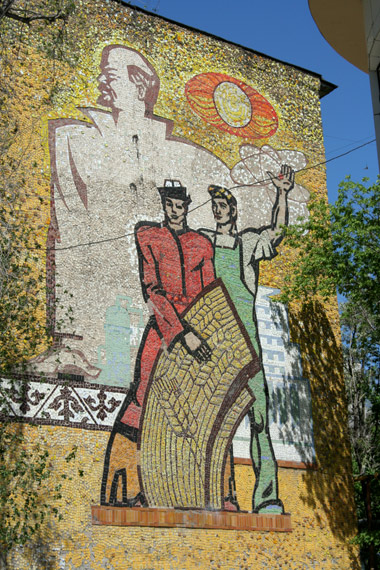
For some reason, I continue to notice his statues, busts, portraits.

That typical pointed goatee, a huge bold spot, "an eagle's look" - or, depending on the customer's demand, the "kind eyes" - which painters and sculptors from different countries tend to portray in their own ways.

Or, to be more precise, used to portray. But in such quantities that even now, nearly a whole generation since the Soviet Union disappeared from the map, you can run into him anywhere. Or, nearly everywhere.

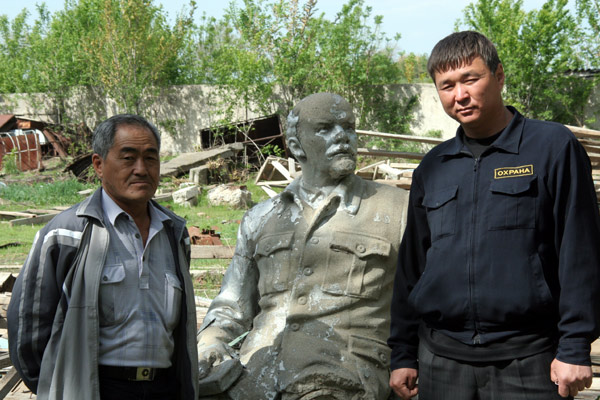
And here, in southern Kazakhstan, not far from the city of Shymkent, formerly known as Chimkent, there is a monument to the former leader, with one leg and one arm missing, at the warehouse behind the Mankent boarding house. [...]

[photo omitted]

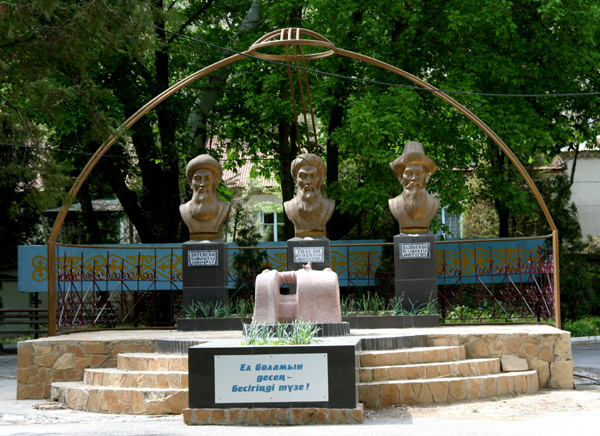
This monument used to stand [in front of] the boarding house. But times have changed, and it has been replaced with a stylized yurt that holds three busts of the leaders of three Kazakh [...] tribes, who are looking at a stone cradle with this inscription in blue on it (translation may be imprecise): "If you want to be the nation, start from the cradle."

[photo omitted]

Many people here speak of Lenin and his monument with affection.

"My son is a third-year student now," a warehouse worker told me. - "When he was in the second grade, I placed him onto Lenin's lap and took a picture of him. Now this photo is in my album at home. Could I have known that this monument would ever be spoiled like this? What had he done to them? Could be left standing..."

[photo omitted]

Of course, this was a cult similar to religious worship. Many people have noted this: among the elements of worship were the holy trinity [Lenin, Marx, Engels], and devoted disciples who were spreading "the light of the true teaching," and holy books, and cult-like celebrations... And, of course, what I see now are the remains of the cult.

[...]

[photo omitted]

[...]

Belarus: Freedom Day Protest

Global Voices Online
Sunday, March 30, 2008


On Tuesday, March 25, police broke up an opposition rally in Minsk, the capital of Belarus, beating protesters with truncheons and detaining dozens of people. According to media reports, thousands of protesters showed up for the annual Freedom Day rally, banned by the government, and attempted to gather at one of Minsk's central squares, which had been blocked off by the police. On Wednesday, the detained protesters - as well as several journalists - were sentenced to jail terms ranging from three to 15 days.

LJ users dranik80, ialeks, coipish posted very vivid photo reports from the March 25 rally - here, here, and here.

LJ user mmpbel, 30, posted a lengthy and detailed account (RUS) of his experiences at the rally and, later, inside a police bus:


[...] When we approached Victory Square, I finally saw the people who, just like me, intended to mark [Freedom Day]. [...] [They] stood on all sides of the intersection. Along the sidewalk, there were traffic cops. There were mainly young people there, 20-year-olds and younger. I saw several middle-aged people, and a few families. There were [white-red-white flags], and they were distributing white-red-white ribbons (I wasn't offered one). There were almost no flowers. I saw only one woman with a white-red-white bouquet. The mood was festive. I saw a small group of young people who walked out onto the road, one guy was waving a flag, encouraging people to follow him, but not many did and traffic cops managed to clear up the road very quickly. Soon, there was a solid cordon of traffic police along the road, and, a minute later, another one made up of riot cops. [...]

People started moving towards Victory Square, the march began. Those in the front row of the formation were carrying a banner (but I didn't see what was written on it). I could hear the usual slogans. (Too bad we're not singing songs. I'm not the [slogan-chanting] type, but I would've joined in a song.) [...]

Very close to the bridge, the formation halted. Must have been because of the police standing in their way. We stood for a few minutes. I saw [opposition leader Anatoly Lebedko] walk forward, to do something about it. After a while, those at the head of the formation began to turn around. At the same time or a bit earlier, a police bus drove towards the bridge. Then things began to move fast. I saw cops in helmets run. Young people with the banner began to reposition themselves quickly, in order to be at the head of the formation again. Someone was hurriedly hiding away a fishing rod with the flag. A guy who carried the banner turned around and called out a female name, but then someone screamed "Andrei!" and I saw a girl being grabbed and dragged to the bus. Quickly, people began to disperse. I've been in a stampede before, but it was the first time that cops were chasing me. Hesitantly, I also began to move faster, still not really believing this was actually happening. As I understood it, they were mainly seizing young people with flags. [...]

[...] I felt it was all over and decided to try reaching the monument to [Belarusian poet Yanka Kupala monument, [to lay flowers]. [...] I moved towards the bridge again. There was a police bus standing nearby, and from its window, a detained girl was making a Victory sign with her fingers. Young people stood next to the bus - possibly, friends of those who were detained.

[...] A few ordinary [not riot] cops stood at the park entrance. I asked one of them: "Is the park closed?" He said, "Yes." [...] As I walked down Yanka Kupala Street, I saw that the park's side entrance wasn't guarded by anyone and that the park itself was empty. A man and two women walked by: he was begging them to stop being scared and enter the park. [...] I came to the monument and put the flowers down. My flowers were the only ones on the snow, but underneath the snow there were many more white-red-white flowers. An elderly man [...] walked by. There was no one but us in the park. I stood a few seconds by the monument, trying to imagine "what He [Yanka Kupala] was thinking of the things that were taking place."

I decided to leave the park through the exit guarded by the police. [...] I had nothing on me that could make them suspicious. There was a bus I'd already seen there. [...] A cop came up to me [and told me to get out.] [...] Another cop came up to me and said: "What are you doing here?" I [exclaimed, in Belarusian]: "Why are you talking to me like that?" (normally, I speak Russian, alas). (I do look very young, but hate it when rude strangers address me [informally], especially the uniformed ones.) And here it began. The cop grabbed me by the jacket and dragged me to the bus, screaming something. [...] The road was slippery, I almost bumped into the bus. [...] They pushed me inside, hit me in the stomach, there were screams, and orders to show them what was inside my backpack. It was all being done just to scare me, without any system to it. The bus was small and narrow, there were about a dozen cops in it. Perhaps this explains why the blow to my stomach was weak. [...] A cop called me to the back of the bus, searched me there, but didn't look into my backpack. Told me to sit at the back seat. Then they forgot about me.

The cops were constantly chatting, joking, and appeared bored. Talked on the phones with their wives, explained to them that they were at an "event." [...] They were cursing constantly. [...] They were discussing the cars they'd bought.

After a while, there was some screaming, the door opened, and they pushed in a tall, skinny guy of about 30 years of age. There was intimidation again, [they ordered him to drop to the floor.] [...] They took him to the back of the bus and searched him. Found an asthma inhaler [...]. Ordered him to sit next to me. Two women were brought on the bus after him (it looked like they didn't push them in). One of them was the guy's mother, the other was her friend. They looked very refined [...]. The mother asked to let her son go, spoke of his and her own poor health (she had heart problems), was asking who was in charge. No one listened to her, the one in charge didn't respond. Someone said that they'd violated the law on mass events, entered the park that was closed for repairs, had [anti-government] flags with them, were calling to the violent overthrow of the [regime]. The mother was begging the cops, tried to argue with them, was asking to be allowed to step out for some fresh air, to call the relatives. They refused to let her do any of it. [...] We were ordered to switch off our phones.

[...]

Things were quieting down and the cops were getting bored.

A cop who looked like he was in charge came in and ordered the women and the guy to leave [...]. [...] They were not allowed to take their white-red-white umbrella with them.

I was left alone again. I felt like a Red Army soldier imprisoned by the fascists. Hatred and the feeling of complete helplessness. If they took me to the forest to shoot then, I wouldn't be very surprised. There was no sign of any legal rights whatsoever.

[...]

The bus began to move [...]. [Then it stopped.] [...] [I was told to get up and go.] I got up and went. [...] The cop in charge, standing by the door, called to me [...]. I came up to him. He hit me on the ear near he back of my head. I heard laughter coming from the bus. I turned away, the door closed, and the bus drove away. [...] I switched on my phone and called my wife. It was around 8:30 PM by then.

It did occur to me to file a complaint with the prosecutor's office, but I didn't consider the idea for too long.


LJ user annie-minsk, 21, described (RUS) what it feels like to be at a rally in Belarus:


You do not feel fear when you find yourself in the midst of everything - the police, people, flags.

No, you harden even more. Tears, fear and shaking hands are long forgotten, replaced with [...] a wicked smile and cold calmness of a convicted person. [...] You're no longer shy and stop [using the polite form of address]. [...] Your blood fills with adrenalin. Everyone is equal here, everyone [is your buddy] - welcome to hell!

When you look at the photos on the web the following morning, you feel it all again. As if you're back there. Back into this dirty, wet, nervous mess made up of people, cameras, fat riot cops with brass knuckles and unruffled traffic cops. And the groaning of the black-clad bastards [riot cops] - "Reh-eh, reh-eh" (this is how they scream when they are pushing people, in order to move in sync) - it doesn't horrify you anymore, not as much as it did then, the first time, in the cold March of 2006 [a GV translation from that time is here]. Then it seemed wild. Monstrous, inhuman. We hoped for the better, believed it was just a threat. They'd scare us and let go. And everyone would go home, and there'd be kitchen talk, and someone would write about it in LJ.

[...]

I've heard one and the same question so many times: "What are you trying to accomplish with your rallies?" My reply is, come, have a look, find it out. And don't bother me, because we won't understand each other anyway.


There are indeed quite a few observers out there who question the approach of the Belarusian opposition.

Mark Grigorian - LJ user markgrigorian, a London-based Armenian journalist and political analyst - wrote this (RUS) on his blog on March 26:


I've been following the events in Belarus for a long time.

And I see how year after year the same story gets repeated: the Belarusian opposition announces a march, demonstration or rally devoted to the date that's important for the country and for the Belarusian nation as a whole. The authorities order them to change the route or the date or the place of the event, moving it from the city's center to its outskirts.

The opposition disagrees, holds the march (rally, demonstration) where it wanted to hold it. Often, it ends in clashes with the police. [...] There are dozens of detained as a result (including journalists), there are short-term arrests, the noise about human rights violations and sympathetic articles in the Western press.

I understand that I risk eliciting extremely negative reactions from my Belarusian [friends]. But I do have to mention that the stubbornness with which the opposition keeps holding events of the same type, which end with in a more or less predictable way, makes one think of the lack of imagination.

Also: I don't know what the response to these actions is inside Belarus. Outside - yes, it is effective. The press keeps writing about it, European and American politicians draw conclusions. But inside the country? What changes in Belarus? Are there more opposition supporters? Or, the opposite, are there fewer of them? [...]

If there is a political component, one has to consider this: what are the political results inside the country? If they are negative, why hold the new [protest] actions?

[...]

And if dispersals, beatings and arrests are so easy to predict, then why push young guys and girls at the riot police cordons?

[...]


Here is one reader's comment on Grigorian's post:


pisalnik:

I think it's a mistake to think that it's the politicians who push the young people towards the riot police cordons. I wouldn't overestimate the impact that the adult politicians have on the mood in various oppositional youth groups. It's actually the young people who often criticize adult politicians for being too moderate and not radical enough. The theory of manageability of the unwise youth by adults (including those from abroad) offers, by the way, the most convenient explanation for such events, but this theory happens to be, more often than not, an unacceptable simplification and cannot serve as a basis for the conclusions that you've arrived at. Belarusian opposition is far from being monolithic, and that's why we shouldn't presume that it can coordinate its actions. That is - what we observe in Belarus isn't the issue of the lack of creativity and imagination, but the problem of discord within the opposition and the "fathers and sons" conflict.

As for the political consequences of such seemingly pointless actions, sometimes one has to wait for a very long time. But there'll be no results if resistance stops.

[...]

I find it hard to imagine how it is possible to diversify the situation, when the regime always has an obvious advantage in its confrontation with the protesters, mainly in the form of the disciplined and obedient repressive machine. [...]

In the end, it's all about the impossibility to coordinate the activities of the conflicting [...] opposition groups - and the regime makes use of it more or less successfully. Coordinated activities and readiness to express solidarity within the oppositional camp - that's the main problem. How to solve it? I don't know.


As for the impact of the opposition's protests within Belarus, some bloggers think there isn't too much of it.

LJ user lidial reposted an inquiry (RUS) from live_report, a joint project of LiveJournal and BBC Russian Service, to minsk_by LJ community:


BBC is asking:

What's going on in Minsk?


Below are some of the responses:


beatleofdoom:

Nothing - 80% of the residents would reply.

lidial:

86% )

aller:

83%

happybullshit:

Something like 93%

head_of_babulka:

No less than 96

cx_vutik:

102