Showing posts with label [oleg_panfilov]. Show all posts

Georgia, Russia: Feeding Looters and Refugees

Global Voices Online
Tuesday, August 19, 2008


See Global Voices special coverage page on the South Ossetia crisis.

A number of Tbilisi residents gathered in front of the Russian embassy Saturday for a protest prank against looting. LJ user oleg-panfilov posted photos and wrote this (RUS) about the initiative:

[...] To the Russian embassy in Tbilisi they brought old refrigerators, toilets, rolls of toilet paper, irons, bottles of vodka, forks and spoons, clothes and other objects that [looters from the Russian army] took interest in during their visits to private houses of Georgians, state institutions, military bases and army barracks.

People are coming up to have a closer look, shake their heads, laugh. Cars that are passing by are honking...

[six photos]


Tbilisi-based LJ user tony-geo wrote critically (RUS) about the stunt:

"Let's Feed the Russian Army" Action

The action itself is, of course, a powerful PR weapon. But only as long as many Russians get to know about it. I suspect, however, that neither [Vremya news show on Channel 1], nor [Vesti news show on RTR] are going to cover this action.

Here's what I mean. A Russian woman, mother of a Georgian officer, horrified, says that her mother in [Kaliningrad] has no idea whatsoever of what's going on in Georgia and thinks that the Georgian army is still attacking Tskhinvali, which is being courageously defended by the Soviet army. Thank God, she hasn't put a curse on her grandson, who is killing Russian soldiers in that Tskhinvali.

I confirm this report. I talked to my sister in Russia yesterday. Formally, my sister is Georgian, but she was born and grew up in Russia, just like myself, and has only spent a total of a few weeks in Georgia in the 30 years of her life. But she kept her Georgian maiden name when she got married [...]. Anyway, she's also clueless about what's going on. Most ordinary people do not use the internet and satellite TV to get reliable news - they are watching what the [Russian state-owned channels] are showing. So why should it be surprising that this majority firmly believes that the Russian troops have not stepped outside Tskhinvali [...]?

But this isn't my point. In a kindergarten [in one of Tbilisi's neighborhoods], there are 110 refugee families with lots of children. Social aid hasn't made it there. They put them there and that's it, if there's time - we'll help you. At this kindergarten, unlike at the school in the same area, there are children's beds at least. Most people sleep on the floor. There are no blankets and mattresses. They eat what they can buy on the money they've got left. As you understand, they don't have much money left. Yesterday, food was delivered just once to this kindergarten. Stale bread. For 110 families - seven kilos of sugar.

Last night, I took a sack with children's clothes, which I had planned to take to the central donation point [...], to this kindergarten. We (along with my neighbors) also took 20 kilos of sugar and one and a half kilo of butter there. Today I've brought them fruit, milk, [matsoni] and diapers.

Georgians, damn it, enough of the information war. Look out of the window, there are kindergartens and schools packed with refugees out there. First, take what you can to them, and then go to the Russian embassy. [...]

Georgia, Russia: “What's Next?”

Global Voices Online
Wednesday, August 13, 2008


Russian president Dmitry Medvedev announced the end of the so-called "peace enforcement" operation yesterday. LJ user varfolomeev66 - Radio Echo of Moscow journalist Vladimir Varfolomeev - asked this question on his blog: "What's next?"

He wrote (RUS):

I'm not referring to Georgia now.

The Russian government has used every serious crisis as a reason for yet another tightening of the screws and strengthening of its own positions. After the [Moscow apartment blasts of 1999], the [Second Chechen War] began, and Putin came to power. After [the 2000 Kursk submarine disaster] and then [the Nord-Ost theater siege in 2002], [ORT and NTV TV channels] were finally suppressed. After [Beslan school siege of 2004], regional elections were canceled.

What is the regime up to now?


Here are a few comments to this post:

oleg_kozyrev:

- Control of the internet

varfolomeev66:

Considering that there's almost nothing uncontrolled left, this is possible.

humanist_us:

They'll tighten the remaining screws on the internet.

And [Radio Echo of Moscow] ;)

Though you were definitely trying hard not to annoy our two dwarfs [with your coverage of the crisis]


Blogging from Tbilisi, LJ user oleg-panfilov - Oleg Panfilov of the Center for Journalism in Extreme Situations - posted the day's summary on his blog and explained (RUS) what the five-day crisis might mean for Georgia politically:

Today was the day of emotions.

First, an incredibly huge rally in the center of Tbilisi and people crying during Saakashvili's address.

Second, a day of waiting, while the politicians were discussing and expressing opinions on Georgia and its relations with Russia.

And finally, Georgia's departure from [CIS, the Commonwealth of Independent States]. For now, in the form of a political statement, but after a while, in a matter of a few days, Russia will automatically turn into an occupying force not just formally, but legally as well, because it will lose its status of a "peacekeeper" on behalf of CIS. And then, in accordance with all international laws, any presence of [Russian] troops on the territory of South Ossetia and Abkhazia can be recognized as illegal.

To put it differently, yet another military adventure has turned into [a nothing].

I don't know what kind of thinking overwhelmed Russian military commanders (of course, if there was any thinking involved at all), but Georgia has managed to endure and avoided getting back into the state it was in during the Soviet times. That is, a state of a ["large shashlyk restaurant"] for the Russian nomenclature.

If we analyze what's happened, we'll find many arguments both in favor of Georgia, and in favor of the imperial ways of today's Kremlin. One thing is clear, though - Georgia is not going to turn into a different country, it has tasted freedom in the past five years, has tasted democracy, despite the fact that many people do not like it.

Now it's up to other remnants of the Soviet empire whether they are going to continue living the way they did or will learn from Georgia.

Tomorrow is another day of waiting.


Below are a few comments:

mormegil11:

Georgia has lost South Ossetia and Abkhazia. When euphoria ends, gray everyday life will begin - without money transfers from [relatives working in] Moscow, without sea and air transport connection [with Russia], without working banks - and then the size of the catastrophe will grow larger than the size of the naive and excited crowd at the rally.

This war has no [winners or losers]. There is guilt, a feeling of enormous guilt before the dead ones: Georgians, Russians, Ossetians, Ukrainians, Dutch... And what is membership in CIS, or NATO, or anyplace else compared to this guilt...

rousyn:

"without money transfers from [relatives working in] Moscow"

Re-orientation of labor migration to the West? Isn't his progress? [...]

realpushkin:

Oleg, you are wrong, unfortunately. [...]

1) NATO countries and allies in general are not going to get themselves involved in a war with Russia, if it happens again - this is [counterproductive] for everyone.

2) Abkhazia and South Ossetia are not going to become part of Georgia even as autonomies - most likely, Russia will recognize their independence.

3) If it is proved that civilians died in Tskhinvali because of [the use of Grad multiple-launch rocket system] - Saakashvili will not have a chance to join [any organization]. [...]

Georgia, Russia: Tbilisi Reports

Global Voices Online
Tuesday, August 12, 2008


See Global Voices special coverage page on the South Ossetia crisis.

Below are a few posts from bloggers who are currently in Tbilisi, Georgia.

LJ user merienn wrote this (RUS) from Tbilisi on Aug. 11 and 12:

Aug. 11, 2008 - 10:46 AM:

At 6 AM today, Marina called, scared to death: there was an explosion, and their windows were nearly smashed over at Gldani. Turned out the radars [...] that serve the international airport were being bombed.

Yesterday, Khelvachauri, a suburb of Batumi, was bombed, Sandro is staying there with grandfather and grandmother and doesn't want to go to the village to my parents.

Khatuna and I were walking with kids [at the park], it's almost empty, and we took them to McDonalds' - banned in peaceful times, it seems so attractive in the time of war.

Yesterday, crowds of people were marching all over the city with flags, chanting "Sakartvelo" - Mishka didn't understand what was going on.

- There's war now, and we are being bombed, and these people are demanding to stop all this.
- And who's doing the bombing? - Mishka the Ant asked, [his eyes huge with surprise].

I didn't tell him who was bombing us.

- Let them throw these bombs on themselves, I hate them, - Mishka got angry in a funny way.

Just a week ago we were chatting about some sweet trifles - where they do French manicure better, and where I put that swimming suit, and how to train your husband to hang his wet towel on the rope.

Now we are breaking our heads, [trying to figure out] how to get to Batumi with kids and avoid being shot at, where a safer place to take shelter is, who said what the UN Security Council, whether it is true that people got killed in Poti.

There's no panic. [...] There was shock on the first day, and then it started feeling as if we've been living like this for a hundred years. Crowds of people are donating blood. We knew that this is how it would be. [...]

We are not leaving anywhere. [Because] all they do is wait for us all to leave.

***

Aug. 11, 2008 - 11:54 AM:

[...] There is no Russophobia whatsoever - I've already said more than once that we have very clear boundaries separating the notions of the Russian state and the relations between the peoples. [...]

I'll pack a backpack, just in case - warm clothes, water, documents. Refugees have taught us so - the rest doesn't matter.

Though it is unclear where we'll be forced to go - there's not a single place in my country that's inaccessible for the brave fighter jets.

They bombed Gori once more. Bombed Kakhetia.

Sites hosted in Georgia have been hacked, there's no opportunity to access Russian sites, so LJ remains my only platform to keep in touch with the world. [...]

***

Aug. 11, 2008 - 07:00 PM:

[...] We've decided not to go yet because it is dangerous. At home, the walls [of a house] help. [...]

Value all that you have. Value the fact that you are alive and healthy, that you can watch a movie instead of the news, that you can buy a ticket and go anyplace you like. [...]

***

Aug. 12, 2008 - 01:38 AM:

I don't know what's going to happen tomorrow morning. Maybe tanks will enter the city. Mishka is asleep, my little boy, he kept turning around, asking: They aren't bombing Batumi, are they? He misses his brother. I shouldn't have told him yesterday. Though this way he is prepared, at least.

All hope for Sarkozy, maybe he'll convince them - but this is unlikely, too, no one is going to back out at this point - they'll be eating us hot.


Tbilisi-based LJ user dzvirpaso wrote this (RUS) on Aug. 11:

I've just called Ukraine's consul in Georgia, I know him well. He said that he and his family (wife and two children) are here. He said that those who wanted to leave were leaving, but assured me that the situation was stable. I asked whether he thinks if it would be better to leave or not, and he replied that there's no need to at this point, that everything is stable and will soon be over. If something happens, he will definitely call me.


LJ user oleg_panfilov reports (RUS) on the situation in Tbilisi this night:

I've just had a ride around the city - everything is quiet and calm. People are discussing the situation on the phones and that's why it's been impossible to reach friends in the past two or three hours. Some people manage to get through [to my number], ask me what to do, and then the phone goes silent again.

There is panic, of course, but for now only in conversations and discussions. Though there are those who've decided to leave already - mainly to Eastern Georgia, towards Azerbaijan.

I can't get rid of the thought that these people do not want to greet the occupational troops with flowers and wine - even though there's such an effort being done for them, all the demands for Saakashvili to escape... [...]


In another post, oleg_panfilov adds (RUS):

[...] Tomorrow there'll be plenty of politics.

Forgot to write that Eka Zguladze, deputy minister of foreign affairs of Georgia, has confirmed to me that tomorrow, in the middle of the day, presidents of Latvia, Lithuania, Estonia, Poland and Ukraine are expected to arrive in Tbilisi.

Georgia, Russia: More Reports On the Conflict From Russophone Bloggers

Global Voices Online
Sunday, August 10, 2008


See Global Voices special coverage page on the South Ossetia crisis.

Blogging from Poti, a Georgian port city whose "oil terminal, port facilities and a nearby railroad junction" were attacked by Russian fighter jets shortly after midnight Saturday, 27-year-old LJ user pepsikolka, an ethnic Russian citizen of Georgia, posted these hurried reports (RUS) on Aug. 8 and 9:

Aug. 8, 2008 - 1:23 PM

My colleagues have been drafted, some of them early in the morning, I'm shocked, can't understand what's going on and where to look for the truth - Georgian channels say one thing, Russian say something else, what's going to happen???

***

Aug. 9, 2008 - 12:50 AM:

The port has been bombed, we're sitting in the street, scared, they say some people have been wounded. Pray for us.

[...]

alchutoff:

[...] That's ours [Russians] who are bombing you, right?

pepsikolka:

Oh God. I don't know, but that's what they are saying.

***

Aug. 9, 2008 - 1:07 AM:

They are done bombing the port, we're out in the street, God save us.

***

Aug. 9, 2008 - 11:48 AM:

It was quiet during the night, but no one went to bed. There's no TV, we're reading the news from our phones. Scary. My friend, a colleague, has been wounded, and there are the dead ones, seven people from the port, they say, and there are also the dead among those mobilized after the bombing. I've no reason to lie, and those commenters who have doubts just don't know anything about me, I am Russian myself, and that's why I'm writing about facts here, so that you knew, we are alive, but scared. I want peace and this is all.

***

Aug. 9, 2008 - 2:20 PM:

[...] The city is nearly empty, I've stayed, [because] I've got my pets, and mama doesn't want to go anywhere. We are home. There's not a single drop of gasoline in the city. Panic. Ships are honking often. [...]

[...]

antifalsehood:

[...] You were the ones who got yourselves involved in the slaughter, you trust your [Georgian president Mikheil Saakashvili] and his circle, and here's what you get. Of course, I don't believe that everyone is as much of a bastard as your [Saakashvili] is, but you'll sure answer for the thousands of dead Ossetians. Watch your asses since you've got no souls anymore.

night_the_only:

Do you understand what you are saying and to whom?

pepsikolka:

I didn't want to get into it, as I feel I'll get a full load for it, but still, I'll say it - why do you assume that we support Saakashvili and do not condemn what's been done in Tskhinvali? Here're the people sitting here, some of them support [Saakashvili], others don't, but the bomb sees no difference between those who supported him and those who didn't.


(A more detailed post by LJ user pepsikolka, written on Aug. 10, will be translated later tonight.)

Oleg Panfilov - LJ user oleg_panfilov, director of the Center for Journalism in Extreme Situations - happened to be spending his vacation in Georgia. He posted this comment (RUS) about air strikes on the Georgian town of Gori, carried out by the Russian forces on Saturday morning:

A few hours after I had passed Gori, the "peacekeepers' fighter jets" hit the town. One plane was downed - one pilot died, the other was arrested and is being interrogated.

It's hard to understand what they are trying to achieve by hitting [outside of] South Ossetia, but it looks like Russia is becoming more and more like the Soviet Union...

If someone in the Kremlin hopes that this will split Georgia and the Georgian society, they are deeply mistaken - all the opposition leaders announced their support for [Mikheil Saakashvili]. Even [Irakli Okruashvili], the [dismissed former] minister of defense, said he was ready to go to South Ossetia as an ordinary soldier.

[...]

There is no panic in Tbilisi, but many friends are calling me, incredulous - they [knew Russia was capable of a lot], but [to act like this]... [...]


A day earlier, on Aug. 8, LJ user tanelorn asked a question (RUS) about the situation in Tbilisi, the capital of Georgia, in the tbiliseli LJ community, set up for "all those who consider [Tbilisi their native city]:

Are things quiet in Tbilisi? How does it all reflect on the life in the city?


Here are some responses:

le_petit_tank:

It was quiet during the day, although, of course, people do worry. They are listening to all newscasts on all available channels - Russian and Georgian. And in between the news, we were watching the opening of the Olympics. They say they were catching people right in the street and sending them to draft centers. But I won't risk asserting that this is actually so...

satis_fiction:

My brother called me and said that they'd announced mobilization. He went to sign up, there were many like him there, who came by themselves.

[...]

vtar_vtar:

I don't think it has [affected life in the city] in any way. Of course, it was somewhat strange to see how in small open-air cafes they were playing news on TV instead of [pop music] videos. And, of course, those families that had their boys drafted are worried. Otherwise, nothing special.


28-year-old Tbilisi-based LJ user shupaka wrote (RUS) about an unpleasant sense of déjà vu, brought about by the announcement of mobilization of the troops in Georgia; the current situation has reminded her of the conflicts that Georgia had found itself in in the early 1990s:

...and one more observation, totally silly: the word "mobilization" inspires the same disgust in me as it did when I was a child. Doesn't matter if you're 13 or 28.


North Ossetia-based LJ user alan-tskhurbaev wrote (RUS) about a mobilization of a different kind, supposedly taking place in South Ossetia now:

[North Ossetian] volunteers in [South Ossetia].

There are many of them. And I have to admit that I was mistaken, thinking that in case of a war only a few would show up. A friend has just returned from the border [...], says many people are crowding there, arriving in their own cars. They are letting everyone in, at their own risk. At least one car goes through every few minutes, he says. He even said that some guys went there in their new BMW X5. Ossetians have not deserted each other. Turns out that in peaceful times we dislike each other, act arrogantly towards some, make fun of others. But as soon as a war begins (and Ossetians have probably lost count of all their wars by now) - we are together. [...]


Elsewhere in the Russophone blogosphere, there seems to be plenty of confusion about what's actually going on in South Ossetia and Georgia now. Take, for example, this post from last night (RUS) in the ru_politics LJ community, by LJ user er_v, and some of the comments it generated:

Can anyone tell me whether there are Russian troops in [Tskhinvali] or not?

***

mr_quietest:

Judging by everything, no.

[...]

beekjuffer:

Judging by what?

deneb_altay:

There are, don't worry.

nurmanov:

[Judging] by many things: the lack of pictures, the demands of the Russian journalists to allow them safe passage out of Tskhinval...

[...]

er_v:

No, but if we took Tskhinvali, they would definitely show it on the news. [...]

beekjuffer:

We already took it. Then Georgians took something, too. Then we were pushing them out. Judging by everything, it will continue like this for a long time.

[...]

elf_ociten:

And the Roksky Pass [on the Trans-Caucasus Highway] has been blown up, too :)

mr_quietest:

Not sure.

[...]


Regarding the alleged destruction of the Roksky Pass, LJ user som, a Russia-based Georgian, posted this item (RUS) last night:

URGENT

ON SATURDAY EVENING, AUGUST 9, GEORGIAN TROOPS BLEW UP ROKSKY PASS, THROUGH WHICH HUMAN PERSONNEL AND MILITARY EQUIPMENT WERE BEING SENT FROM RUSSIA TO THE FIGHTING ZONE IN TSKHINVALI REGION.


Some two hours and about 50 comments later, however, LJ user som admitted (RUS) that there had been no confirmation of this report and that this could be part of the "information war."

Russia, Tajikistan, Kazakhstan: Lenin's Birthday

Global Voices Online
Wednesday, April 23, 2008

On April 22, Vladimir Lenin would have turned 138 - and quite a few Russophone bloggers still remember the date.

Oleg Panfilov - LJ user oleg_panfilov, director of the Center for Journalism in Extreme Situations - chose to write (RUS) about his native city - Khujand, Tajikistan - which was known as Leninabad from 1939 till 1992:

You know, [Soviet/Russian scholar Dmitry Sergeyevich Likhachev] once supported the idea - put forward by myself and my colleagues - to return the ancient name to my native city. And it successfully made it back into history as Khujand, not as Leninabad, which it had been for over 50 years, even though Comrade Lenin had never visited it.

To me, April 22 is now the day when I can smile sarcastically - perhaps he lived and used to be alive [allusion to these lines by poet Vladimir Mayakovsky], but he'll no longer be in my city. Thank God!


Mark Grigorian - LJ user markgrigorian, a London-based Armenian journalist and political analyst - posted his reflections (RUS) on Lenin and his legacy from Shymkent, Kazakhstan:

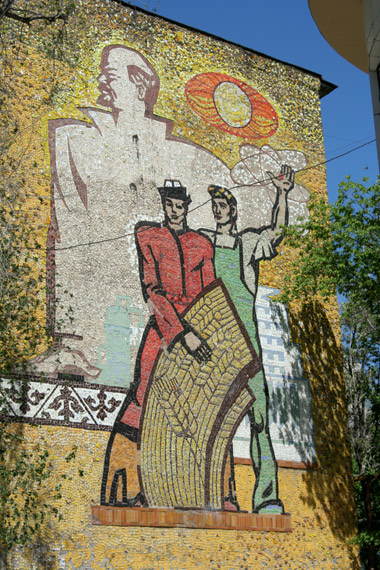
For some reason, I continue to notice his statues, busts, portraits.

That typical pointed goatee, a huge bold spot, "an eagle's look" - or, depending on the customer's demand, the "kind eyes" - which painters and sculptors from different countries tend to portray in their own ways.

Or, to be more precise, used to portray. But in such quantities that even now, nearly a whole generation since the Soviet Union disappeared from the map, you can run into him anywhere. Or, nearly everywhere.

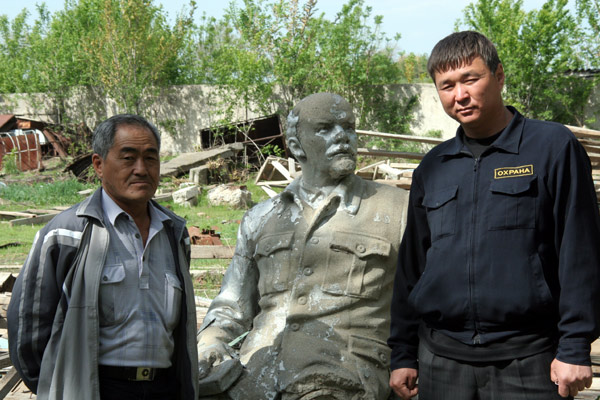
And here, in southern Kazakhstan, not far from the city of Shymkent, formerly known as Chimkent, there is a monument to the former leader, with one leg and one arm missing, at the warehouse behind the Mankent boarding house. [...]

[photo omitted]

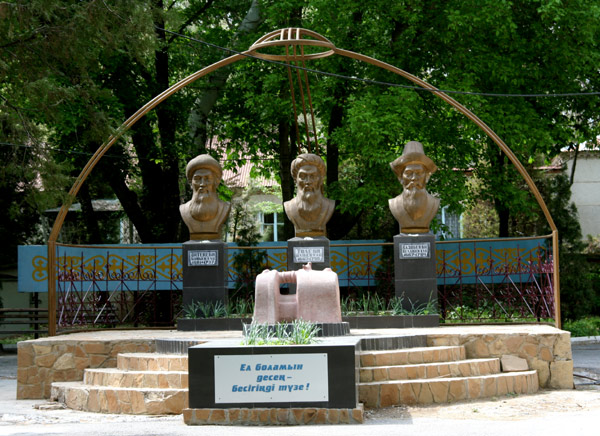
This monument used to stand [in front of] the boarding house. But times have changed, and it has been replaced with a stylized yurt that holds three busts of the leaders of three Kazakh [...] tribes, who are looking at a stone cradle with this inscription in blue on it (translation may be imprecise): "If you want to be the nation, start from the cradle."

[photo omitted]

Many people here speak of Lenin and his monument with affection.

"My son is a third-year student now," a warehouse worker told me. - "When he was in the second grade, I placed him onto Lenin's lap and took a picture of him. Now this photo is in my album at home. Could I have known that this monument would ever be spoiled like this? What had he done to them? Could be left standing..."

[photo omitted]

Of course, this was a cult similar to religious worship. Many people have noted this: among the elements of worship were the holy trinity [Lenin, Marx, Engels], and devoted disciples who were spreading "the light of the true teaching," and holy books, and cult-like celebrations... And, of course, what I see now are the remains of the cult.

[...]

[photo omitted]

[...]

Uzbekistan, Ukraine: Tashkent Blacksmith and His Children

Global Voices Online
Monday, April 21, 2008


On April 13, Oleg Panfilov - LJ user oleg_panfilov, director of the Center for Journalism in Extreme Situations - reposted an item (RUS) from a Central Asian news agency Ferghana.ru on the dismantling of the International Friendship Monument in downtown Tashkent. The news got many people upset: there are 162 comments on Panfilov's post (RUS), and 128 comments on Ferghana.ru's Russian-language article.

Below is part of the article's translation, posted on Ferghana.ru on April 16:

The Tashkent authorities had the International Friendship monument in front of the Friendship of Peoples Palace dismantled on April 12 night. The monument had been erected in memory of the Shamakhmudovs who adopted 15 orphans in the Great Patriotic War and became a symbol of generosity and humanism of the Uzbek people.

[...]

The Shamakhmudovs' story is known to absolutely everyone in Uzbekistan. When Tashkent women appealed to the women of Uzbekistan to adopt children evacuated from all over the Soviet Union in the first months of the Great Patriotic War, smith Shaakhmed Shamakhmudov and his wife Bakhri Akhmedova adopted 15 orphans - Russians, Belarussians, a Moldovan, Ukrainian, Latvian, Kazakh, Tatar, and others.

The Shamakhmudovs gave the children what they lacked - a genuine home and family. [...]

It is clear that not even the head of the city administration could made this decision entirely on his own. The monument must have failed to fit Islam Karimov's concept of the Uzbek state.


LJ user diana-ledi - Diana Makarova, a Kyiv-based journalist - read about the dismantling of the Tashkent monument on Panfilov's blog. She responded by blogging about one of Shamakhmudov's adopted children, Fyodor Kulchanovsky, and the role her own father played in helping the war orphan find his biological family. Below is a partial translation of this very moving story (RUS) - which has received 187 comments:

It happened someplace else. An outrageous, unpleasant thing, but far away, not where we are. Why am I crying then?

[...]

... The boy's name was Fyodor. He was 4 at the time when they were [in a hurry to evacuate the kids of Ukraine]. There was little time - the Germans were conquering Ukraine [very quickly]. There were not enough trains - the children were leaving without their families. No room for adults - [saving the kids was a priority]. Their IDs were getting lost, or copied by hand...

Fyodor arrived in Tashkent with [...] a notebook that stored his personal info, entered in someone's handwriting. At the orphanage, the contents of the notebook were copied when they created [Fyodor's] personal file. But they misread the handwriting. Fyodor was Kulchanovsky - but was turned into Kulchakovsky. And then blacksmith Shamakhmudov came to the orphanage and took Fyodor in. There were 16 adopted kids living in the blacksmith's house, I guess. Though they now say there were 15 of them.

But this doesn't matter. What matters is that the blacksmith and his wife brought them all up. Provided them with education and living quarters. Impressive, isn't it? Fyodor was the most difficult of the kids. He often quarreled with his father. But his adoptive mother, following the father's death, spent the rest of her life at Fyodor's house - and this says a lot about Fyodor.

[...] Fyodor didn't remember any of his blood relatives, but dreamed of finding them. And he devoted his whole life to this dream.

Just one tiny letter misread in a last name! And all the investigations that Fyodor led since childhood kept getting nowhere. And he grew up in the meantime, got married, was raising three kids of his own already. He buried his adoptive father and had his mother move in with him.

They kept telling him to stop searching. It was clear that it was impossible to trace a family about which it was only known that it had stayed back in Ukraine. That was it. No other initial data, except for the last name. Which, as it turned out later, was not accurate.

But the piles of documents, letters, inquiries were getting heavier. Fyodor kept looking. He became a grandfather himself, but continued his search.

... My papa lived in [Ukraine's Zaporizhzhya] region, worked as a journalist. [...]

His favorite occupation [...] was searching for people who had disappeared during the war. These were quiet investigations that lasted years. Piles of documents, letters, responses to inquiries.

Once, papa got an assignment to write about an old woman from [Ukraine's Dnipropetrovsk] region, who had managed to survive till 104 years of age, keeping clarity of mind [...].

[...]

- [...] Do you know why she's managed to survive till 104 years of age?
- Well, I don't. Perhaps, she was a good girl, didn't drink, didn't smoke?
- That too, of course. - My papa smiled. - But here's what has shocked me. She lost her grandson during the war. A 4-year-old boy left to her by her deceased daughter. And this old woman swore not to die until she found the grandson. She said - "How will I look my daughter in the eye in that world?" And she keeps on living, still keeps on searching.
- And then what?
- Nothing. A dead end. The boy either died along the way, or in evacuation. Or someone adopted him, and changed his last name. I think it's impossible to find him.

This was what my kind papa said. And began looking for a boy who was impossible to find.

Two thin threads existed for a few years - one from Tashkent, the other from Zaporizhzhya. Papa decided to check the possible interpretations of the last name Kulchanovsky. He counted on bad handwriting and the factor of a misspelled last name.

Papa had a surgery and was diagnosed with cancer in its final stage. According to the doctors, he couldn't last longer than two weeks. But he lived another year. He worked so hard in that last year! When he was not losing conscience from pain...

Every morning, we were sending out letters with texts that he was working on at night, and, of course, the inquiries. [...]

Two weeks before his death, he asked to be taken to the hospital. Mama explained to me later that he didn't want me to see his death. My tiny [daughter] was a month and a half then. I couldn't worry THAT much, my papa believed. [...] Papa was being taken away to die, he was hugging me and kissing my children [...]. He was saying farewell. And me, I wasn't, I was thinking, it's okay, dear papa, I'll rush to your hospital tomorrow. I didn't know that he had ordered not to let me in to see him. Dinochka shouldn't worry, because she can lose her milk for the baby...

And this was when they brought that crazy telegram:

"Come urgently! The meeting of grandmother with her grandson! Grateful, happy!" [...]

Papa read it and smiled. He knew already that the two tiny threads had met - Fyodor's thread and the thread of papa's new search. And it was a matter of time before Fyodor arrived to meet his grandmother, who had sworn not to die until she found him. And to meet his aunts, brothers, sisters, cousins.

[Pravda] later wrote about this meeting, and next to this piece, there was my papa's obituary.

[...]

Three months later, Fyodor came to our house. He asked us to take him to papa's grave. When he came to this freshly laid clay hill, he knelt and kissed the ground. We don't do it here, right? But Fyodor had had [an Oriental] upbringing. He was not afraid to speak in beautiful words. He valued beautiful feelings. He said:

- Your family is my family now.

And he came for a visit every year since then - to see his grandmother, then to papa's grave.
Then - to his grandmother's grave, and to papa's grave.

Then we moved. Fyodor also moved from Tashkent to Rostov. Difficulties of the post-Soviet period began, and we lost each other...

Two years ago [...] Fyodor found us. It hadn't been difficult for him to - he was used to searching. He came to ask about our lives, whether we were healthy. Whether we needed any help.

We were drinking tea. I was again asking him about his life in the renowned family of the Tashkent blacksmith. And he was telling me about the construction of that monument in Tashkent - a monument to their family. With his [...] finger, he was pointing at the stone figures of the children on the photograph, explaining which of them was devoted to him.

... On April 12, they destroyed the monument to the Shamakhmudovs family in Tashkent. [...] I'm crying. I always cry when someone hurts children.

And I'm also crying because my papa is dead. It's as if he died the second time today. [...] My kind papa - journalist KONSTANTIN SALNICHENKO.

[...]

Southeast Europe, Russia: War, Peace, and Shared History

Global Voices Online
Sunday, April 6, 2008


In Vladikavkaz, the capital of Russia's North Ossetia, LJ user alan-tskhurbaev ran into a stencil graffiti, whose message (RUS) seemed somewhat unlikely for this North Caucasian region:

Kosovo is Serbia!


Referring to Georgia's breakaway region of South Ossetia, whose leaders regard Kosovo independence as a precedent, Oleg Panfilov - LJ user oleg_panfilov, director of the Center for Journalism in Extreme Situations - posted this comment (RUS):

Wasn't there a second part - "South Ossetia is Georgia"?


LJ user alan_tskhurbaev replied (RUS):

Since the question is addressed to me and not to the author of the graffiti, I'll express my own opinion - South Ossetia is not Georgia even more than Kosovo is not Serbia. And here [in North Ossetia], you don't have to write it on the buildings - everyone knows it anyway.


***

Paris-based LJ user sebtinos stumbled upon a history textbook published by the Center for Democracy and Reconciliation in Southeast Europe (CDRSEE): "A textbook that teaches peace," he described it. Below are some of his thoughts (RUS) on the project:

[...] Sixteen historians from various corners of the Balkans have developed the region's joint history textbook.

The essence is simple. Albanian history textbooks teach that if all other peoples disappear from the earth, Albanian nation will continue to flourish. In Greece, high school students are being taught that "the fall of Constantinople" took place in 1453, while their Turkish counterparts learn about the "liberation of Istanbul." Students from Skopje, Belgrade and Sofia get to know the history of the "liberation from the Turkish yoke," while in Ankara they study the "dramatic and unfair war that put an end to the Great Ottoman Empire."

Indeed, there are as many versions of the Balkan history as there are nations living in this region. Each group is searching through history to find explanations of the present and arguments in favor of the national idea. Kosovo believes it has historical arguments to support its independence. Belgrade is convinced of the opposite. Today, every nation has its own view of the past and isn't really concerned with finding ways to co-exist in the present.

[...]

And it has occurred to me ... that, perhaps, the former Soviet republics should stop [...] re-writing history separately and finally publish something jointly.


In response to a reader, LJ user sebtinos added:

I had a chance to attend schools in four different countries: USSR, Russia, Ukraine and France. The views differ completely. It's not fair that the humankind has one universal history, but nations or individuals [do not share a common view on it.]


LJ user sebtinos also crossposted his history textbook entry to the ru_politics LJ community, and below are two reader responses (RUS):

kabashek:

Joint history is not good for the powerful elites [of each nation]. Makes it harder to manipulate [the population]. And the example you're citing is funded by the EU, not by Albania and Turkey.

***

stepanov_karel:

I, of course, haven't read this textbook, but I suspect that it's written [in an extremely appeasing manner]. That is, all controversial topics are simply ignored.

All controversial topics have to be thoroughly discussed, however.

Russia: Two Dagestani Journalists Killed

Global Voices Online
Sunday, March 23, 2008


Ilyas Shurpaev, a 32-year-old TV journalist and blogger (LJ user shurpaev), was found strangled in the apartment he was renting in Moscow Friday. (More detailed English-language media accounts of the murder are here.)

A native of Dagestan, Shurpaev had been based in Makhachkala until very recently, covering the Caucasus region for the state-owned Channel One. (A Sept. 2007 Global Voices translation featuring his observations on the situation in Ingushetia is here.) He transferred to Channel One's Moscow office a month ago.

Timur Aliev - LJ user timur_aliev, a journalist and Chechen president Ramzan Kadyrov's aide - wrote this (RUS) about Shurpaev:

[...] He was an excellent guy - witty, communicative. Lots of fun stuff on his blog - yesterday, by the way, he wrote a lot there. We knew each other mainly through LJ. Though we did run into each other once in real life - at a seminar in [Nalchik]. And for the New Year's, he sent us some gifts, through friends from Makhachkala. It's been hardly a month since he moved to Moscow, and we were congratulating him in LJ on the new job location. He had been covering all kinds of things in his native Dagestan (explosions, terrorist acts, warfare) and nothing had happened to him. And in Moscow, he got killed...


Oleg Panfilov - LJ user oleg_panfilov, director of the Center for Journalism in Extreme Situations - wrote this (RUS):

Ilyas had a book in him. And, perhaps, even more than one. He was very talented, his blog was, I think, one of the best ones in my [feed]. I recommended it to many people, although sometimes I had a problem with his loose style and "salty" words...

Most likely, they attempted to rob him, but they didn't take his laptop. I don't think it was a work-related murder, because Ilyas was a rare journalist who did the most serious stories solidly and neutrally. Sometimes, when we got together in Makhachkala, we talked about propaganda, and Ilyas, who understood perfectly well what kind of place he was working at [state TV], was making it clear that he was trying hard to avoid propaganda cliches. And he was successful in doing that...


The following exchange on Shurpaev's professionalism (RUS) took place in the comments section to Panfilov's post:

z_ari_n:

[...] he... was... a good journalist. [...]

dinrid

Then what was he doing at Channel One if he was a good journalist? In Russia, it is now practically impossible to be an honest journalist if you don't have your work published in the oppositional mass media.

oleg_panfilov:

This opinion, of course, is legitimate, too, but, first, the oppositional media also frequently have problems with objectivity, and second, the number of honest journalists and "honest" media is not the same.

z_ari_n:

I'm sorry, but this doesn't mean anything. To be a good journalist, it's enough not to be a frenzied journalist. Basically, a good journalist can work practically anywhere, as long as [he/she] is considerate and diligent.


Here is a comment (RUS) Shurpaev made on March 3 about his work and the Russian presidential election, which took place the previous day:

Watched our programming yesterday. I'm so happy I'm here in Abkhazia now, on a work trip, and am not taking part in this bacchanalia. Thanks for your attention.


Shurpaev's last blog entry (RUS) has received much attention both in the Russian blogosphere and in the media. In it, he wrote that he'd been "blacklisted" by a Dagestani newspaper critical of the republic's president:

Here we go! I'm a [dissident] now! Not sure if I should laugh or cry. I already wrote here that there's a battle going on at one Dagestani paper between its journalists and founders. The latter, according to the journalists, wanted to use them as informational killers. The potential killers [the journalists] rebelled. But all this business is way too serious and I don't understand it. But here's what blew me away. The founders came up with a list of people who it's forbidden to publish in this paper, mention them or [...] even interact with them in the newspaper's building. And there I am, in the front row! Heading the list! The funniest thing is that I've never written anything subversive for this paper - only notes on my travels, in which I did not touch upon the political situation in Zimbabwe, but just describe where I'd been, what I'd eaten and who I'd seen. I haven't taken part in the political life of the republic [Dagestan] or even of my region, because I'm lazy and, in general, I had to go to the gym and take my daughter to the movies and to the playground. And then boom! Such a turn of events... Perpaps the [newspaper's] founders know something about me that I do not know myself? Maybe I should do the "suitcase-train station-Israel" thing, so as not to become a second [Khodorkovsky]? Anyways. Matilda [a frequent anonymous addressee of Shurpaev's blog postings]! Knit me some woolen socks. Just in case. The size is 43 1/2. [...]


Among other individuals on the newspaper's "black list" was Gadzhi Abashilov, head of Dagestan's state TV. Around 8 PM on Friday, Abashilov was shot dead in the republic's capital, Makhachkala.

Timur Aliev posted some thoughts (RUS) on this murder as well:

The second murder of a Dagestani journalist in two days - now, following Ilyas Shurpaev (in Moscow), Gadzhi Abashilov has been killed in Makhachkala.

I don't know whether these two murders are connected. But here's one version (I do not possess any insider information whatsoever). Abashilov was a pro-government journalist, a media bureaucrat - head of the "Dagestan" [State TV and Radio Company]. Ilyas [Shurpaev] could have also been perceived to have ties with the government - because he worked for [state-owned Channel One] - the main federal channel. Both were on some list of journalists who had been banned from being published and mentioned in an independent (and, lately, more of an oppositional) Dagestani newspaper. Thus, they were both identified more like pro-government people.

This leads to two conclusions (of course, only in case these two murders originate from the same source) - either the opposition is retaliating, or someone wants to compromise the opposition - namely, [Suleiman Kerimov] (who has been mentioned as the newspaper's sponsor). [...]


According to media reports on the ongoing investigation, the killings of Shurpaev and Abashilov are not connected.